
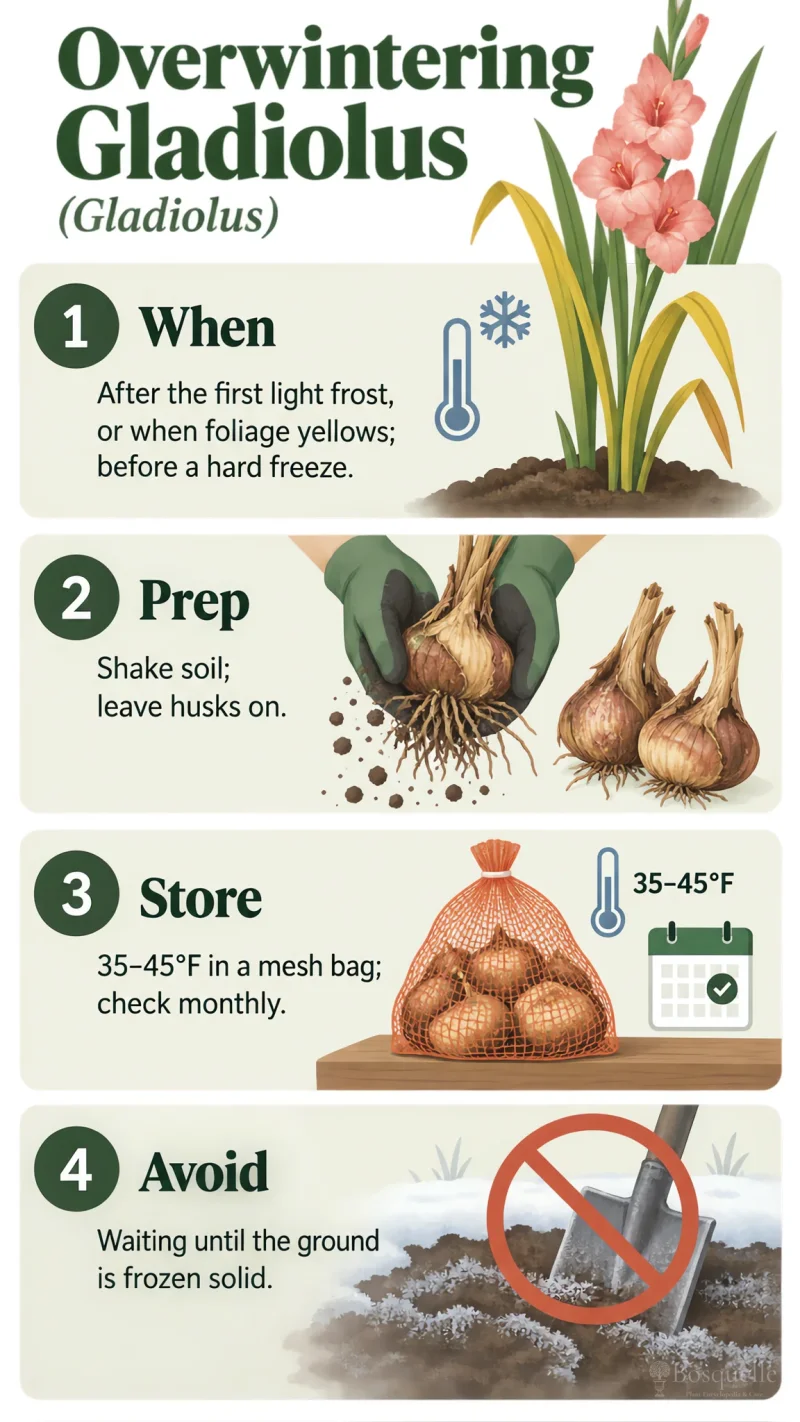
Lift gladiolus corms after the first light frost, or when the foliage yellows, and before a hard freeze. Shake the soil off. Do not wash. Cure in a single layer for two to three weeks, snap off the spent mother corm, and store the new corms at 35–45°F in a mesh bag. Check monthly.
A gladiolus corm is the flattened storage organ often sold as a bulb. Sun, stake, and cut stay on How to Grow Gladiolus. When and how deep stay on Planting Gladiolus.
When to lift gladiolus corms
| Factor | Recommended | Avoid |
|---|---|---|
| When | After the first light frost, or when foliage yellows; before a hard freeze | Waiting until the ground is frozen solid |
| Prep | Shake soil; leave husks on | Washing the corm |
| Store | 35–45°F in a mesh bag; check monthly | Sealed plastic; wet mix in a cold garage |
The window is foliage first, then frost. Yellow leaves mean the new corm has finished. A light frost that blackens tops is the usual cue. Dig before a hard freeze locks the ground. [1]
Do I lift gladiolus corms in winter?
In cold winters, yes. Lift after frost or yellow foliage, then cure and store. Mild drained winters can leave a hardy species in the ground.
When do I dig gladiolus corms?
After the first light frost, or when foliage yellows, and before a hard freeze.
How to lift, cure, and store
- Dig 6 to 8 inches from the stem. Do not yank the stalk. [2]
- Shake the soil off. Do not wash the corm.
- Cut the stalk to 1 to 2 inches.
- Cure in a single layer for 2 to 3 weeks in a dry, frost-free place.
- Snap off the spent mother corm. Keep the new corm on top.
- Store the new corms at 35–45°F in a mesh bag, not sealed plastic.
Gladiolus wants a longer cure than most tender storage organs — about two to three weeks until the necks are dry. Check the bag once a month. Discard anything soft. Do not sprinkle water to keep them alive.
How do I store gladiolus bulbs over winter?
Cure the corms two to three weeks, then keep them at 35–45°F in a mesh bag. Check monthly.
Mother corms and cormels
Each season a new corm forms on top of the old one. The spent mother is withered and can rot in the bag. Snap it off after the cure and discard it. Tiny offsets — cormels — take two to three years to bloom. Save them if you want more of a named type. They are not a first-year show. [3]
Leave foliage in the bed after a vase cut so the new corm can finish. Strip spent florets in the vase. Do not scalp the plant the day bloom ends.
Aftershock, White Prosperity, and Priscilla are tall grandiflora types. They follow the same lift. Label the bag before the leaves die or you will guess in February.
Wrong storage and what you can leave in the ground
Do not wash corms after you dig. Shake them. A wash starts rot in storage. Leave the dry husks on. [4]
Do not pack gladiolus in peat the way you pack dahlias. A mesh bag with air is the store. Do not sort this job by a numbered zone chart. Drain and a mild winter decide whether a hardy species can stay. Tall florist hybrids still lift in cold winters.
Where winters stay mild and soil drains, you may leave corms in the ground under a light mulch. A wet clay bed still rots them. Byzantinus is the usual in-ground species type. Do not copy that onto a tall florist hybrid without drain. Murielae is a specialty species — confirm winter lift on the profile. Compact nanus types such as Atom still lift in cold winters.
Do I wash gladiolus corms before storage?
No. Shake the soil off. Do not wash.
Can I leave gladiolus in the ground?
Only in a mild winter with drain, and usually only a hardy species such as Byzantinus. Tall florist hybrids lift in cold winters.
Grow, plant, or pot
Sun, stake, and cut stay on How to Grow Gladiolus. Height class: Types of Gladiolus. When and how deep: Planting Gladiolus. Pots: Gladiolus in Containers.
Lift corms from a pot the same way as from a bed. Knock them from the mix after frost. Do not leave them in wet mix in an unheated garage.
FAQ
Can I store gladiolus in the refrigerator?
Only if it stays dry and near 35–45°F. A wet crisper rots them. A mesh bag in a cool dry place is the usual store.
Can I treat them as annuals and skip the lift?
Yes. Buy new corms each spring if you do not want to store. Lift if you want the same named type next year.
Do nanus types skip the lift?
No. Compact nanus types still lift in cold winters. Size of the plant does not change the store.
Should I peel the husks?
Leave the dry husks on. They protect the corm in storage.
Do I need a fungicide dust?
No as a default. A dry cure and a cool mesh bag are the method. Discard soft corms.
What if the ground already froze?
Dig if you still can. Discard mushy corms. Do not wait until spring in a frozen wet bed.
Can I pack them in peat like dahlias?
No. Peat pack is the dahlia job. Gladiolus store in a mesh bag with air.
How many years can I reuse a corm?
The new corm forms each season. Store that one. Cormels take two to three years to bloom.
Will thrips ruin stored corms?
Cool dry storage at 35–45°F is the first check. Do not start a spray on corms in the bag.
Do I lift corms from pots the same way?
Yes. Knock them from the mix after frost, then follow the same cure and store.
Related guides


Recommended plants


References
- [1] Iowa State Extension -
https://yardandgarden.extension.iastate.edu/how-to/how-overwinter-tender-perennials - [2] Longfield Gardens -
https://www.longfield-gardens.com/blogs/gladiola-care/how-to-manage-your-gladiolus-bulbs-winter-care - [3] University of Missouri Extension -
https://extension.missouri.edu/publications/g6620 - [4] Almanac -
https://www.almanac.com/plant/gladiolus
This note is part of Gladiolus Guides.
More first-season notes by plant are gathered in How to Grow Guides.
Updated: Reviewed by Bosquelle Editors