
Grow Japanese aralia in a pot with drainage holes, in a cool bright room. Water when the surface of the mix is dry, and do not leave the pot in a full saucer.
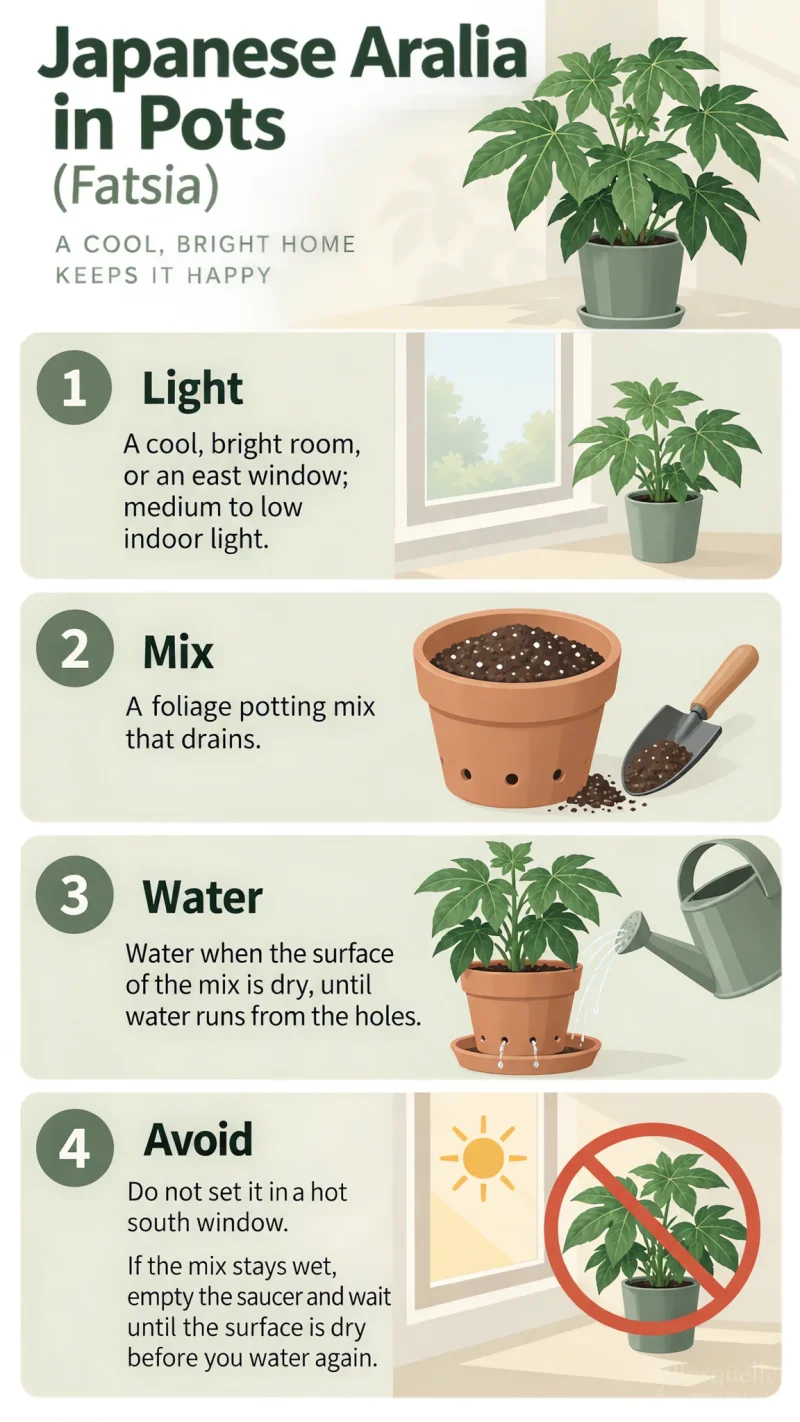
Use a pot that drains, and keep it in a cool, bright room
| Factor | Recommended | Avoid |
|---|---|---|
| Pot | A pot with drainage holes, large enough for the root ball | Do not use a pot with no holes |
| Mix | A foliage potting mix that drains | Do not pack garden soil into the pot |
| Light | A cool, bright room, or an east window; medium to low indoor light | Do not set it in a hot south window |
| Water | Water when the surface of the mix is dry, until water runs from the holes | Do not leave the pot sitting in a full saucer |
Japanese aralia takes a pot if the pot has holes and the room stays cool and bright. A hot, dry window browns the leaves. A saucer of standing water rots the roots. [1] [2] This is a cool-room plant. Night temperatures in the 50s and days in the 60s suit it better than a heated south window. [3] Push a finger into the mix. Water when the surface is dry, because the top can look dry while the mix below is still wet. [4]
- Pick a pot with drainage holes. Set the root ball so the top sits just below the rim.
- Fill with a foliage potting mix, even with the top of the root ball. Do not add garden soil.
- Water until mix runs from the holes. Empty the saucer. Keep the pot in a cool, bright room, not in hot midday sun.
Can I grow Japanese aralia in a pot?
Yes, in a pot with drainage holes and a mix that drains. Keep it in a cool bright room, and empty the saucer.
Set it on a shady patio in summer, and bring it in before a hard freeze
A potted plant can spend summer on a shady patio, then come inside before a hard freeze. The outdoor shade is the same idea as the room: bright, not a hot wall. When you bring it in, set it in the brightest cool spot you have, and water when the surface of the mix is dry.
- Move the pot outdoors after frost, into shade. Give it a few days to settle so the leaves do not scorch.
- Check the leaves before you bring it inside, so you do not move scale or mites into the house.
- Bring the pot in before a hard freeze. Water less in winter, still emptying the saucer. Do not fertilize until new growth starts.
When do I bring the pot inside?
Bring it in before a hard freeze. Set it in a cool bright room, and water when the surface of the mix is dry.
If the mix stays wet, empty the saucer and wait until the surface is dry before you water again.
FAQ
Do I need to repot every year?
Move it up one pot size when roots fill the holes, or when the mix stays wet and then dries in a day. A large shrub is happier in the ground.
Can it live indoors all year if I never put it outside?
Yes, in a cool bright room. A dim, warm room stretches the stems. A summer spell on a shady patio is optional, not a second plant.
Related guides
Recommended plants
References
- [1] Clemson Home & Garden Information Center -
https://hgic.clemson.edu/factsheet/fatsia/ - [2] NC State Extension Gardener -
https://plants.ces.ncsu.edu/plants/fatsia-japonica/ - [3] University of Georgia Cooperative Extension -
https://fieldreport.caes.uga.edu/publications/B1318/growing-indoor-plants-with-success/ - [4] Royal Horticultural Society -
https://www.rhs.org.uk/plants/fatsia/how-to-grow-fatsia
This note is part of Fatsia Guides.
More container notes by plant live in Container Growing Guides.
Updated: Reviewed by Bosquelle Editors