
An Anthurium move fails fastest in a pot two sizes too big, or when you pot a still-loose plant into wet peat. flamingo flower can stay slightly snug. This page covers when to move and how to pot one size up.
Keep-alive after the move still lives on How to Grow Anthurium.
When roots fill the pot — not a calendar
| Factor | Recommended | Avoid |
|---|---|---|
| Timing | When roots fill, coil at the holes, or the mix dries in a day | A yearly ritual into a larger tub |
| Size | One nursery size up, with a drain hole | A jump to a floor cachepot of wet peat |
| Mix | Coarse bark, peat or coir, and perlite | Garden soil; a moisture-control brick |
Clemson Extension: let roots fill the container first. The cue is a coil at the holes, a lifted crown, or mix that dries in a day because there is almost no mix left — not a calendar. Spring is kinder. Skip a cold, wet mid-winter move into peat.
What size pot should I use?
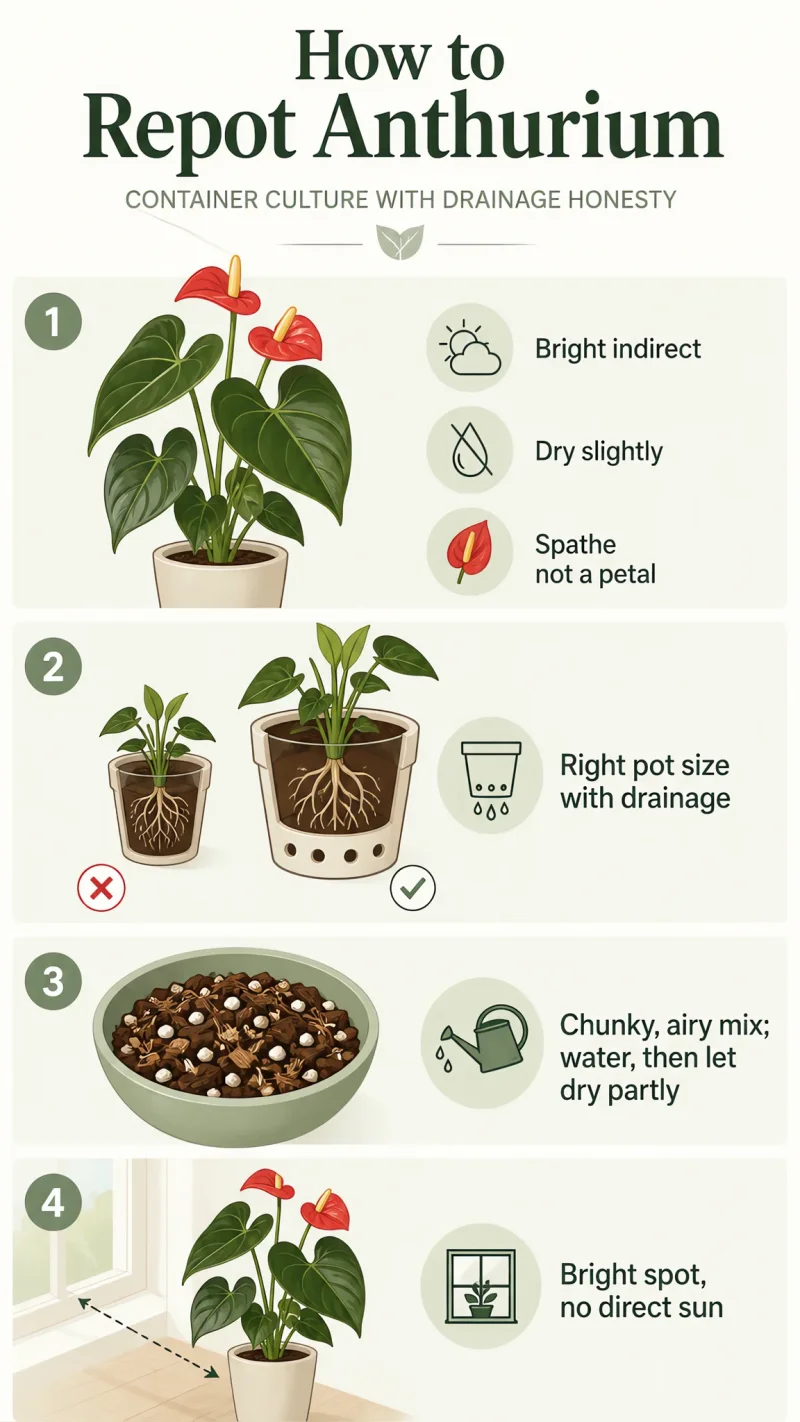
One size up, with a drain. A jump to a huge cachepot holds wet mix around epiphyte roots. Coarse mix, then let the top inch dry before the next drink.
Roots at the holes, a nursery pot that bowed, or a crack are signs. One sign can wait. A crack cannot. Slightly snug is useful for an epiphyte that still wants air. Extra unused mix stays wet and rots the roots.
If the plant is still small in a huge nursery tub, that is a wet-mix problem, not a cue to go bigger still.
A plant that sulks after a move is usually wet, not underpotted. Empty the saucer. The leaves firm when the roots drink, not when the new pot looks full. Do not chase a droop with a second flood the same week. Do not move because scale showed up. Wipe, isolate, fix the wet mix. A larger pot will not cure a pest.
One size up, coarse draining mix
- Choose a pot one size up with a drainage hole. Do not jump to a huge cachepot.
- Use coarse mix: peat or coir, pine bark, and perlite. Do not bury the crown deeper than before.
- Water once, empty the saucer, then wait until the top inch dries again.
- Do not fertilize for weeks. Disturbed roots burn.
Ease the clump out. If the plastic will not give, cut the nursery pot rather than yank the stems. Tease circling roots. Cut away only what is rotten. Set the crown at the old height. Decorative moss piled on the crown stays wet against the stems — leave the mix open.
Clones live on How to Propagate Anthurium. If you only needed air, refresh mix in the same pot. If the clump has more than one crown, split it now: each piece needs roots, then a small pot. Full keep-alive after the move still lives on How to Grow Anthurium.
Give the plant the same bright-indirect window it had. A darker corner after a move looks like wilt and tempts a second flood. Terracotta dries faster than plastic. Glazed ceramic and a sealed cachepot hold water longer — lift the grower pot so it is not sitting in a puddle.
A hanging basket with no hole is the same wet-pot failure, only higher.
One size up means the next nursery diameter, not a jump from a four-inch pot to a floor urn. If you already jumped too far, lift the grower pot, empty the cachepot puddle, and let the mix dry before the next drink. Skip ice cubes. Skip a week of misters. Wear gloves if sap bothers you.
Acid-leaning mix suits this epiphyte. Bark plus peat or coir plus perlite is enough; you do not need a branded bag. Do not pack it. Leave a little air. Aerial roots that sat above the old mix should sit above the new mix too.
A plant that dried in a day may only need a soak and drain, then a decision: if roots have eaten every gap, move; if mix still fills the pot, stay and water more thoroughly next time.
A mid-winter move into wet peat is a rot clock. Wait until the plant is using water again in spring unless the pot has already split. After the move, the same bright-indirect window and the same top-inch rule apply. Fast growth is not this genus. A wet oversized pot is still a fail.
What fails an Anthurium pot
Most failures are a pot that never drains, or a pot so large the mix stays cold and wet around slow roots. The plant sulks. People answer the sulk with more water. That is how a move becomes rot.
- A cachepot puddle — lift the grower pot after you water.
- Buried crown — extra mix against the stems stays wet. Match the old soil line.
- A bigger pot because you wanted blooms — light makes spathes. Move because roots filled, not because you wanted faster growth.
- Feed on day one — wait weeks. See the numbered steps above.
- Garden soil as the only mix — stays wet indoors.
- A hanging basket with no hole — still a swamp. This genus belongs in a table pot that drains.
- Two sizes up “for growth” — wet mix, slow roots, sour smell. One size is the job.
- Yanking stems to free a stuck clump — cut the nursery pot instead.
FAQ
How often should I repot an anthurium?
When roots fill. See When roots fill the pot above. Spring is kinder than a mid-winter soak.
Should I keep it pot-bound?
Slightly snug is useful. A cracked pot is too far. One size up when roots fill.
Can I keep it in the same pot forever?
You can refresh mix for years. Watch for sour peat or a coil, not only a calendar.
Should I water heavily after the move?
Water once, drain, then wait until the top inch dries. A wet settle-in is how roots rot.
My plant wilted after the move — did I kill it?
Often a sulk. Bright indirect, dry slightly, wait. Do not answer wilt with a second flood.
When in the year?
Spring is kinder. Skip a cold, wet mid-winter move into peat.
Do I divide every time I repot?
Only if you can see more than one crown. One size up is enough when it is still one plant.
Is this the same move as ZZ plant?
Both hate a wet pot. Anthurium wants the top inch to dry slightly after, not a full cactus rest.
Table pot or hanging basket?
Usually a table pot that drains. Stalks are upright, not a trailing hanging plant.
Related guides

Recommended plants

This note is part of Anthurium Guides.
More container notes by plant live in Container Growing Guides.
Updated: Reviewed by Bosquelle Editors