
Propagate cushion bush from a semi-ripe cutting pushed into grit, watered once, then kept barely moist until it roots. That is the usual way to replace a short-lived mound.
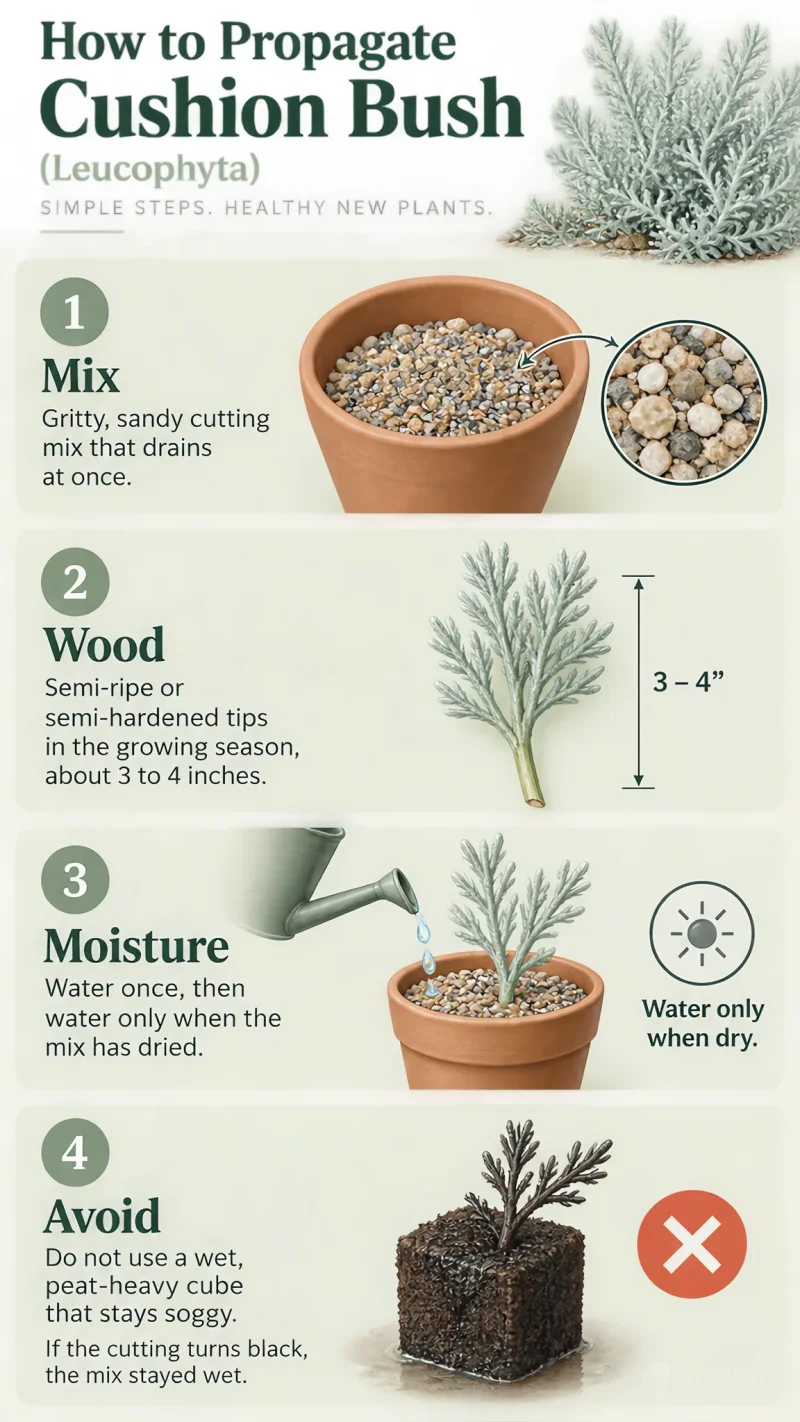
Take a semi-ripe cutting into grit, and keep it barely moist
| Factor | Recommended | Avoid |
|---|---|---|
| Wood | Semi-ripe or semi-hardened tips in the growing season, about 3 to 4 inches | Do not take a soft, floppy shoot, and do not cut into old leafless wood |
| Mix | Gritty, sandy cutting mix that drains at once | Do not use a wet, peat-heavy cube that stays soggy |
| Moisture | Water once, then water only when the mix has dried | Do not bag the cuttings so they stay wet |
| Place | Warm, bright shade with moving air | Do not stand the tray in full scorch or in a dark, still corner |
Cushion Bush is usually started from cuttings, not from a division. Nurseries raise it that way because a cutting keeps the compact silver form, and because garden plants are often short-lived. [1] Take a semi-ripe tip, strip the lower foliage, and push it into a gritty, sandy mix. Water once, then leave it somewhere warm and shaded, and water again only when the mix has dried. [2] Wet cuttings rot. Roots often show in a few weeks; pot them on once they tug back, then plant out after frost as on Planting Cushion Bush. [3] See How to Grow Cushion Bush for the grown mound.
- In the growing season, cut a 3- to 4-inch semi-ripe tip just below a node. Strip the lower scale-like leaves.
- Fill a small pot with gritty, sandy mix. Insert the cutting so the stripped stem sits in the grit. Optional: dip the base in rooting powder first.
- Water once to settle the mix. Set the pot in bright shade with moving air, and water only when the mix has dried.
- When the cutting tugs back, pot it into its own gritty pot. Grow it on, then plant it out after frost.
How wet should the cutting mix stay?
Barely moist. Water once, then wait until the mix has dried. A wet cutting rots.
Sow the seed on the surface if you want a batch from seed
Seed also works, and it needs no cold spell. Scatter it on the surface of a gritty mix, press it in, and do not bury it. Keep the surface just moist. Seedlings show in about 10 to 30 days. [4] Bottom-water the tray so you do not wash the seed away. Thin to the strongest seedling in each cell, then grow them on in grit and full sun. Cuttings are still the more reliable way to copy a compact mound you already like.
- Fill a tray with a lean, gritty seed mix. Sow the seed on the surface and press it in. Do not cover it.
- Set the tray in bright light. Keep the surface just moist — bottom-water, or mist — until seedlings show in 10 to 30 days.
- Thin to the strongest seedling in each cell once two true leaves show.
- Grow them on in grit, then plant them out after frost.
Do I need to chill the seed?
No. Surface-sow it on gritty mix and keep that surface just moist. It usually comes up in 10 to 30 days.
If the cutting turns black, the mix stayed wet. Next time use grit, water once, and wait until it has dried before you water again.
FAQ
Can I collect my own seed?
Yes, from garden plants. Leave a few heads to ripen, dry them, and store the clean seed cool and dry. Cuttings are still the usual way to copy a named mound.
Can I divide the mound?
Not as a home method. Raise a new plant from a cutting, or from seed.
Related guides

Recommended plants

References
- [1] Australian National Botanic Gardens -
https://anbg.gov.au/gnp/interns-2014/leucophyta-brownii.html - [2] Aussie Green Thumb -
https://aussiegreenthumb.com/cushion-bush-leucophyta-brownii/ - [3] Royal Horticultural Society -
https://www.rhs.org.uk/plants/75550/leucophyta-brownii/details - [4] North Carolina Extension Gardener Plant Toolbox -
https://plants.ces.ncsu.edu/plants/leucophyta-brownii/
This note is part of Leucophyta Guides.
More notes on making another plant live in Propagating Guides.
Updated: Reviewed by Bosquelle Editors