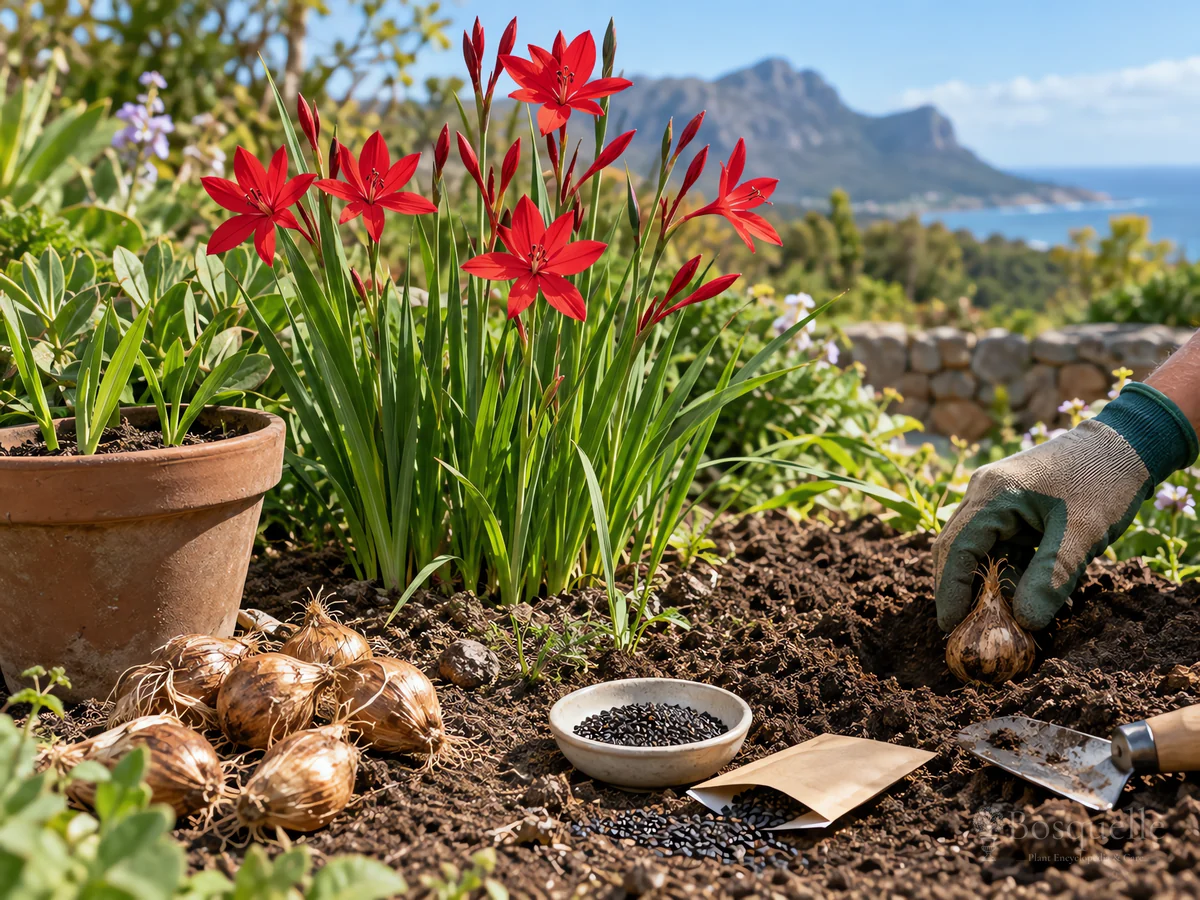
Lift and divide congested crimson flag lily clumps in spring, every two or three years. Discard the woody center and replant the young outer pieces about 2 inches deep.

Lift and divide congested clumps in spring
| Factor | Recommended | Avoid |
|---|---|---|
| When | Mid to late spring, every two or three years, as growth restarts | Do not wait until the center is a woody mat that has stopped flowering |
| Piece | Fist-sized pieces with several healthy shoots and roots — about six leaf shoots | Do not replant a single leafless scrap with no roots |
| Depth | Replant about 2 inches deep, 8 to 12 inches apart | Do not bury the pieces deep or leave them on the surface |
| Soil | Refresh the hole with compost so the soil holds moisture | Do not drop them back into the same exhausted, dry ground |
Crimson flag lily spreads by rhizomes that creep outward and knit into a dense mat. After two or three years the center of the clump turns woody and starved, and flowering drops away even when you water. Spring division is how you keep the spikes coming, and how you get more plants. [1] Do the work in mid to late spring, once new shoots are moving. Lift the whole clump with a fork, shake off the soil, and pull or cut it into fist-sized pieces. Each piece needs several healthy young rhizomes, some roots, and about six leaf shoots. [2] Replant the good pieces about 2 inches deep and 8 to 12 inches apart in refreshed, moist soil, then water them in. First plant-out of a purchased rhizome is on Planting Crimson Flag Lily. [3] [4]
- In mid to late spring, loosen the soil around an established clump and lift it with a fork.
- Shake off the soil so you can see the rhizomes and the old, woody center.
- Pull or cut the clump into fist-sized pieces. Each piece should have several shoots and roots, about six leaf shoots.
- Replant the good pieces about 2 inches deep and 8 to 12 inches apart, and water them in.
How often should I divide it?
Every two or three years in spring. Wait longer, and the center of the clump goes woody and flowering fades.
Discard the woody center and replant the young pieces
The middle of an old clump is the part that stops flowering. It is hard, woody, and often almost leafless. Throw that center away, or compost it. Keep the young outer pieces, which are pale, pliable, and already showing this year's shoots.
Do not drop the pieces back into the same tired hole. Fork compost into the soil so it holds moisture, then replant. Water the new pieces in, and keep them moist through their first summer so they make roots before the fall bloom. They usually flower the same autumn.
- Sort the pieces: keep young outer rhizomes with shoots and roots.
- Throw away the woody, starved center. Cut off any soft or rotten bits.
- Fork compost into the hole, then replant the good pieces 2 inches deep and 8 to 12 inches apart.
- Water them in and keep the soil moist through summer so the new clumps settle.
Which pieces should I keep?
Keep the young outer pieces with healthy shoots and roots. Throw away the woody center; that is the part that has stopped flowering.
If an old clump has stopped flowering, the center is woody. Lift it in spring, keep the young outer pieces, and replant them in refreshed, moist soil.
FAQ
Can I grow it from seed?
You can, but it is slow. Sow in spring in a moist, gritty mix; germination can take up to three months, and plants may need a few years before they flower. Division is the faster way.
Will the divisions flower this year?
Usually yes, the same autumn, if you divide in spring and keep the new pieces moist through summer.
Can I take cuttings instead of dividing?
No. This plant multiplies from rhizomes. Lift and split the clump; stem cuttings are not how it grows.
Related guides

Recommended plants

References
- [1] BBC Gardeners' World -
https://www.gardenersworld.com/plants/how-to-grow-hesperantha/ - [2] Garden UK -
https://gardenuk.co.uk/growing/how-to-grow-hesperantha-uk/ - [3] Royal Horticultural Society -
https://www.rhs.org.uk/plants/142724/hesperantha-coccinea/details - [4] NC State Extension -
https://plants.ces.ncsu.edu/plants/hesperantha-coccinea/
This note is part of Hesperantha Guides.
More notes on making another plant live in Propagating Guides.
Updated: Reviewed by Bosquelle Editors