
Grow woolly bluecurls in full sun on soil that drains, and stop summer watering once the shrub is established. Woolly bluecurls is Trichostema lanatum, a California chaparral mint, not the rosemary you cook with.
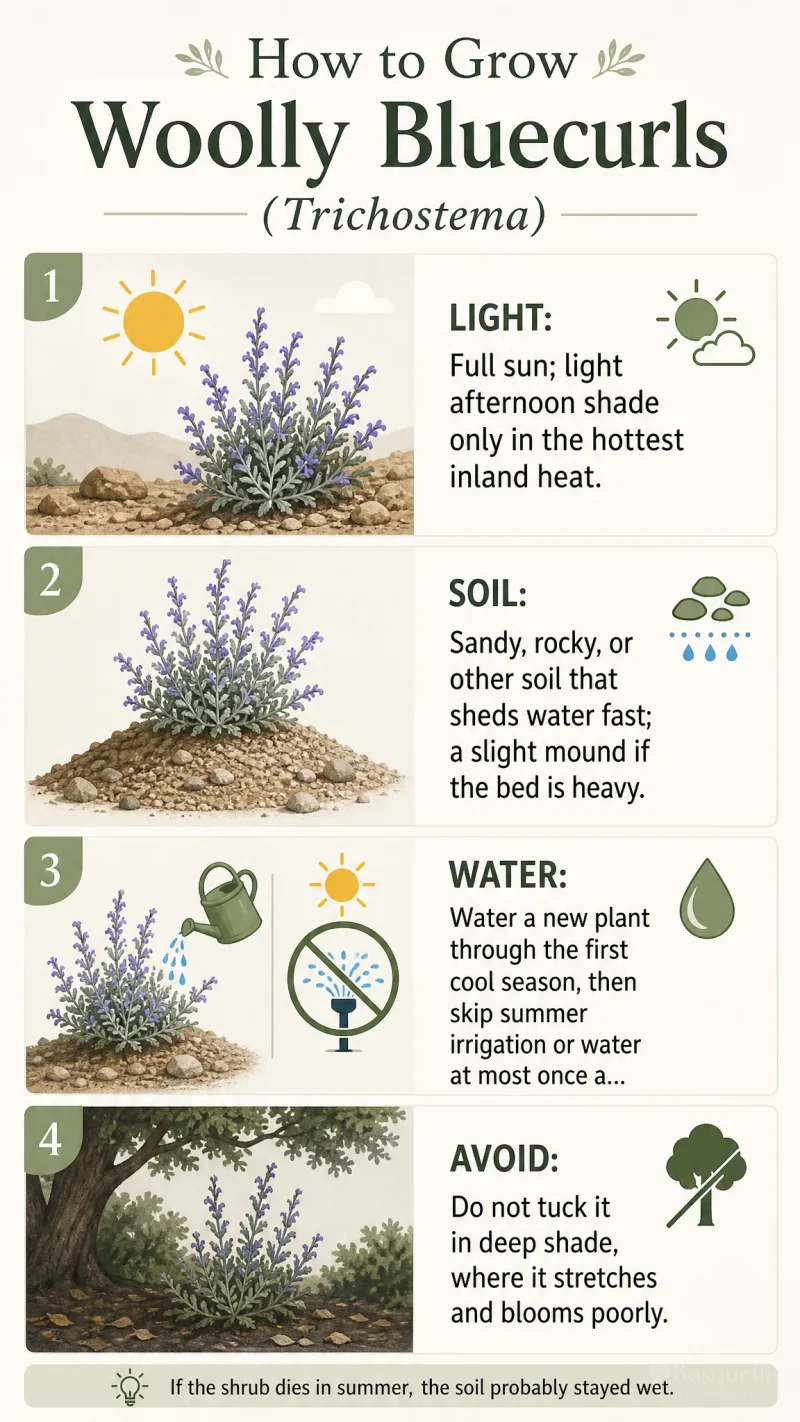
Give it full sun, soil that drains, and almost no summer water once it is established
| Factor | Recommended | Avoid |
|---|---|---|
| Light | Full sun; light afternoon shade only in the hottest inland heat | Do not tuck it in deep shade, where it stretches and blooms poorly |
| Soil | Sandy, rocky, or other soil that sheds water fast; a slight mound if the bed is heavy | Do not plant it where summer water stands, and do not amend the hole with compost or fertilizer |
| Water | Water a new plant through the first cool season, then skip summer irrigation or water at most once a month and let the soil dry | Do not run drip on it all summer once the roots have taken |
| Mulch | Gravel, or a rock beside the shrub | Do not pile bark or compost against the stems |
| Deer | Deer often leave it | Do not count on that in a hard year, when they may browse it |
woolly bluecurls is an evergreen shrub about three to five feet tall, with narrow aromatic leaves and woolly blue-violet spikes. Sit it in full sun in ground that drains. Water a new plant until the roots take through the first cool season. After that, extra summer water is what usually kills it, even a drip line that never lets the soil dry. [1] Do not fertilize it, and do not improve the hole with rich mix. If the bed is clay, raise a slight mound so water cannot stand against the crown. [2] Once it is established, leave summer irrigation off. [3] Deer often skip it, though they may browse it when forage is scarce. Pair it with other plants that also want sun and a dry summer, such as California sage.
- Choose full sun and soil that sheds water. Raise a small mound if the bed stays wet.
- Water a new shrub through the first cool season. After that, skip summer watering, or give at most one deep soak a month and let the soil dry.
- Keep bark and compost off the stems. Gravel or a rock beside the plant is enough.
How much sun does woolly bluecurls need?
Full sun. Give it at least six hours a day. In the hottest inland heat, light afternoon shade is fine. Deep shade makes a weak, sparse shrub.
How often should I water woolly bluecurls?
Water a new plant through the first cool season. Once it is established, skip summer watering, or water at most once a month and let the soil dry. Weekly drip in summer is the usual reason it dies.
Plant in the cool season, with the crown a little high, and gravel not bark
Plant from a one-gallon in the cool season, so winter rain can settle the roots before summer heat. Set the woody crown about a quarter inch above the surrounding soil so wet mix does not sit against the stems. Space about three to five feet so the shrub can fill out. [4]
- Dig a hole as deep as the root ball and a little wider. Do not bury the crown.
- Set the top of the root ball about a quarter inch above grade. Backfill with the native soil, not a rich planting mix.
- Water in well the first time, then keep bark mulch off the stems. Gravel is fine.
- If the ground is heavy clay, plant on a slight mound so water runs away.
When do I plant woolly bluecurls?
In the cool season, from a container, so winter rain can settle it. Set the crown a little above the soil, and use gravel rather than bark.
Tip-prune after bloom, and do not cut into old wood
Light tip-pruning after the main flush keeps the mound denser. Pinch a young plant so it bushes. Do not cut into old leafless wood expecting it to resprout; this shrub will not take a hard renovation cut. Plan to replace a plant after about four to five years, because it is a short-lived fire follower, not a hedge you can cut back to stumps.
- Wait until the main flowers have finished. Pinch or tip-prune leafy growth.
- Cut out dead stalks if you need to, with clean tools.
- Do not cut into old bare wood. Do not shear it like a hedge.
When do I prune woolly bluecurls?
After the main bloom. Tip-prune leafy growth and pinch a young plant. Do not cut into old wood.
Start a new plant from a cutting on How to Propagate Woolly Bluecurls.
Not culinary rosemary — and not forked bluecurls
A tag that says romero may be culinary rosemary, which is Salvia rosmarinus. That plant is a woody kitchen herb. Woolly bluecurls has rosemary-like leaves and a strong scent, but you grow it for the woolly blue spikes, not for cooking. See How to Grow Sage for culinary rosemary.
Blue curls on a tag may be selfheal, which is Prunella. That plant is a low lawn or meadow mint, not this chaparral shrub. See How to Grow Selfheal.
Forked bluecurls is Trichostema dichotomum, an eastern annual that reseeds in dry woods. It is the same genus and the same long, curled stamens, but it is not this evergreen shrub, and this catalog does not hold it.
Is woolly bluecurls the same as rosemary?
No. Rosemary is Salvia rosmarinus, the kitchen herb. Woolly bluecurls is Trichostema lanatum. Romero on a tag often means rosemary, not this shrub.
Is this the same as selfheal or blue curls?
No. Selfheal is Prunella, a low lawn mint. Forked bluecurls is an eastern annual in the same genus. This shrub is the California evergreen woolly bluecurls.
If the shrub dies in summer, the soil probably stayed wet. Sit the next one in full sun on a mound that drains, skip summer drip, and leave kitchen rosemary to the sage bed.
FAQ
Can I grow woolly bluecurls in a pot?
Yes, in a large pot with a drainage hole and a cactus or sandy mix. Water a potted plant more often than one in the ground — about weekly in heat — because the mix dries faster. It is still an outdoor shrub, not a low-light houseplant.
Is there more than one kind of woolly bluecurls?
This catalog holds Trichostema lanatum. Forked bluecurls is an eastern annual, not a second shop card here. Midnight Magic is a hybrid name you may see at a native nursery, not an extra card in this list.
Will it come back after a hard freeze?
A hard freeze can burn the foliage. Even in a mild-winter garden the shrub is often short-lived, about four to five years, so plan to replace it rather than cut it to the ground.
Related guides
Recommended plants

References
- [1] Calscape / California Native Plant Society -
https://www.calscape.org/Trichostema-lanatum-(Woolly-Bluecurls) - [2] Las Pilitas Nursery -
https://www.laspilitas.com/nature-of-california/plants/680--trichostema-lanatum - [3] Theodore Payne Foundation -
https://www.theodorepayne.org/nativeplantdatabase/index.php?title=Trichostema_lanatum - [4] Houzz -
https://www.houzz.com/magazine/california-gardeners-add-woolly-bluecurls-to-your-fall-planting-list-stsetivw-vs~73055594
This note is part of Trichostema Guides.
More first-season notes by plant are gathered in How to Grow Guides.
Updated: Reviewed by Bosquelle Editors