
Grow winter aconite as a low yellow cup in late winter, under deciduous trees, in moist soil that drains. Shops list E. hyemalis.
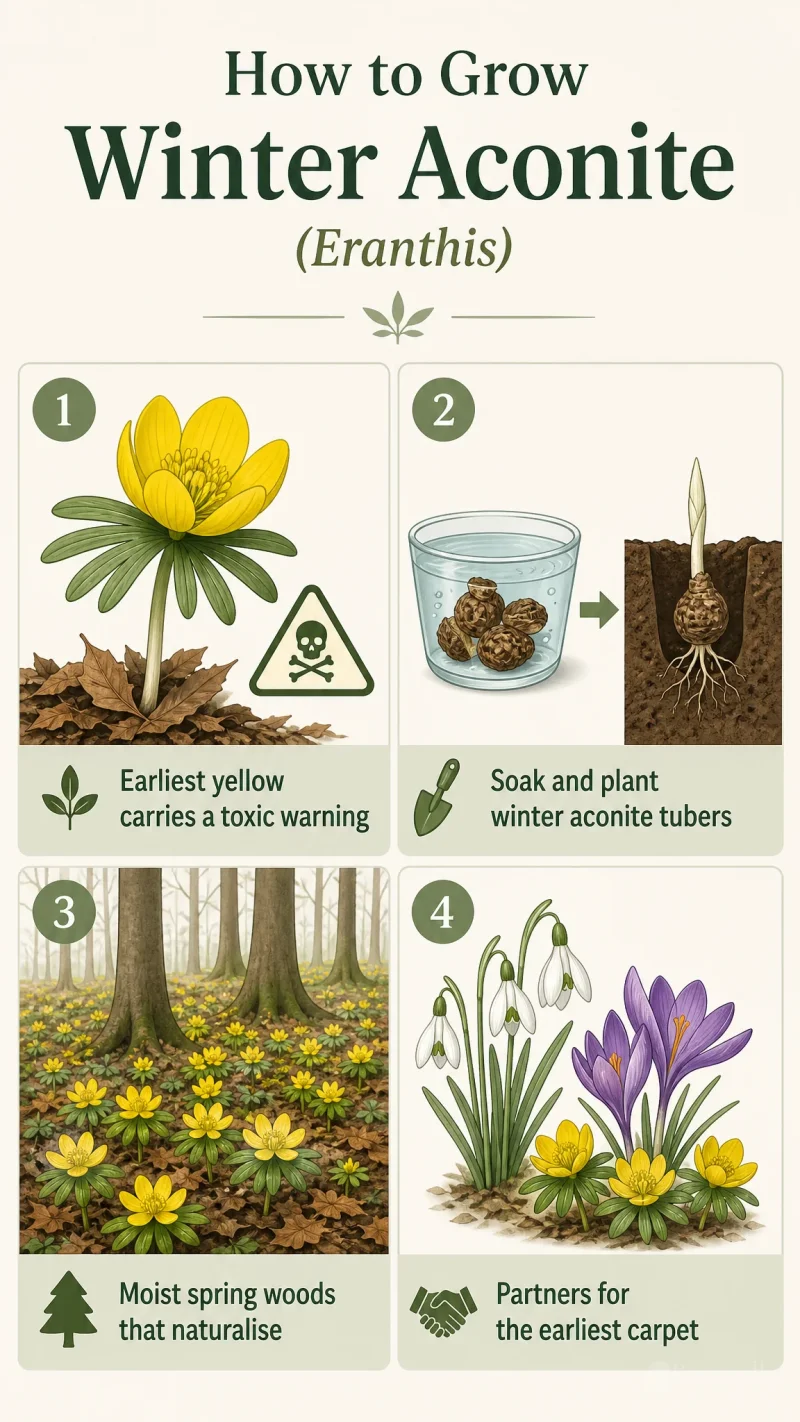
Winter sun under deciduous trees, and moist soil that drains
| Factor | Recommended | Avoid |
|---|---|---|
| Light | Winter and early-spring sun under a bare deciduous canopy | Year-round evergreen shade, or a thin south slope with no spring moisture |
| Soil | Humus-rich loam that stays moist in growth and still drains | A frozen puddle, or bone-dry grit with no spring water |
| Summer quiet | Dormant under leafed-out trees; residual cool moisture | Bare, baking soil after the leaves fade |
| Safety | Gloves for tuber work; keep pets and children from chewing the plant | Eating the yellow cups as a spring green |
Winter aconite wants light while it blooms, then shade as the trees leaf out. Keep the soil moist in late winter and spring, not stagnant. [1] All parts are poisonous if eaten — the tuber especially. [2]
Do winter aconites need full sun?
They need bright light while they bloom. A deciduous canopy is the usual setup. Deep evergreen shade cuts flowering.
Is winter aconite toxic?
Yes. Do not eat any part. Wear gloves if you have cuts, wash hands after planting, and site the colony away from unsupervised chewing.
Water while it is in leaf, and let the foliage yellow before you mow
Water if rainfall fails while the plant is green — especially the first two springs. After bloom, leave the leaves until they yellow so the tuber can store food. Early mowing or shearing removes next year's flowers. [3] Keep that moisture even, not a stagnant puddle. [4]
- Keep the bed from drying out while cups and leaves are up.
- Skip heavy fertilizer. A thin leaf-mould top-dress in autumn is enough.
- Wait until foliage yellows before you mow a lawn drift or cut the patch tidy.
Can I mow over winter aconite?
Only after the foliage yellows. Green leaves are the recharge window. Early mowing is the usual way a lawn colony disappears.
Not a hellebore, and not monkshood
Shops sometimes list winter hellebore or winter wolf's bane. Those names are old labels. Winter aconite is a 3 to 6 inch yellow cup with a green ruff — not Lenten rose (Helleborus), and not tall monkshood (Aconitum). Read Eranthis on the tag.
Is winter aconite the same as hellebore?
No. Winter hellebore is an old nickname. Helleborus is a different plant with different culture. Monkshood is Aconitum — a tall summer perennial, not this low cup.
If cups stay thin after a few springs, check evergreen shade and early mowing first — then soak a new batch of tubers into the same moist woodland strip.
FAQ
Can I grow winter aconite in a pot?
Yes if the pot drains and stays moist in spring. A woodland-style container works; a saucer of standing water fails the same way a puddle does.
What else can I plant nearby?
Snowdrops share the same late-winter light. Hellebores give height after the cups fade. Do not flood the dormant patch with summer irrigation.
What pests hit winter aconite?
Serious insects are uncommon. Wet, stagnant soil rots tubers — that is drainage, not a spray job. Occasional fungal spots show up; pull affected stems.
When does winter aconite bloom?
Late winter into earliest spring, often before or with snowdrops. Mild spells open cups; a hard freeze pauses them. That stop-start calendar is normal.
Are there many kinds of winter aconite?
Garden stock is Eranthis hyemalis. Lists also mention a Cilicica Group and a Guinea Gold hybrid. Soak and plant those the same way if you find them.
Related guides

Recommended plants
References
- [1] NC State Extension Gardener -
https://plants.ces.ncsu.edu/plants/eranthis-hyemalis/ - [2] University of Wisconsin–Madison Division of Extension -
https://hort.extension.wisc.edu/articles/winter-aconite-eranthis-hyemalis/ - [3] Ohio State University Extension — Buckeye Yard & Garden onLine -
https://bygl.osu.edu/node/1219 - [4] Cornell University Home Gardening -
http://www.gardening.cornell.edu/homegardening/scenea5d2.html
This note is part of Eranthis Guides.
More first-season notes by plant are gathered in How to Grow Guides.
Updated: Reviewed by Bosquelle Editors