
Grow Virginia saltmarsh mallow in full sun and soil that stays moist to wet. Virginia saltmarsh mallow is Kosteletzkya virginica, now usually listed as Kosteletzkya pentacarpos — also called seashore mallow.
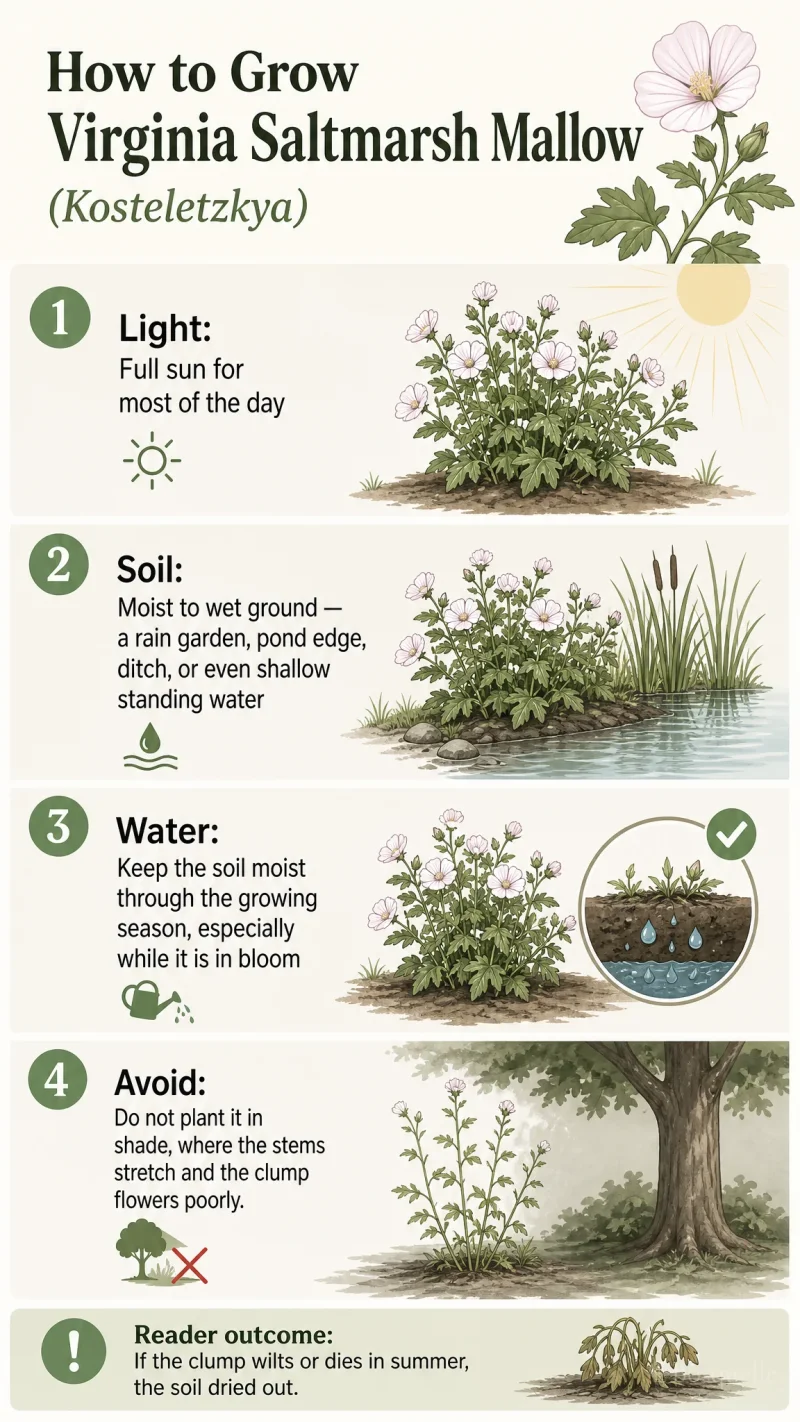
Give it full sun and soil that stays moist to wet
| Factor | Recommended | Avoid |
|---|---|---|
| Light | Full sun for most of the day | Do not plant it in shade, where the stems stretch and the clump flowers poorly |
| Soil | Moist to wet ground — a rain garden, pond edge, ditch, or even shallow standing water | Do not plant it in dry ground, which is the main reason clumps fail |
| Water | Keep the soil moist through the growing season, especially while it is in bloom | Do not let the bed dry out between waterings in summer |
| Feed | Little or none in ordinary garden soil | Do not feed it richly, because soft stems flop and then need staking |
Virginia saltmarsh mallow is an erect, branching clump from a woody crown, native to salt and brackish marshes along the Atlantic and Gulf coasts. Give it open sun and ground that stays wet, the same kind of ground it grows on in the wild. [1] It also grows inland in a rain garden, at a pond edge, or in a low spot, as long as you water it when the soil would otherwise dry. [2] Once it is in bloom, do not let that soil dry out. [3] A sheltered, sunny spot keeps the 3- to 5-foot stems from needing a stake.
Will it grow in salty or brackish soil?
Yes. It grows in salt and brackish marshes, and it also grows in ordinary moist garden soil inland. Keep the soil wet either way; dry ground is what fails it.
Plant it in spring, with room to grow, and keep it moist
Set nursery plants in spring, after frost has passed, in a full-sun bed you can keep moist. Choose the spot now, because the clump can reach 3 to 5 feet tall and about 2 to 3 feet wide from a woody crown. [4] Keep the crown at the same soil line it had in the pot, firm the backfill, and water it in the same day. Space plants about 2 to 3 feet apart so they can fill without crowding. New shoots often come late — sometimes not until the soil is warm — so do not dig into that empty patch in spring.
- Pick a full-sun, moist to wet bed you can water, such as a rain garden, pond edge, or low spot.
- Dig a hole the size of the pot and set the crown at the same soil line it had in the container.
- Space plants about 2 to 3 feet apart, then firm the soil so there are no air pockets around the roots.
- Water thoroughly the same day, and keep the soil moist through the first growing season.
Why is my plant still not up in spring?
It is one of the last plants to emerge. Wait until the soil is warm before you assume the crown is dead, and do not dig into that empty spot.
Pink flowers open one day at a time from summer into fall
Virginia saltmarsh mallow carries pink, hibiscus-like flowers about 2 to 3 inches across from summer into fall, each with a yellow column of stamens. Each flower opens for one day, then the plant opens more, so a clump can have dozens of flowers on a good morning. Leave the brown, five-part capsules if you want seed; to raise a batch on purpose, see Growing Virginia Saltmarsh Mallow From Seed.
When frost has killed the stems, cut them to the ground in late winter before new growth starts. Plant it with other wet-sun natives, such as switch grass or blue flag iris, so taller neighbors do not shade the clump.
When does Virginia saltmarsh mallow bloom?
From summer into fall. Each flower lasts one day, but the plant keeps opening more until frost. Cut the dead stems to the ground in late winter.
Not swamp rose mallow — and not a garden hollyhock
This plant is a wet-ground mallow with pink flowers about 2 to 3 inches across. Swamp rose mallow is Hibiscus moscheutos, with dinner-plate flowers often 6 to 8 inches wide, usually in freshwater wetlands. If that is what you have, read How to Grow Hibiscus.
Garden hollyhock is Alcea, a tall spike for ordinary borders, not a brackish marsh. Read How to Grow Hollyhocks if that is the shop tag. The brown capsules look a little like a flattened okra pod; okra is Abelmoschus — see How to Grow Okra. True marsh mallow is Althaea officinalis, a different plant. Older tags that say Kosteletzkya pentacarpos are this same Kosteletzkya virginica, not a second kind.
Is Virginia saltmarsh mallow a hibiscus?
No. It is in the mallow family and the flower looks similar, but swamp rose mallow is Hibiscus moscheutos, with much larger flowers.
If the clump wilts or dies in summer, the soil dried out. Put the next plants in full sun and wet ground, and water whenever that soil would otherwise go dry.
FAQ
Is there more than one kind of Virginia saltmarsh mallow?
Kosteletzkya virginica is the plant here, also listed as Kosteletzkya pentacarpos — the same wildflower. A white-flowered form exists in trade, but it is not in this catalog.
Can I grow it in a pot?
Yes, in a large pot with moisture-retentive mix in full sun, if you never let the mix dry out. A rain garden or pond edge is an easier home.
Will it come back after winter?
Yes, from the woody crown, as long as the soil is not bone dry. New shoots often come late, so wait before you dig.
Related guides
Recommended plants

References
- [1] Lady Bird Johnson Wildflower Center -
https://www.wildflower.org/plants/result.php?id_plant=KOPE2 - [2] North Carolina Extension Gardener Plant Toolbox -
https://plants.ces.ncsu.edu/plants/kosteletzkya-pentacarpos/ - [3] Growing Wild Nursery -
https://www.growingwildnursery.com/blogs/news/seashore-mallow - [4] Duke Gardens -
https://gardens.duke.edu/garden-talk/seashore-mallow/
This note is part of Kosteletzkya Guides.
More first-season notes by plant are gathered in How to Grow Guides.
Updated: Reviewed by Bosquelle Editors