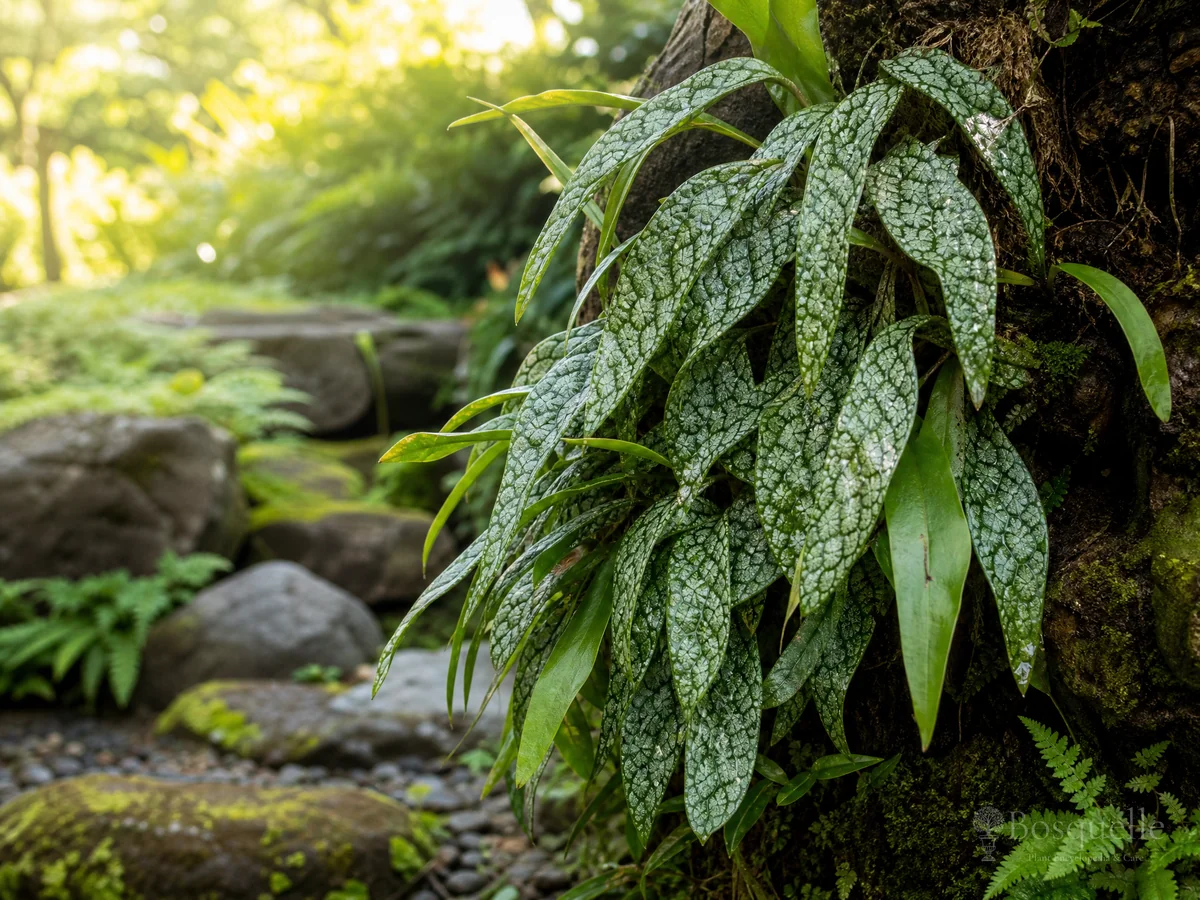
Grow tongue fern in bright shade, in mix that drains, and water when the top is dry. Tongue fern here is Pyrrosia, also sold as felt fern — not hart's-tongue.
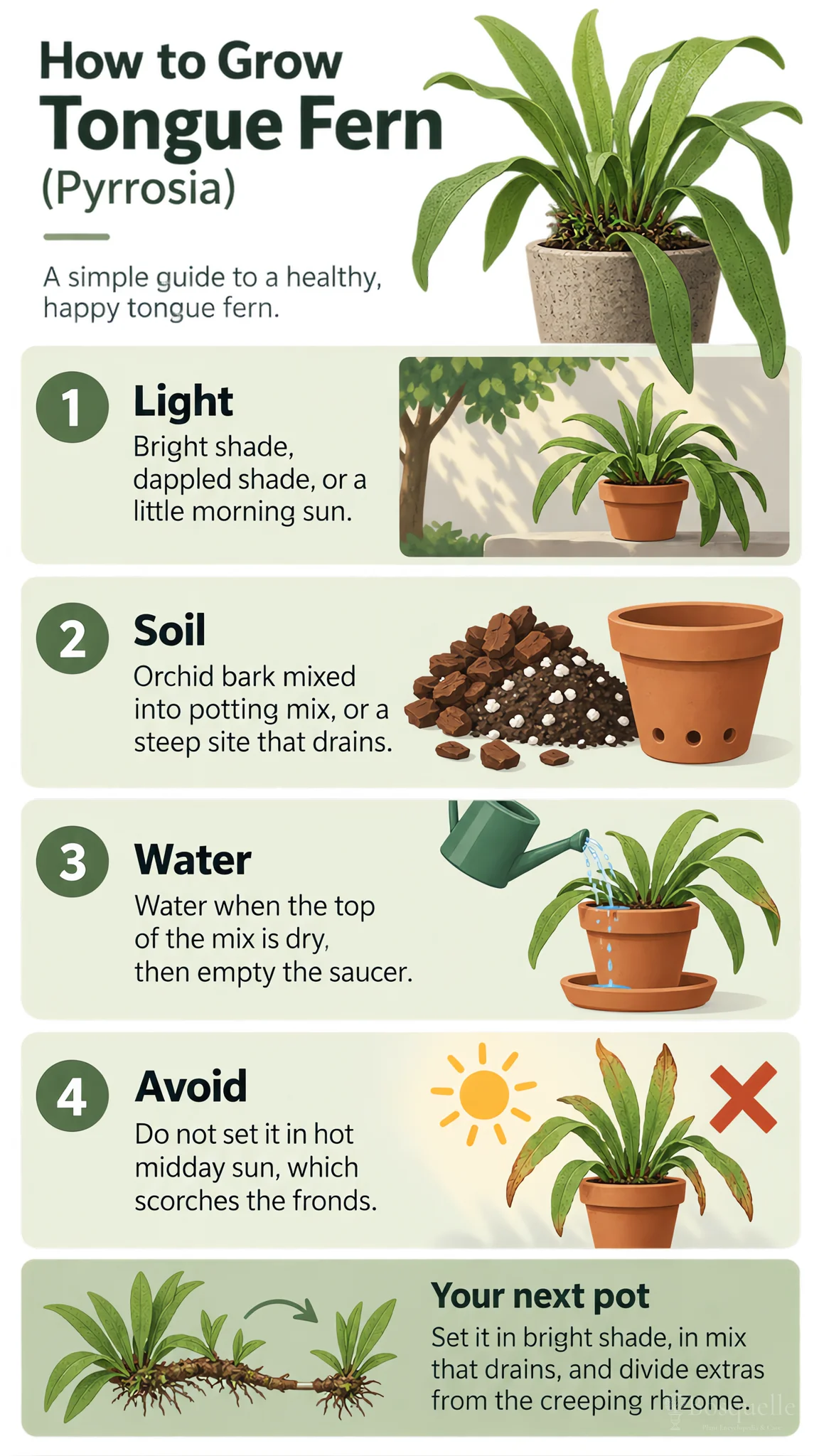
Give it bright shade, mix that drains, and let the top dry before you water
| Factor | Recommended | Avoid |
|---|---|---|
| Light | Bright shade, dappled shade, or a little morning sun | Do not set it in hot midday sun, which scorches the fronds |
| Water | Water when the top of the mix is dry, then empty the saucer | Do not keep the mix wet, and do not leave the pot standing in water |
| Soil | Orchid bark mixed into potting mix, or a steep site that drains | Do not plant it in a low, soggy pocket |
| Drought | Once tongue fern is established, skip extra water in a dry spell | Do not water on a calendar while the mix is still wet |
Give it an open, bright-shade spot and mix that dries a little between waterings. Soggy mix around the rhizome is the primary cause of rot, and hot midday sun scorches the leathery fronds. [1] Water deeply, then wait until the top feels dry. Overwatering is the usual reason a pot fails. [2] tongue fern uses that same bright shade and drain. Once it is settled, the fronds can curl in a dry spell and then fill again when moisture returns. dragon scales uses the same shade. Keep that tiny fern frost-free on a mount, and do not treat it as a drought plant. [3]
- Set it in bright shade or morning sun, out of hot midday sun.
- Water when the top of the mix is dry, then empty the saucer.
- Grow it in a pot with a hole if you need to move it, or on a slope that sheds water.
- Bring dragon scales in before a frost. A tongue fern in a hanging basket can stay out where winters stay mild; everywhere else, slide the basket into a garage or a bright room before a hard freeze.
How much sun does a tongue fern need?
Bright shade, dappled shade, or a little morning sun. Hot midday sun scorches the fronds.
How often do I water a tongue fern?
Water when the top of the mix is dry, then empty the saucer. Do not keep the mix wet.
Does drought bother it?
Once tongue fern is established, skip extra water in a dry spell. Young plants still need regular water. Dragon scales stay frost-free; do not copy a long drought onto that tiny fern.
Plant it in orchid bark, or tie it to cork, with the rhizome on the surface
Knock the plant from its nursery pot and set the creeping rhizome on top of the mix, not under it. A buried rhizome rots. Orchid bark keeps air around the roots in a pot. On a slope, a rock, or a tree trunk, the same rhizome can cling to the surface.
- Choose a pot with a hole, or a piece of cork or bark if you are mounting it.
- Fill a pot with potting mix cut with orchid bark. Do not pack a fine, wet mix around the rhizome.
- Lay the rhizome on the surface. On cork, cover it lightly with damp sphagnum and tie it until it holds. [4]
- Water once to settle, then wait until the top is dry before you water again.
How do I pot or mount it?
Use a pot with a hole and orchid bark, or tie the rhizome to cork. Keep the rhizome on the surface. Water once to settle, then wait until the top is dry.
Cut brown fronds at the base
This fern stays evergreen. You do not cut it to the ground. Snip a brown or faded frond at the base in spring or summer, and leave the green ones.
- In spring or summer, find a frond that is brown, torn, or faded.
- Cut it at the base, close to the rhizome. Do not leave a long stub.
- Do not strip a full flush of green fronds at one time.
- Rake wet fallen leaves off a bed planting so they do not sit on the crown all winter.
Divide a creeping rhizome
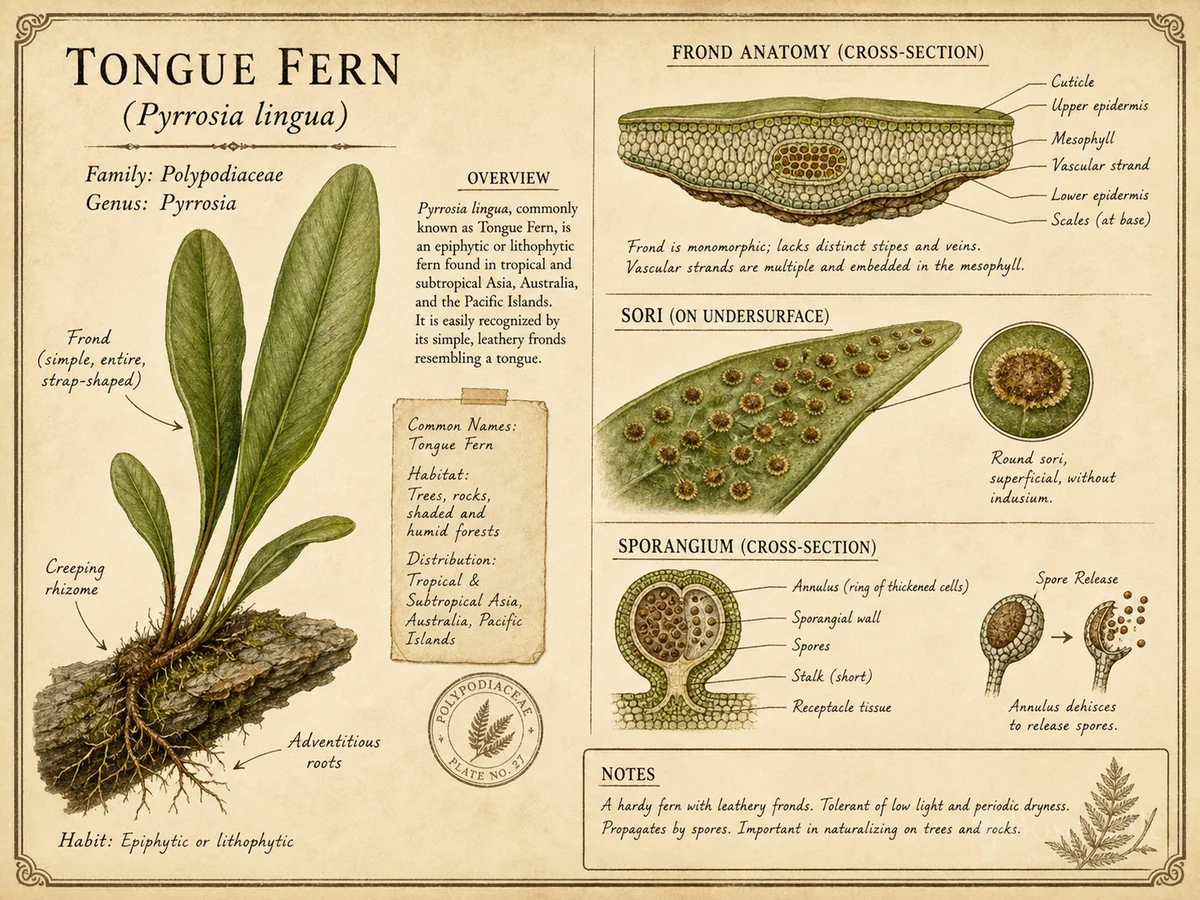
The usual way to make more tongue fern is to divide a piece of the creeping rhizome. Unpot a mature clump in spring, cut a section that has fronds and roots, and set that piece on the surface of fresh bark mix. A severed frond will not root. Yellow dust on the underside is spores, not a cutting.
- In spring, slide the plant out of the pot, or lift a piece from the edge of a clump.
- Cut the rhizome so each piece has at least two or three fronds and some roots.
- Lay each piece on orchid-bark mix, or tie it to cork the same way you planted the parent.
- Keep it in bright shade until new fronds hold. Then water as you would the parent plant.
Do I cut brown fronds off?
Yes. Cut faded fronds at the base in spring or summer. Leave the green ones. Do not cut the whole plant to the ground.
How do I start a new plant?
Divide a piece of rhizome that already has fronds and roots, and lay it on the surface. A leaf cutting will not root.
Not hart's-tongue — and not a dragon-scale Alocasia
Hart's-tongue is Asplenium scolopendrium. It has a smooth strap frond with sori in parallel lines, not a felty cinnamon underside. Tongue fern is Pyrrosia, with star-shaped hairs on the back of the blade. See How to Grow Bird's Nest Fern if the tag is Asplenium.
Dragon-scale Alocasia is a big aroid with thick, puckered leaves. Catalog dragon scales are a tiny fern with round beads of foliage on a creeping rhizome. See How to Grow Alocasia if that is the plant you bought.
Japanese painted fern is a lacy Athyrium, not this leathery tongue. See How to Grow Lady Fern. Bird's-nest fern makes a central nest of straps; this plant runs a rhizome across bark or a slope.
Is this hart's-tongue?
No. Hart's-tongue is Asplenium, with smooth straps and sori in parallel lines. Tongue fern has a felty underside and a creeping rhizome.
Is this a dragon-scale Alocasia?
No. Alocasia dragon scale is a large aroid. Dragon scales here are a tiny fern that carpets bark.
Set the next pot in bright shade, in mix that drains, and divide extras from the creeping rhizome.
FAQ
Can I grow the tiny dragon-scale fern the same way?
Give it the same bright shade and mix that drains. Keep it frost-free on a mount or in a small pot, and do not treat it as a drought plant. Water when the mount or mix is nearly dry.
Can I leave a hanging basket out all winter?
Tongue fern can stay in a hanging basket where winters stay mild. Everywhere else, slide the basket into a garage or a bright room before a hard freeze. Bring dragon scales in before a frost.
Can I start it from spores?
Yellow dust on the underside is spores. Division is the practical way. Spore sowing takes months and a sterile tray.
Is this medicinal?
Some cultures use the fronds in a poultice. Do not copy a medicine method from a care guide.
Are names like Ogon Nishiki a different watering job?
Those are extra shop forms of tongue fern. They still want bright shade, mix that drains, and the rhizome on the surface.
Do I need to feed it?
A light fern or fish feed in spring and summer is enough. Skip fertilizer in winter, and do not keep it in rich, wet soil.
Is it safe for pets?
Keep pets from chewing houseplants. A chewed frond can upset a stomach. Do not treat a missing listing as a clearance to feed it.
Recommended plants

References
- [1] NC State Extension Gardener Plant Toolbox -
https://plants.ces.ncsu.edu/plants/pyrrosia-lingua/ - [2] San Marcos Growers -
https://www.smgrowers.com/products/plants/plantdisplay.asp?plant_id=3962 - [3] National Parks Board Singapore -
https://www.nparks.gov.sg/florafaunaweb/flora/1/5/1571 - [4] Hardy Fern Foundation -
https://hardyferns.org/ferns/pyrrosia-lingua/
More first-season notes by plant are gathered in How to Grow Guides.
Updated: Reviewed by Bosquelle Editors