
Grow Texas sage in full sun and lean soil that drains, and skip extra water once the roots are in. Texas sage is Leucophyllum frutescens, also sold as cenizo — the silverleaf shrub, not Salvia.
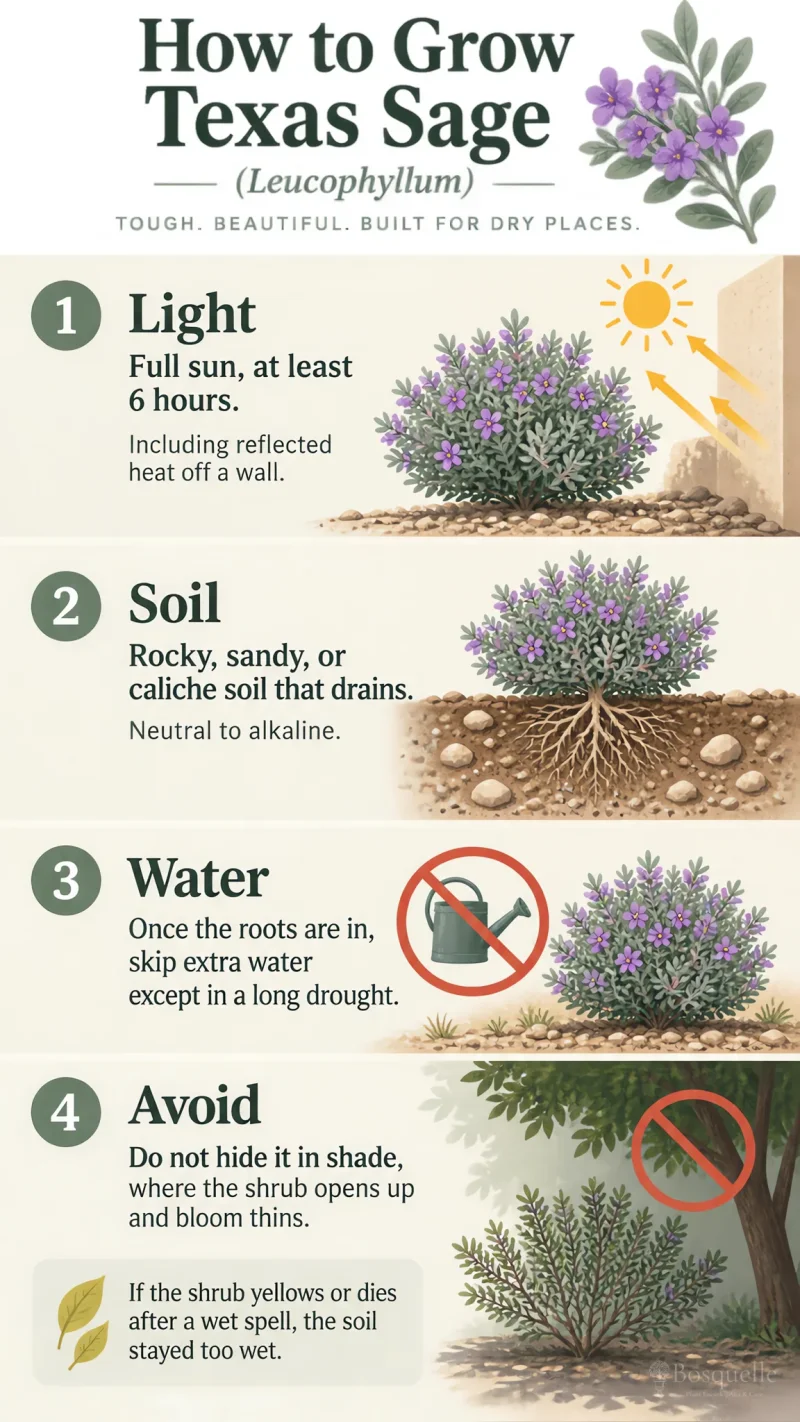
Give it full sun, lean soil that drains, and little water once it is established
| Factor | Recommended | Avoid |
|---|---|---|
| Light | Full sun, at least 6 hours, including reflected heat off a wall | Do not hide it in shade, where the shrub opens up and bloom thins |
| Soil | Rocky, sandy, or caliche soil that drains, neutral to alkaline | Do not plant it in a low wet hole or heavy clay that stays soggy |
| Water | Once the roots are in, skip extra water except in a long drought | Do not keep the soil wet, and do not set it next to a lawn sprinkler |
| Size | About 5 to 8 feet tall and 4 to 6 feet wide | Do not crowd the mound against a wet neighbor |
| Feed | Skip fertilizer. Poor, lean ground is enough | Do not push lush, floppy growth with extra feed |
Texas Sage is Leucophyllum frutescens, an evergreen figwort shrub with ashy-gray leaves and short flushes of pink-lavender flowers after rain or a jump in humidity. [1] Give it open sun and soil that sheds water. Once the roots are in, it lives on rainfall. Extra water and rich compost make weak growth and fewer flowers. [2] Wet soil around the roots is the primary cause of rot, including cotton root rot in ground that stays moist. Skip fertilizer. After a rain the shrub often covers itself in bell-shaped flowers for a few days, then drops them and waits for the next shift in weather. [3] On limestone and caliche it is at home. Pair it with other dry-sun plants at a distance, not a wet lawn plant against the crown. [4]
How much sun does Texas sage need?
Give it full sun, at least 6 hours. Shade makes a sparse shrub and a thinner bloom.
How often do I water Texas sage?
Once the roots are in, skip extra water except in a long drought. Wet soil around the roots is the primary cause of rot.
Is Texas sage drought tolerant?
Yes, once the roots are in. An established shrub lives on rainfall and needs a soak only in a long dry spell.
Is Texas sage deer resistant?
Yes. Deer usually leave it alone. That is not a spray job — it is a site choice for a dry, open bed.
Is Texas sage rabbit resistant?
Yes. Rabbits usually leave it alone once the shrub is in dry, open ground.
Not autumn sage — and not the sage you cook with
Shop tags that say Texas sage are often this silverleaf shrub. They are also used on autumn sage, Salvia greggii, a smaller mint-family plant about 2 to 3 feet tall with aromatic green leaves and flowers from spring to frost in many colors. If the tag is Salvia, grow it as sage — see How to Grow Sage.
Culinary sage is Salvia too. California purple sage is Salvia leucophylla, not this plant, even though purple sage is a shop name for cenizo. Desert lavender is Condea, a different dry-sun shrub — see How to Grow Desert Lavender. True lavender is Lavandula — see How to Grow Lavender. Read the Latin. This shrub is Leucophyllum frutescens: ashy leaves, rain bloom, and a mound that fills several feet.
Is Texas sage the same as autumn sage?
No. Autumn sage is Salvia greggii, a smaller mint-family shrub. This plant is Leucophyllum frutescens, the silverleaf cenizo.
Can I cook with Texas sage?
No. This is not culinary sage. Do not put the leaves in food.
If the shrub yellows or dies after a wet spell, the soil stayed too wet. Put the next plant in full sun and draining ground, and skip extra water once the roots are in.
FAQ
Is there more than one kind of Texas sage?
Leucophyllum frutescens is the plant here. Extra shop names such as Compacta, Green Cloud, and Silverado are size or flower selections of the same shrub, not a second type. Give every tag the same sun and soil that drains.
Can I grow it in a pot?
A compact plant can live in a large pot that drains, in full sun. Let the mix dry between waterings. It is not a houseplant.
Will Texas sage stay green in winter?
Yes in its range, except after a hard freeze near 10 degrees, when it may drop some leaves. Wet soil through winter is the bigger problem.
Does Texas sage bloom after rain?
Yes. Short flushes of pink-lavender flowers often follow rain or a jump in humidity in summer and fall. Extra irrigation does not force a flush the same way.
Related guides


Recommended plants

References
- [1] NC State Extension -
https://plants.ces.ncsu.edu/plants/leucophyllum-frutescens/ - [2] Lady Bird Johnson Wildflower Center -
https://www.wildflower.org/plants/result.php?id_plant=lefr3 - [3] Arizona-Sonora Desert Museum -
https://www.desertmuseum.org/visit/sheets/Leufru.pdf - [4] Texas A&M AgriLife Extension -
https://rangeplants.tamu.edu/plant/ceniza-purplesage-texas-silverleaf/
This note is part of Leucophyllum Guides.
More first-season notes by plant are gathered in How to Grow Guides.
Updated: Reviewed by Bosquelle Editors