
Grow spike moss in shade, in mix that stays moist, and in humid air. Spike moss here is Selaginella, also sold as African clubmoss — not Irish moss.
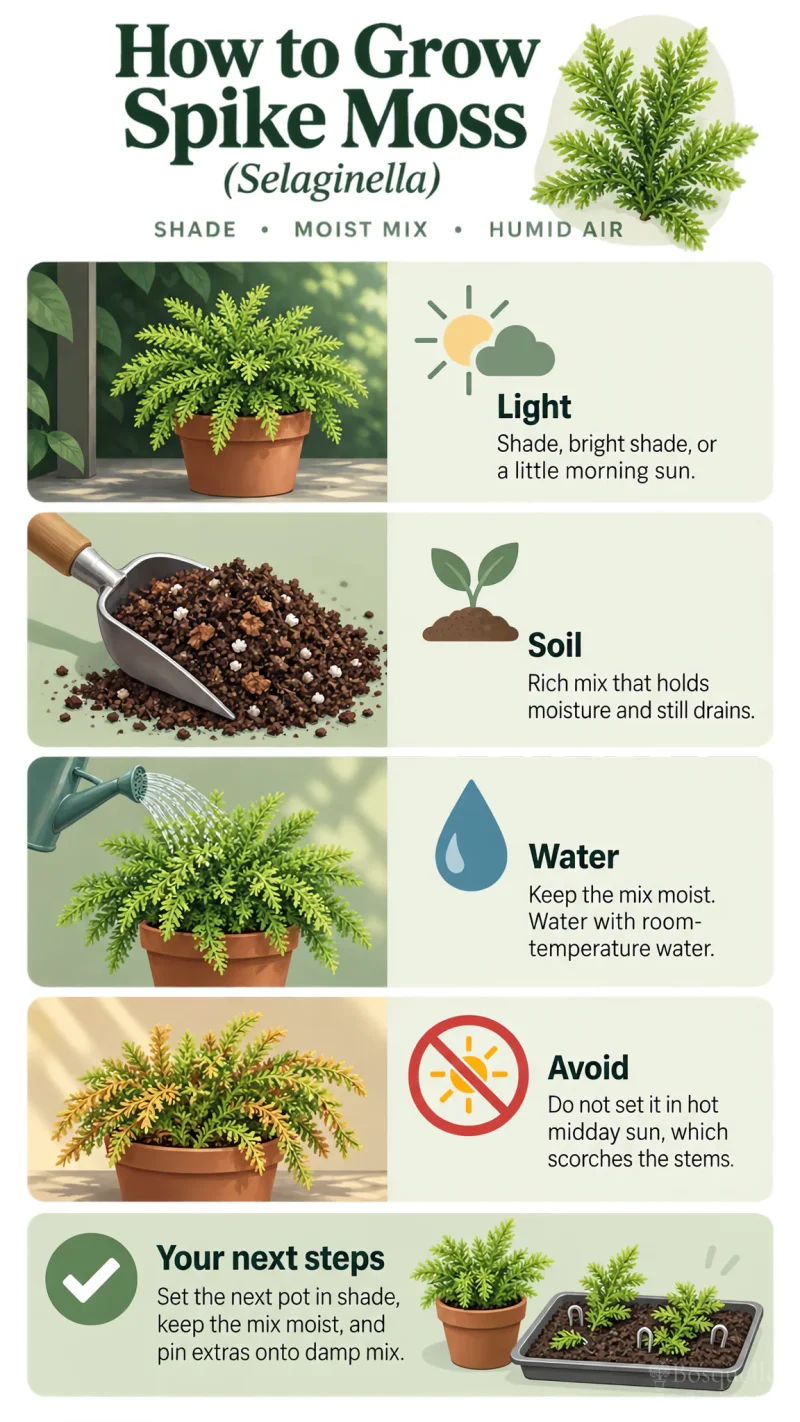
Keep it in shade, keep the mix moist, and raise the humidity
| Factor | Recommended | Avoid |
|---|---|---|
| Light | Shade, bright shade, or a little morning sun | Do not set it in hot midday sun, which scorches the stems |
| Water | Keep the mix moist. Water with room-temperature water | Do not let the pot dry out, and do not leave it standing in a full saucer |
| Humidity | A bathroom, a terrarium, or a pebble tray under the pot | Do not grow it in dry heated air on an open shelf |
| Soil | Rich mix that holds moisture and still drains | Do not plant it in a hot, dry gravel bed |
| Rabbits | Rabbits usually leave the mat | Do not plant it as a deer-proof groundcover |
Give it shade and mix that stays moist. Dry air browns the tips, and hot sun scorches the fine stems. A bathroom, a covered dish, or a pebble tray keeps the air damp around the pot. [1] Keep the mix moist at all times. A short dry spell is tolerated; a dry week on a heated sill is not. [2] African clubmoss uses that same shade and moisture. flower of stone is a different job — a dry ball that soaks in a dish. See How to Grow Resurrection Plant.
- Set it in shade or bright shade, out of hot midday sun.
- Water so the mix stays moist. Use room-temperature water. Empty a saucer that stays full, so the roots are not sitting in stale water.
- Raise humidity with a terrarium, a cloche, a bathroom, or a pebble tray under the pot.
- Bring the pot in before a frost. This is a tender mat for most of the country.
How much sun does spike moss need?
Shade, bright shade, or a little morning sun. Hot midday sun scorches the stems.
How often do I water spike moss?
Keep the mix moist. Do not wait until the pot is dry, and do not leave the saucer full.
Why are the tips brown?
Dry air browns the tips. Move it to a bathroom or a terrarium, and keep the mix moist.
Plant it in a shallow pot, or as a shade mat
The roots are shallow, so a wide, shallow pot with a hole is enough indoors. Outdoors it is a shade groundcover in rich, moist soil — a woodland edge or a rock pocket that does not bake. A terrarium or bottle garden holds the humidity this plant needs. [3]
- Choose a shallow pot with a hole, or a shady bed that stays moist.
- Fill the pot with rich potting mix that holds moisture. Do not pack a hot, dry gravel mix around the stems.
- Set the nursery plant at the same depth it grew in the pot. Spread the running stems on the surface so they can root as they go.
- Water to settle, then keep the mix moist. If the room is dry, cover the pot or move it into a terrarium.
How do I pot it?
Use a shallow pot with a hole and rich mix that stays moist. A terrarium helps in dry rooms.
Trim the edges, then pin a stem onto moist mix
You do not cut this plant to the ground. Snip the running edges when the mat crawls past the pot or the path, and keep those pieces — they root in damp mix.
- Find a stem that has run past the pot rim or the path edge.
- Snip it cleanly. Do not strip the whole mat at one time.
- Lay the cutting on moist mix, or pot it at once. Keep it humid until new roots hold.
Pin a stem onto moist mix
The usual way to make more spike moss is to pin a long stem onto moist mix, or to divide a clump. Unpot a mature plant, tease a section that already has stems and roots, and set that piece on moist mix. A spore sowing is slow and is not the practical start.
- In the warm growing season, slide the plant out of the pot, or lift a piece from the edge of a mat.
- Tease the clump so each piece has stems and some roots, or lay a stem 6 in or longer on moist mix and cover it at a few points.
- Keep the new piece moist and humid until it holds. Then water as you would the parent plant.
Do I trim the running stems?
Yes. Snip the edges when the mat crawls past the pot. Keep the cuttings — they root in damp mix.
How do I start a new plant?
Pin a stem onto moist mix, or divide a clump that already has roots. A spore tray is slow.
Not Irish moss — and not a resurrection plant
Irish moss in a paver joint is Sagina, a flowering plant with tiny white blooms. Spike moss is Selaginella, with scale leaves and no flowers. Shops also print Irish moss on this tag — read the Latin.
Moss rose is Portulaca, a sun annual with bright flowers. See How to Grow Moss Rose if that is the plant you bought. True moss has no true roots. This plant roots as the stems run. [4]
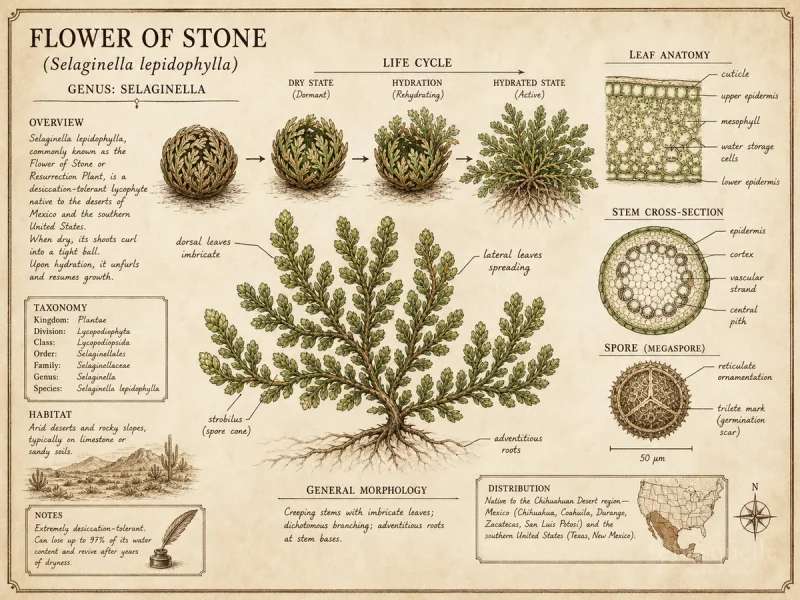
A dry brown ball that unfurls in a dish of water is the resurrection plant in this catalog, not this moist carpet. See How to Grow Resurrection Plant. A Christmas “frosty fern” with white tips is often a taller Selaginella, not this low mat.
Is this Irish moss?
No. Irish moss between pavers is Sagina, with tiny white flowers. Spike moss is Selaginella, with scale leaves and no flowers.
Is this a resurrection plant?
No. A resurrection plant is a dry ball that soaks in a dish. Spike moss is a moist shade mat. Do not let this pot dry out to test it.
Set the next pot in shade, keep the mix moist, and pin extras onto damp mix.
FAQ
Can I grow the gold-tip or frosty-fern forms the same way?
Gold tips on this mat still want shade, moist mix, and humid air. A Christmas frosty fern is often a taller kind. Keep that one humid too, and do not copy a dry-ball soak onto either plant.
Can I leave it out all winter?
Bring the pot in before a frost. Outdoors it is a shade mat only where winters stay frost-free.
Can I start it from spores?
Yellow dust in the small cones is spores. Pinning a stem or dividing a clump is the practical way. Spore sowing takes a sterile tray and time.
Do I need to feed it?
A weak houseplant feed twice in spring and summer is enough if the mix is old. Skip feed in winter, and do not keep it in rich, wet soil that never drains.
Is it safe for pets?
It is often listed as non-toxic to cats and dogs. Still keep pets from chewing houseplants. A chewed stem can upset a stomach.
Related guides

Recommended plants

References
- [1] NC State Extension Gardener Plant Toolbox -
https://plants.ces.ncsu.edu/plants/selaginella-kraussiana/ - [2] South African National Biodiversity Institute -
https://pza.sanbi.org/selaginella-kraussiana - [3] Royal Horticultural Society -
https://www.rhs.org.uk/plants/17035/selaginella-kraussiana/details - [4] Wikipedia -
https://en.wikipedia.org/wiki/Selaginella_kraussiana
This note is part of Selaginella Guides.
More first-season notes by plant are gathered in How to Grow Guides.
Updated: Reviewed by Bosquelle Editors