
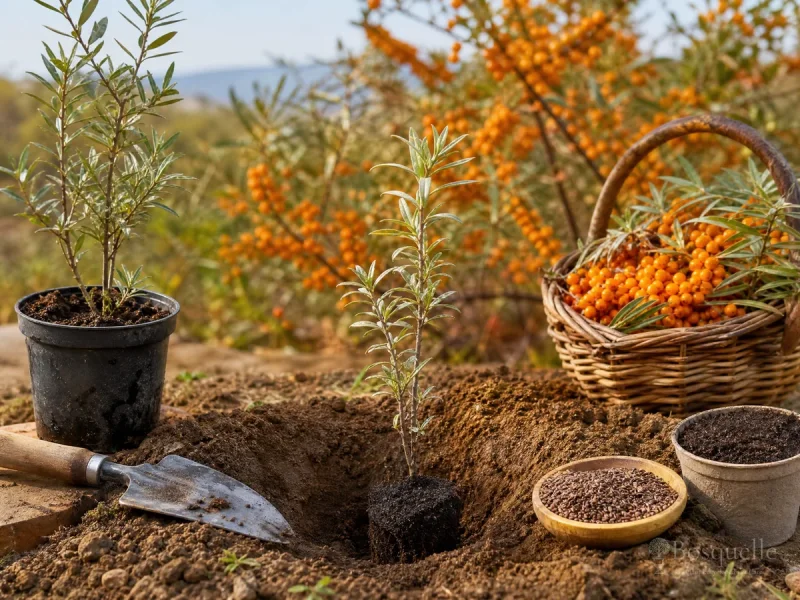
Grow sea buckthorn in full sun, in soil that drains, and water it through the first two summers. Sea buckthorn is Hippophae rhamnoides, also sold as seaberry — a thorny deciduous shrub, not a true buckthorn and not Russian olive.

Give it full sun, soil that drains, and water the first two summers
| Factor | Recommended | Avoid |
|---|---|---|
| Light | Full sun, about six hours or more a day | Do not plant it in shade if you want fruit |
| Water | Water through the first one to two summers so the roots take, then water again in a long dry spell while fruit fills | Do not leave it in a hole that stays wet after rain |
| Soil | Sandy loam or sandy soil that drains, alkaline to neutral | Do not plant it in a low, waterlogged spot |
| Feed | Skip extra nitrogen; the roots fix their own | Do not dump a high-nitrogen fertilizer on it |
| Size | Leave room for a shrub about 8 to 12 feet tall and as wide | Do not crowd it against a walk without room for thorns and suckers |
sea buckthorn is a deciduous, thorny shrub that wants an open, sunny site and soil that does not sit wet. It will grow in poor, sandy ground, and the roots fix nitrogen with Frankia bacteria, so extra fertilizer is not the job. [1] Give it a full day of sun. Less than about six hours and the crop thins; deep shade almost stops fruiting. Water a new plant through the first one to two summers. After that, water in a long dry spell while the berries fill, and skip extra otherwise. [2] The one site it cannot take is a soggy hole. Root rot starts in waterlogged or compacted ground, so plant on a slope or a raised spot if your soil holds water. Do not copy a drought slogan onto a wet clay pocket. [3] The shrub is a coastal hedge and windbreak in catalog use, but suckers will take a bed if you ignore them. Check your state's invasive list before you plant, and keep it out of dunes and wild ground. The male-and-female layout is on Planting Sea Buckthorn. Pick when the berries are fully orange on Harvesting Sea Buckthorn. [4]
Does sea buckthorn need full sun?
Yes, if you want fruit. Give it about six hours or more. Shade makes a thin crop.
How often should I water it?
Water through the first one to two summers. After that, water in a long dry spell while fruit fills. A wet hole still rots the roots.
In late winter, take out the oldest wood and the suckers
Fruit sits on two-year and three-year wood, so you do not shear the shrub like a hedge. In late winter, while it is still dormant, take out dead, crossing, and the oldest stems at the base, and keep enough young wood for next year's berries. Wear heavy gloves, long sleeves, and eye protection; the thorns are sharp and close.
- Wait until late winter, before the tiny yellow flowers open on last year's wood.
- Wear heavy leather gloves, long sleeves, and eye protection.
- Cut out dead, damaged, and crossing stems, then take a few of the oldest stems down to the base so new wood can take their place.
- Do not strip every fruiting stem in one year, or you lose the next crop.
- Walk the drip line and sever suckers below the soil with a spade, unless you want a thicket.
When do I prune sea buckthorn?
Late winter, while it is dormant. Take out the oldest wood and the suckers, and leave enough two-year wood for fruit.
Not Russian olive — and not autumn olive or a true buckthorn
Russian olive is Elaeagnus angustifolia, often a small tree with leaves silvery on both sides and dry, yellow-brown fruit. Sea buckthorn has narrower, willow-like leaves that are greener above and silver beneath, and the fruit on female plants is juicy and orange. Do not buy a Russian olive and call it this shrub.
Autumn olive is a related deciduous fruit shrub with red, silver-speckled berries — see How to Grow Autumn Olive. Oleaster, sold as Gilt Edge, is the evergreen gold-edge hedge in that genus — see How to Grow Oleaster. Buffaloberry is Shepherdia, with opposite leaves; we do not list it here. True buckthorn is Rhamnus or Frangula. Carolina buckthorn has no spines and red-then-black drupes — see How to Grow Carolina Buckthorn. Coffeeberry is the evergreen Rhamnus in this catalog — see How to Grow Coffeeberry. The name rhamnoides only means the thorns look a little like buckthorn.
Is sea buckthorn the same as Russian olive?
No. Russian olive is Elaeagnus angustifolia, with silvery leaves on both sides and dry yellow-brown fruit. Sea buckthorn is Hippophae, with orange berries on female plants.
If the shrub sulks, check sun and wet ground first: give it a full day of sun and soil that drains, then water it through the first two summers.
FAQ
Is there more than one kind of sea buckthorn?
This catalog holds Hippophae rhamnoides. Named fruiting shrubs in trade are the same keep-alive: full sun, drain, a male nearby. They are not a second type page.
Can I grow it in a pot?
It wants open ground. A shrub this size sits poorly in a small pot, and the roots still sucker. Plant it in a bed you can walk for suckers.
Does it need winter protection?
No. It is a hardy deciduous shrub that rests outdoors. Wet, airless soil in winter is the usual problem, not ordinary cold.
What can I plant with sea buckthorn?
Give it the sunny edge of a hedge or food planting so it does not shade neighbors. Keep acid, nitrogen-shy plants off the downhill side of a mature stand.
Will it take over the bed?
Suckers will, if you ignore them. Walk the drip line each year and cut them below the soil. Do not plant it into dunes or wild ground, and check your state's list first.
Related guides

Recommended plants

References
- [1] BBC Gardeners' World Magazine -
https://www.gardenersworld.com/how-to/grow-plants/sea-buckthorn-hippophae-rhamnoides/ - [2] One Green World -
https://onegreenworld.com/sea-berry-growing-guide/ - [3] Raintree Nursery -
https://raintreenursery.com/pages/seaberry-growing-guide - [4] Oregon State University -
https://landscapeplants.oregonstate.edu/plants/hippophae-rhamnoides
This note is part of Hippophae Guides.
More first-season notes by plant are gathered in How to Grow Guides.
Updated: Reviewed by Bosquelle Editors