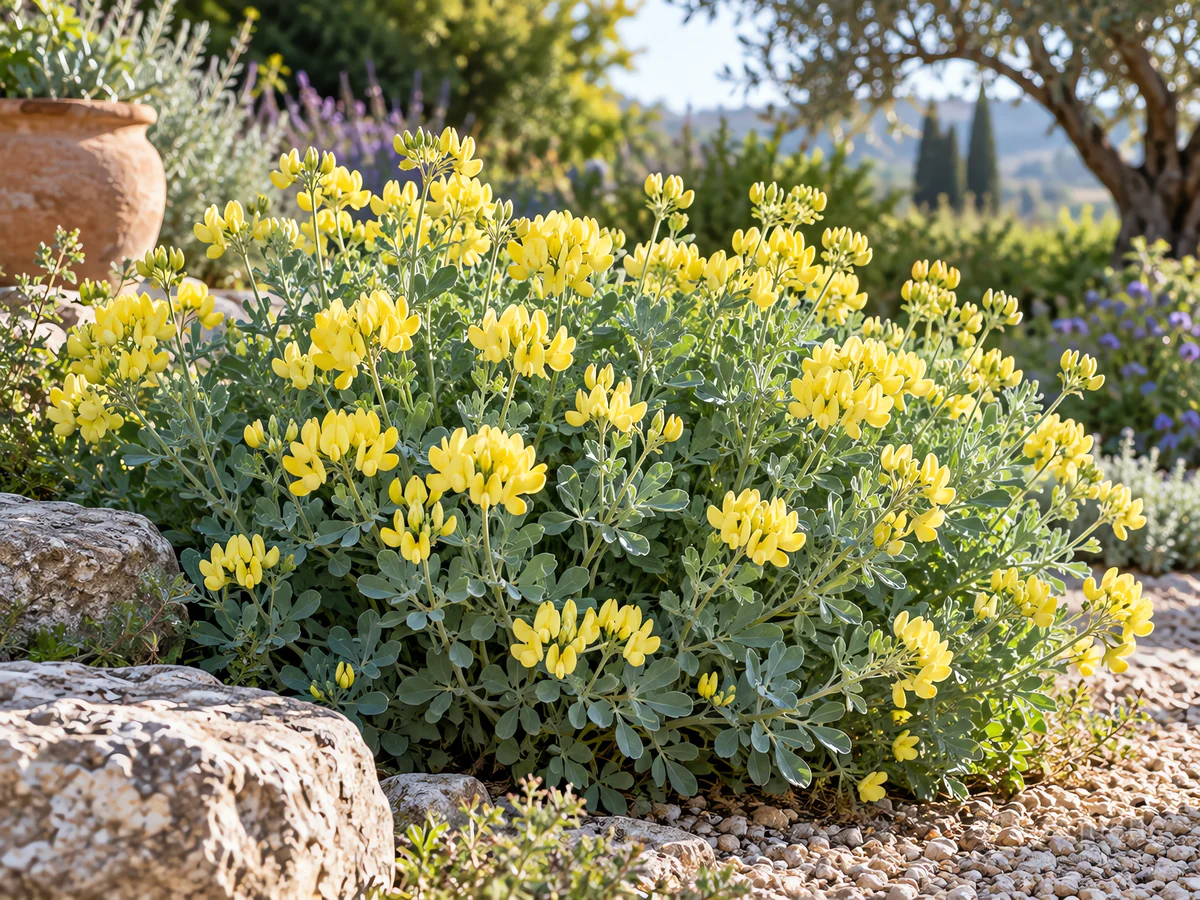
Grow scorpion vetch in full sun on soil that drains, set it against a sheltered wall, and water a new shrub until the roots take. Scorpion vetch is Coronilla valentina, and the plant in this catalog is the lemon-flowered form Citrina. If a search for crown vetch sent you to a pink roadside spreader, or a search for smoke bush sent you to a large plume shrub, those are different plants.
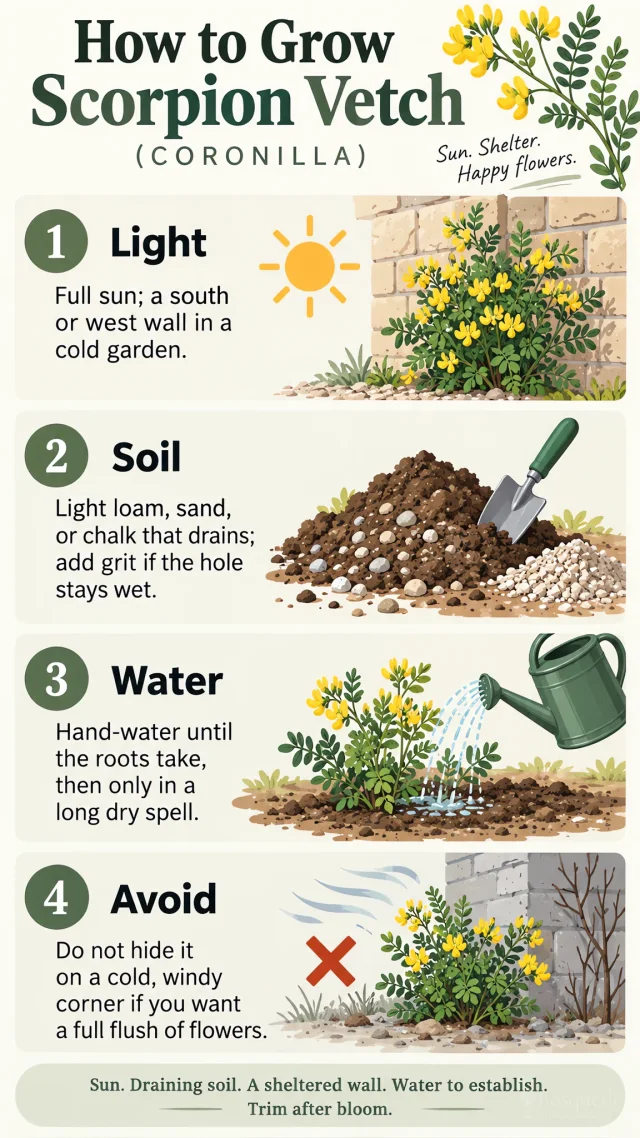
Give it full sun, a sheltered wall, and soil that drains, then ease off the water
| Factor | Recommended | Avoid |
|---|---|---|
| Light | Full sun; a south or west wall in a cold garden | Do not hide it on a cold, windy corner if you want a full flush of flowers |
| Water | Hand-water until the roots take, then only in a long dry spell | Do not keep the crown in standing water |
| Soil | Light loam, sand, or chalk that drains; add grit if the hole stays wet | Do not plant into a wet clay hole |
| Frost | Set it against a warm wall; move a pot under cover if a hard freeze is due | Do not count on it through a hard freeze in the open |
| Room | A rounded shrub about 2 to 3 feet tall and wide | Do not buy it as a spreading roadside crown vetch |
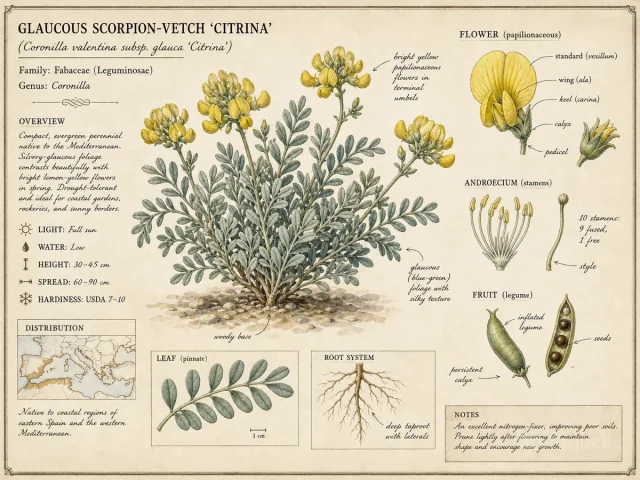
Scorpion vetch wants the brightest spot you can give it and ground that does not stay wet. Full sun keeps the blue-gray leaves dense and the lemon flowers coming. A south or west wall adds heat and blocks a cold wind, which is why the shrub flowers more there. Water a new plant by hand whenever rain is missing until the roots take. After that, skip the regular sprinkler except in a long dry spell. [1] Scorpion Vetch 'Citrina' is a small evergreen pea shrub with blue-gray pinnate leaves and lemon-yellow flowers in crown-shaped clusters from late winter into spring. The flowers smell sweet in the daytime. Plan on about 2 to 3 feet tall and wide as a free-standing shrub. [2] A hard freeze can kill it even against a wall, so a pot you can move under cover is safer in a marginal garden. Heavy wet clay around the roots is the usual cause of rot. Once the roots take, the shrub can go through a dry spell. Do not feed a rich lawn dose. [3]
How big does scorpion vetch get?
Plan on about 2 to 3 feet tall and wide as a free-standing shrub. A plant trimmed against a wall can run a little taller. Give it room to stay a mound, not a trailing bank cover.
Will a south-facing wall help?
Yes. Full sun against a south or west wall keeps the growth dense and the flowers coming. Plant it where the soil still drains after rain.
Plant a nursery shrub in spring, or in a mild fall
Plant after frost, when you can water by hand. Spring is the usual window. Fall is fine where winters stay mild. Dig a hole several times wider than the root ball, and no deeper. Mix grit into a heavy hole so water can leave. Set the root ball even with the surrounding soil.
- Plant in full sun, after frost, on ground that drains, against a south or west wall in a cold garden.
- Slide the plant out of the pot and loosen circling roots so they can grow out.
- Set the crown even with the soil. Give the shrub room to reach 2 to 3 feet across.
- Water after you plant, then by hand until the roots take whenever rain is missing.
When should I plant scorpion vetch?
Plant in spring after frost, when you can water by hand. Fall is the next window in a mild winter garden.
Trim after bloom, and cut a leggy plant in spring
This shrub does not need a yearly shear. After the main flush fades, tip the stems back a few inches if you want a denser mound. Cut out dead wood at the base. If the plant is already a leafless stick, you can cut it near the ground in spring after bloom. That is a rescue cut, not the yearly trim.
- Wait until the main flush of flowers fades.
- Tip each stem back a few inches, just above a leaf.
- Cut out dead or crossing twigs at their base.
- If the shrub is a leafless stick, cut it near the ground in spring after bloom. Do not make that the yearly habit on a healthy plant.
Can I cut scorpion vetch back hard?
A healthy plant only needs a light trim after bloom. Cut a leafless, leggy shrub near the ground in spring after the flowers fade. Do not shear a leafy plant to a stump in one day.
Not crown vetch — and not smoke bush
Scorpion vetch is a woody evergreen with blue-gray leaves and lemon-yellow pea flowers in a small crown. Crown vetch is Securigera varia, once sold as Coronilla varia — a pink-and-white spreader with trailing stems, planted on roadsides, not a 2-foot wall shrub. [4] Smoke bush is Cotinus, a large shrub grown for puffy plumes — see How to Grow Smoke Bush. Wild senna is Senna, a hardy meadow perennial — see How to Grow Wild Senna. Older tags may say bastard senna for this Coronilla; that is a shop name, not the meadow senna. Crown of thorns is Euphorbia, a spiny plant — see How to Grow Euphorbia. A bottlebrush tagged Citrina is Melaleuca, not this pea shrub. True vetch has tendrils; this shrub does not. If the tag says Coronilla valentina or Coronilla glauca Citrina, and the flowers are lemon yellow on a small evergreen, you have scorpion vetch.
Is this the same as crown vetch?
No. Crown vetch is a pink spreading roadside plant. Scorpion vetch is a small evergreen with yellow flowers, grown against a warm wall.
Is bastard senna a true senna?
No. Bastard senna is an older shop name for this Coronilla. True senna is a different genus with its own summer meadow care.
How to start a new plant from a cutting
A semi-hardwood cutting is the way to keep the lemon form you bought. Take the cutting in summer from a non-flowering shoot.
- Take a non-flowering shoot about 2 to 4 inches long, and cut just below a node.
- Strip the lower third of the leaves. Keep a few leaves at the top.
- Stand the stem in mix that drains, with plenty of perlite. Water lightly.
- Keep the pot bright and out of direct sun until roots hold the mix, then grow it on frost-free until it is large enough to plant out.
Seed is slower than a cutting
Seed can grow a plant, but it is slower, and seedlings may not match the lemon parent. Sow on mix that drains, cover the seed lightly, and keep the tray barely moist in good light. Move seedlings into sun after frost, once they have a few true leaves.
How can I start a new plant?
Take a summer cutting from a non-flowering shoot, stand it in mix that drains, and wait until roots hold. Seed is slower, and it may not come lemon-yellow like Citrina.
Set scorpion vetch in full sun on ground that drains, against a sheltered wall, water it by hand until the roots take, and trim after bloom.
FAQ
Can I grow scorpion vetch in a pot or indoors?
A patio pot with a drainage hole can hold a plant if the mix drains and the pot sits in sun. Water when the top of the mix is dry. Move it to shelter if a hard freeze is due. It is not a houseplant.
Do you list other kinds of Coronilla?
This catalog holds Scorpion Vetch Citrina, Coronilla valentina subsp. glauca. Greener Coronilla valentina and dwarf names still want sun, a sheltered wall, and soil that drains.
Is it safe around pets?
Keep pets from chewing the leaves or pods as food. Do not eat any part of the plant, and do not use it as a home remedy.
Recommended plants
References
- [1] Royal Horticultural Society -
https://www.rhs.org.uk/plants/53148/coronilla-valentina-subsp-glauca-citrina/details - [2] Hayloft -
https://hayloft.co.uk/how-to-grow-evergreen-coronilla - [3] Trees and Shrubs Online -
https://www.treesandshrubsonline.org/articles/coronilla/coronilla-valentina/ - [4] Missouri State University -
https://ag.missouristate.edu/PBTrewatha/crown-vetch.htm
More first-season notes by plant are gathered in How to Grow Guides.
Updated: Reviewed by Bosquelle Editors