
Grow purple false foxglove as an annual in sun and moist sandy soil. Purple false foxglove is Agalinis, also called purple gerardia.
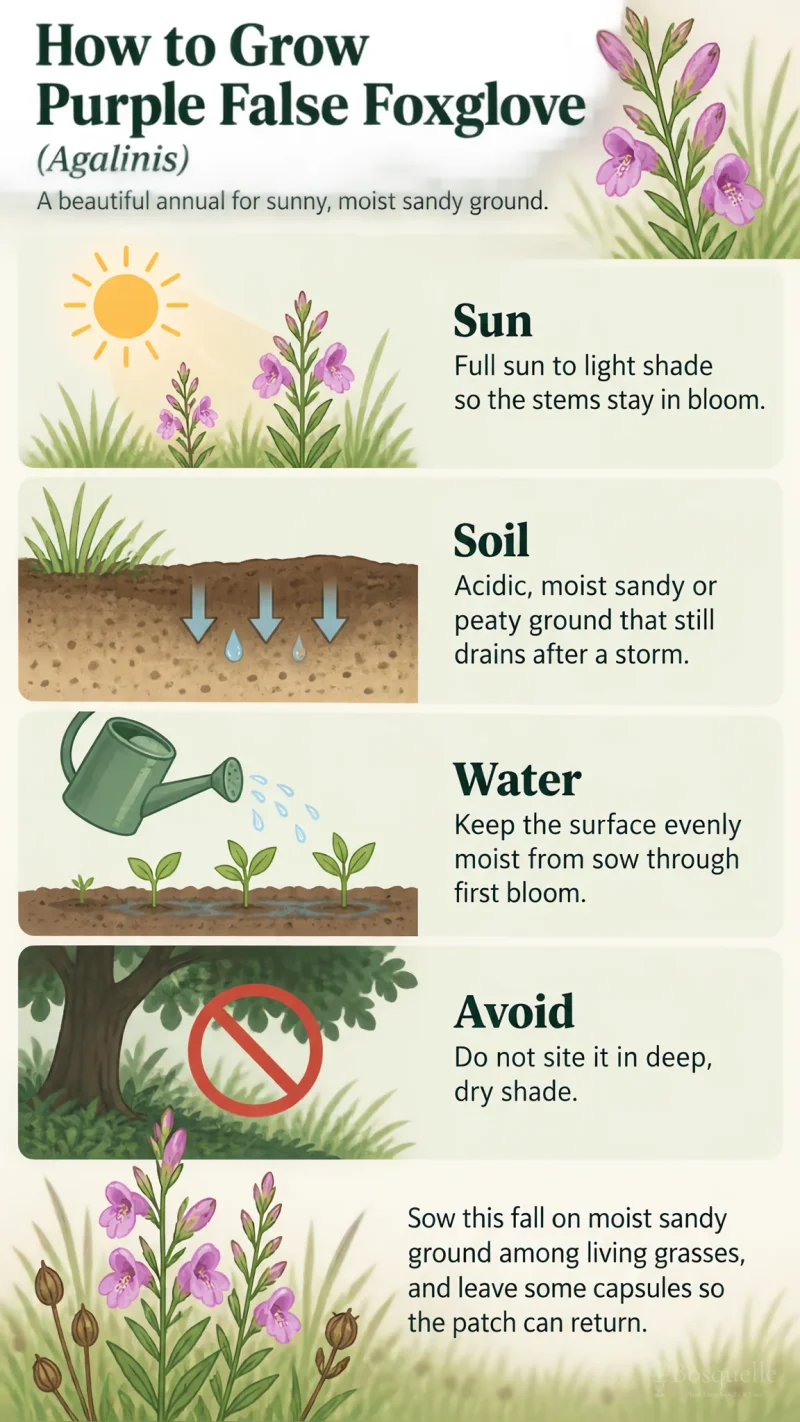
Give it sun, moist sandy soil, and living grass nearby
| Factor | Recommended | Avoid |
|---|---|---|
| Sun | Full sun to light shade so the stems stay in bloom | Do not site it in deep, dry shade |
| Soil | Acidic, moist sandy or peaty ground that still drains after a storm | Do not plant it where the surface bakes dry around tiny seedlings |
| Water | Keep the surface evenly moist from sow through first bloom | Do not let a dry crust form on the seedbed |
| Host | Sow among living plants, especially grasses, so the roots can attach | Do not start it in a pot of sterile mix with no neighbors |
| Feed | Little or no fertilizer in moist meadow ground | Do not dump extra nitrogen that pushes the grasses ahead of this plant |
purple false foxglove is an annual in the broomrape family. It wants sun to light shade and moist sandy or peaty soil, then it dies after the seed ripens. It is a hemiparasite: the leaves make their own food, and specialized roots tap nearby plants, usually grasses, for extra water and minerals. Keep the seedbed moist. Tiny seedlings wither if the surface dries out. [1] [2]
Does purple false foxglove need full sun?
Full sun to light shade. Deep, dry shade makes a thin plant with few flowers.
How often should I water it?
Keep the surface moist from sowing through bloom. A dry crust on the seedbed kills the seedlings before they can attach to nearby roots.
Does it need a host plant?
Yes. Sow it among living plants, especially grasses. A clean pot of mix with no neighbors is a poor start.
Sow on the surface in fall, and keep the seedlings moist
Sow where the plants will bloom, among living grasses in moist sandy ground. The seed is tiny and wants light, so do not bury it. Late fall or winter sowing lets weather break dormancy. If you start indoors, give the damp seed about 30 days of cold in the refrigerator first, then surface-sow it next to living grass. [3]
- Choose a moist sandy or peaty patch that already has living grasses. Pull weeds so the seedlings are not lost, but leave the grasses in place.
- Scatter the seed in late fall or winter on the surface. Mix it with dry sand if it is too fine to spread. Press it so it touches the soil. Do not cover it with a layer of soil.
- Keep the surface moist until the plants show and through the first weeks. A dry day can kill the seedlings before the roots attach.
- If you missed fall, chill damp seed about 30 days in the refrigerator, then sow it on the surface next to living grass in spring. Do not pot it up in sterile mix and expect a meadow plant.
When should I sow the seed?
Sow on the surface in late fall or winter. If you missed that window, chill damp seed about 30 days, then sow it in spring among grasses.
Should I cover the seed?
No. Press it onto the soil so it gets light. Buried seed often fails to sprout.
Not garden foxglove — and not yellow false foxglove or false indigo
Purple false foxglove on a tag is this slender annual, not the garden foxglove that holds a tall biennial spike. Garden foxglove is Digitalis, which is poisonous if eaten — see How to Grow Foxgloves. If you searched for foxglove and landed here, check the tag. This plant has narrow opposite leaves and pink-purple tubes in late summer, not a dense one-sided tower of bells. [4]
Yellow false foxglove is Aureolaria, a different genus that often taps oak roots and carries yellow flowers. False indigo is Baptisia, a perennial pea with lupine-like blooms — see How to Grow False Indigo. Indian paintbrush is Castilleja — see How to Grow Paintbrush. If the packet says purple gerardia or Agalinis and the flowers are pink-purple tubes on a wiry annual, you still have this plant.
Is this garden foxglove?
No. Garden foxglove is Digitalis, a toxic biennial with a tall spike. This is a native annual with slender stems.
Is yellow false foxglove the same plant?
No. Yellow false foxglove is Aureolaria. Purple false foxglove is Agalinis. This catalog holds the purple annual.
Leave seed so the patch returns next year
The plants die after the seed ripens. A patch returns only if some capsules split and that seed can hit open soil among the grasses. Do not cut every stem to the ground the week bloom ends if you want seedlings next year.
- Leave later flowers to form rounded capsules. The capsules split at the top and the wind moves the tiny seed.
- Do not shear the whole stand after the first flush if you want the patch back. A light tidy of broken stems is enough.
- Leave the grasses in place over winter. The next year's plants start from seed at their feet, not from a crown you can divide.
Will it come back next year?
The plants themselves die after seed. A patch returns if seed can hit moist, open soil among the grasses.
Sow this fall on moist sandy ground among living grasses, and leave some capsules so the patch can return.
FAQ
Can I grow it in a pot?
A pot with living grass can hold a few plants, but a sterile mix with no neighbors usually fails. A moist meadow strip in the ground holds a patch better.
Can I take cuttings?
No. This plant spreads by seed. It does not make new plants from stem cuttings or from a divided crown.
Do you sell slender or yellow false foxglove?
No. This catalog holds purple false foxglove. Slender false foxglove is another Agalinis. Yellow false foxglove is Aureolaria.
Is Gerardia a different plant?
No. Gerardia and purple gerardia are older names for this Agalinis. The plant is the same.
Is seaside gerardia the same plant?
No. Seaside gerardia is a smaller salt-marsh cousin. Treat pink-purple meadow tubes on a wiry annual as purple false foxglove.
Recommended plants

References
- [1] NC State Extension Gardener -
https://plants.ces.ncsu.edu/plants/agalinis-purpurea/ - [2] Prairie Moon Nursery -
https://www.prairiemoon.com/agalinis-purpurea-purple-false-foxglove - [3] Illinois Wildflowers -
https://www.illinoiswildflowers.info/prairie/plantx/pf_foxglovex.htm - [4] Lady Bird Johnson Wildflower Center -
https://www.wildflower.org/plants/result.php?id_plant=AGPU5
More first-season notes by plant are gathered in How to Grow Guides.
Updated: Reviewed by Bosquelle Editors