
Grow pineapple lily in full sun, keep the soil moist while the leaves grow, and never leave the bulb in a winter puddle. Shops also list king’s flower for Eucomis comosa. Let the foliage yellow, then mulch in place or lift the bulb.
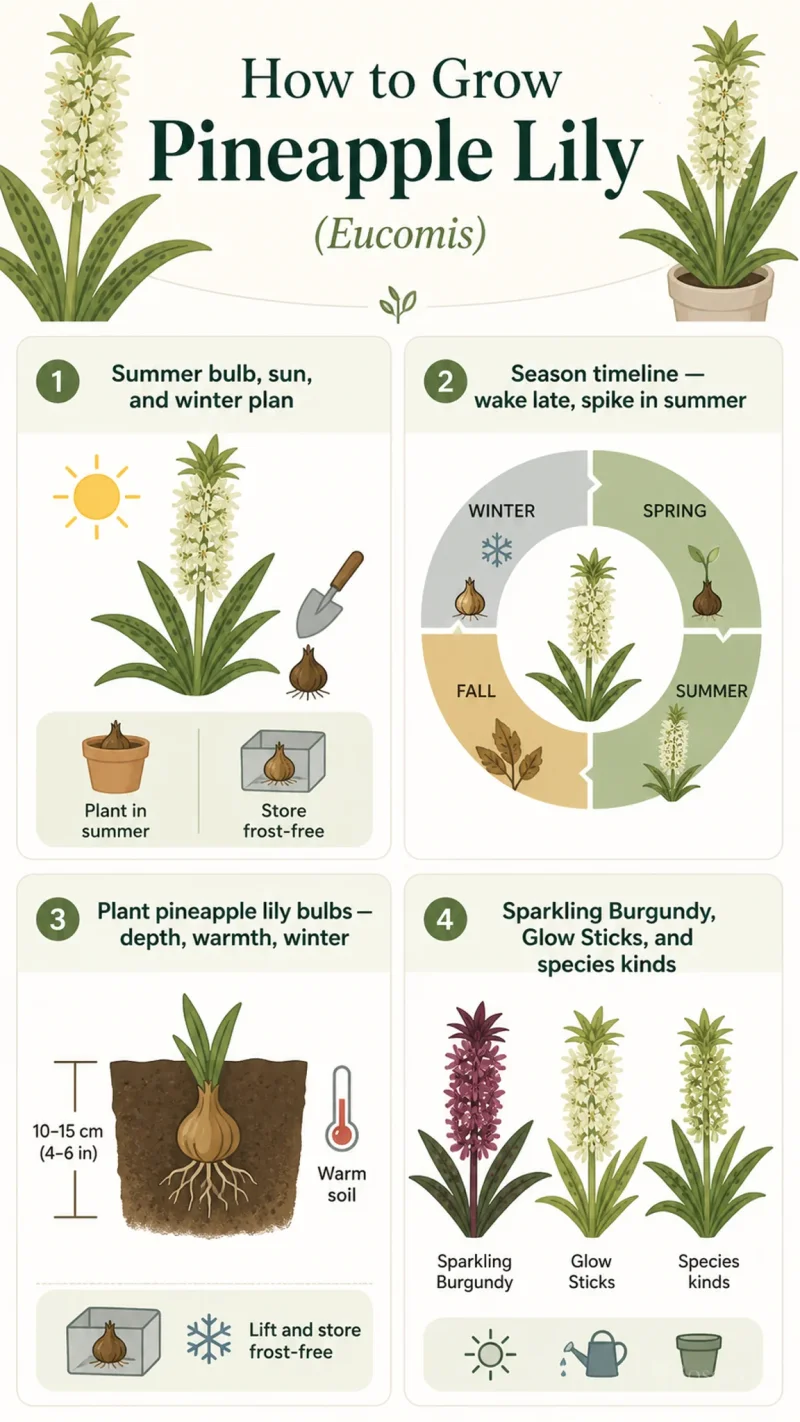
Full sun, moist in summer, soil that drains
| Factor | Recommended | Avoid |
|---|---|---|
| Light | Full sun for strong spikes; afternoon shade in hot southern summers | Deep shade that thins flowers and softens stems |
| Soil | Rich ground that stays moist in growth and drains in winter | A winter bog or a waterlogged clay pocket |
| Water | Even moisture while leaves grow; drier once the plant is set | Constant wet around a dormant bulb |
| Winter | Deep mulch on drained ground, or lift and store cool and dry | A frozen puddle around the bulb |
Pineapple lily wants full sun for the strongest spikes and the best leaf color. In a hot southern summer, light afternoon shade keeps the leaves from scorching. [1] Keep the soil moist while the rosette grows, then let it drain. Waterlogged ground in winter rots the bulb faster than a dry cold spell. [2] Once roots take, the plant handles short dry spells. Winter drainage still matters more than summer rain. [3]
Does pineapple lily need full sun?
Full sun gives the strongest spikes and the best leaf color. In a hot southern summer, light afternoon shade is fine. Deep shade thins flowers.
Does Eucomis like wet soil?
It wants moisture while summer leaves grow, and sharp drainage always. Winter-wet cold soil is the usual cause of rot.
Let the leaves yellow, then mulch or lift for winter
After bloom, leave the strap leaves in place until they yellow. They feed the bulb for next summer. Then pick one winter method: a deep mulch on drained ground, or lift and store the bulb cool and dry.
- Let the foliage yellow after bloom. Do not cut green leaves to tidy the bed.
- On drained ground at the cold edge, pile a thick dry mulch over the bulb after the leaves die back.
- Where a hard frost will sit on wet soil, lift the bulb after the foliage fades, dry it, and store it cool and dry like other summer bulbs. [4]
- A pot you can move to a dry, cool shelter is the same job without digging.
Does pineapple lily need winter protection?
Yes at the cold edge. Mulch on drained ground, lift and store cool and dry, or move the pot indoors. A wet freeze is the usual fail.
Do pineapple lilies come back every year?
Yes when the bulb stays firm through a dry dormant winter. Rot from winter wet is why they vanish.
Should I cut the leaves after flowering?
No. Leave the foliage until it yellows so it can feed the bulb, then mulch or lift.
If a bulb sat in a winter puddle, reset it onto ground that drains — or grow it in a pot you can move — before the next warm spring.
FAQ
Can I grow pineapple lily in a pot?
Yes in a large pot with drainage holes, in sun. Move it to a dry, cool shelter after the leaves fade.
What else can I plant nearby?
Pair it with other full-sun summer plants that share drainage. Skip bog plants and deep-shade neighbors in the same small bowl.
What pests hit pineapple lily?
Usually few. Watch slugs on tender young leaves. Rot is winter-wet soil, not a spray job.
Are pineapple lily flowers fragrant?
Some species have a starchy, fly-attracting scent. Many named kinds are milder and fine as cut spikes.
Related guides
Recommended plants


References
- [1] NC State Extension Gardener -
https://plants.ces.ncsu.edu/plants/eucomis/ - [2] Clemson Cooperative Extension — HGIC -
https://hgic.clemson.edu/pineapple-lilies/ - [3] University of Arkansas Division of Agriculture -
https://www.uaex.uada.edu/yard-garden/resource-library/plant-week/lily-pineapple-9-3-10.aspx - [4] Illinois Extension -
https://extension.illinois.edu/blogs/hort-home-landscape/2016-07-22-plant-week-pineapple-lily
This note is part of Eucomis Guides.
More first-season notes by plant are gathered in How to Grow Guides.
Updated: Reviewed by Bosquelle Editors