
Grow persicaria in moist soil in sun or part shade. Persicaria is fleece flower.
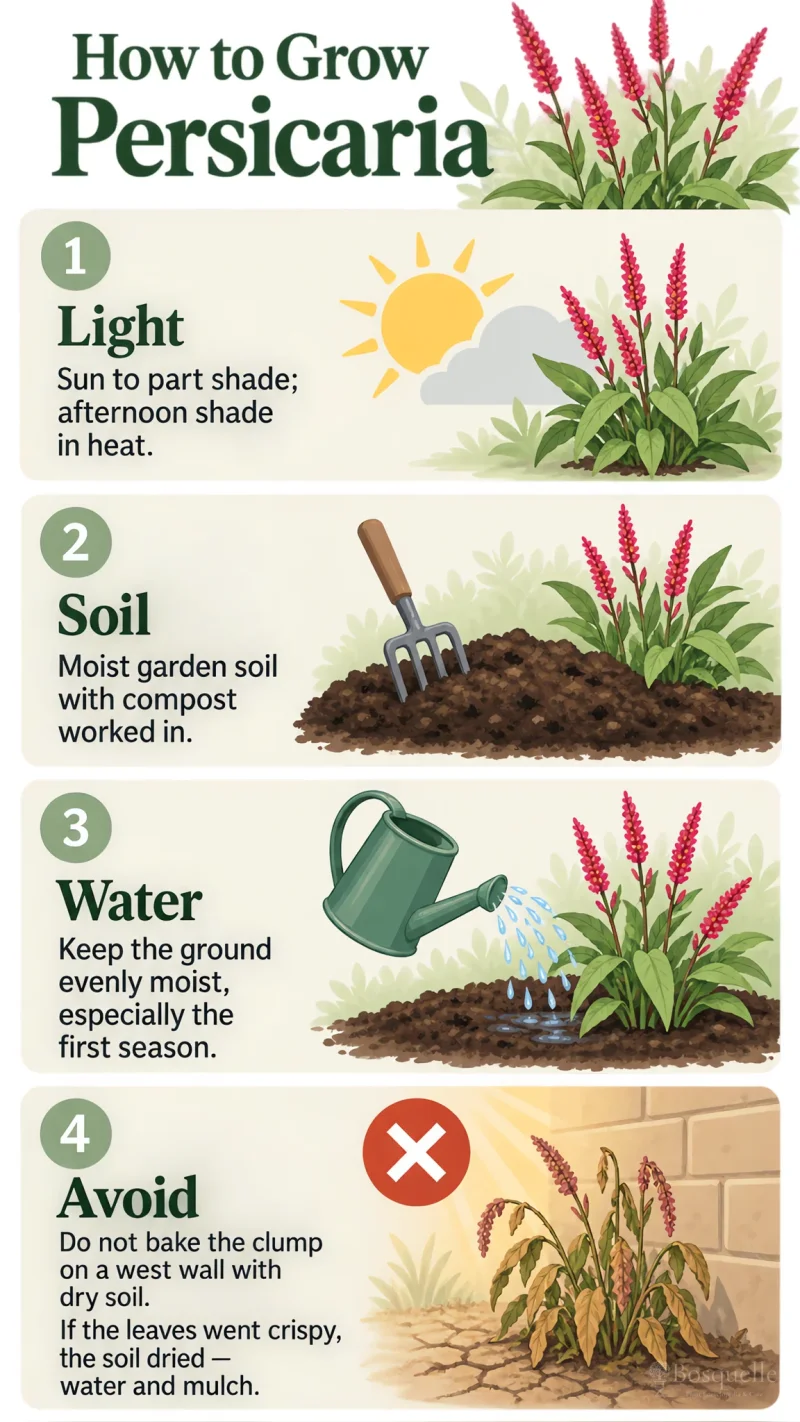
Keep the soil moist, and give afternoon shade in heat
| Factor | Recommended | Avoid |
|---|---|---|
| Light | Sun to part shade; afternoon shade in heat | Do not bake the clump on a west wall with dry soil |
| Soil | Moist garden soil with compost worked in | Do not plant it in thin sand that dries between waterings |
| Water | Keep the ground evenly moist, especially the first season | Do not let the bed go bone-dry in full sun |
| Mulch | A few inches of bark or chopped leaves, off the crown | Do not bury the growing point under a thick wet mat |
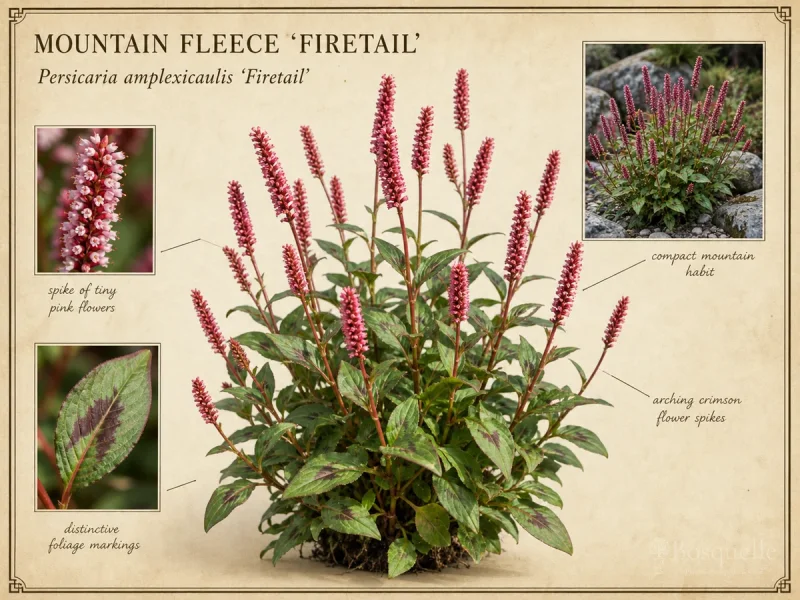
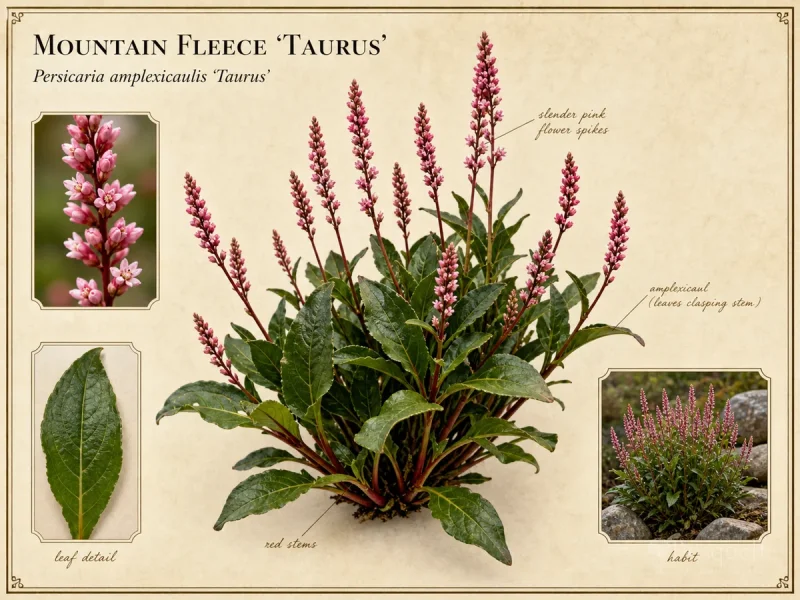
Persicaria is a moisture-loving perennial. Give it sun or part shade and soil that stays damp. It tolerates wet ground. In heat, afternoon shade keeps the leaves from scorching. Crispy foliage is the first sign the soil dried. [1] [2] Firetail and Taurus want that same moisture. Pick a kind on Types of Persicaria.
Does persicaria need full sun?
Sun to part shade is the usual site. It blooms best with several hours of light. In heat, afternoon shade keeps the leaves from scorching.
How often should I water persicaria?
Keep the soil evenly moist the first season. After that, water when the top starts to dry, especially in full sun. Do not let the bed go bone-dry.
Cut old stems to the ground in late winter
The clump dies back after frost. You can leave the spent spikes through winter, or cut them after bloom to tidy the bed. Cut the old stems to the ground in late winter, before new shoots mix with the straw. [3]
- After bloom, snip spent spikes if you want a tidier clump or fewer seedlings.
- In late winter, cut the old stems to the ground before new growth shows.
- Haul the cut stems off. Do not bury the crown under a wet pile of debris.
When should I cut back persicaria?
Late winter, before new shoots appear. You can also snip spent spikes after bloom. Do not wait until new growth is mixed with last year's stems.
Plant in spring, and leave room for the clump
Plant from a nursery pot in spring once the soil can be worked, or in early fall with time for roots to take before a hard freeze. Set the crown even with the surrounding soil. A mountain-fleece clump reaches about three to four feet, so measure to the mature plant, not the pot.
- Confirm persicaria on the tag — fleece flower, not Japanese knotweed.
- Dig a hole as deep as the root ball and a little wider. Set the crown at soil level. [4]
- Leave about three to four feet between large clumps. Low groundcovers sit closer — pick habit on Types of Persicaria.
- Backfill, firm, and water in once. Keep the soil moist while roots take. Mulch around the plant, not on the crown.
How far apart should I plant persicaria?
Leave about three to four feet between large clumps. Measure to the mature plant. Low groundcovers sit closer.
Divide a crowded clump in spring or fall
A nursery plant is the usual start. Named cultivars rarely come true from seed. When the clump thins or crowds its neighbors, divide it in spring or fall.
- Lift the rhizomes. Pull or cut the clump into pieces that each have shoots and roots.
- Reset each piece at the same depth, in moist soil, with room to mature.
- Water to settle, then keep the ground evenly moist until new leaves push.
Set a water-garden kind at the wet edge
Amphibious bistort and the rain-garden mountain fleeces want ground that stays wet, not a dry ridge. Set that kind at a pond edge or in a low, wet strip, with the crown at soil level — the same depth as a border clump, just wetter ground.
- Choose a spot that stays wet, or a shallow pond shelf, not baked sand.
- Set the crown at the soil line. Do not bury it under standing silt.
- Keep the soil wet while it roots. Do not treat a water-garden kind like a drought plant.
Not Japanese knotweed
Garden persicaria is a soft-stemmed clump you can lift with a spade. Japanese knotweed is Fallopia japonica, also sold as Reynoutria japonica — hollow bamboo-like canes and deep rhizomes that punch through paving. A tag that says mountain fleece, fleece flower, or Persicaria is this plant. A tag that says Japanese knotweed, Fallopia, or Reynoutria is not. Do not plant Japanese knotweed. Do not treat a mountain-fleece clump as that weed.
A tag that says Asian mint is still this genus's tender herb, not garden mint. Grow it on How to Grow Vietnamese Coriander. How to Grow Mint covers Mentha.
Is persicaria the same as Japanese knotweed?
No. Japanese knotweed is Fallopia, a different genus with deep rhizomes. Garden persicaria is a clump you can lift with a spade.
If the leaves went crispy, the soil dried — water and mulch. Confirm the tag is not Japanese knotweed.
FAQ
Can I grow mountain fleece in a pot?
A large draining pot can hold a small clump if you keep the mix moist. Most mountain fleece is happier in the ground. The culinary herb that often lives in a pot is on How to Grow Vietnamese Coriander.
Is fleeceflower the same plant?
Yes. Fleece flower, fleeceflower, mountain fleece, and bistort are common names in this genus. Knotweed on a tag may mean this plant or Japanese knotweed — read the Latin.
Is Firetail a chenille plant?
No. Chenille firetail is a different plant. Firetail here is mountain fleece, Persicaria amplexicaulis.
Can I eat mountain fleece?
Do not eat a clump you cannot identify. Vietnamese coriander is the culinary kind in this catalog. Mountain fleece is grown as an ornamental.
Does it get slugs or Japanese beetles?
Aphids, Japanese beetles, slugs, and snails may visit. There is no serious disease for most garden clumps. Pick beetles by hand and keep debris off the crown. That is not a spray calendar.
Related guides

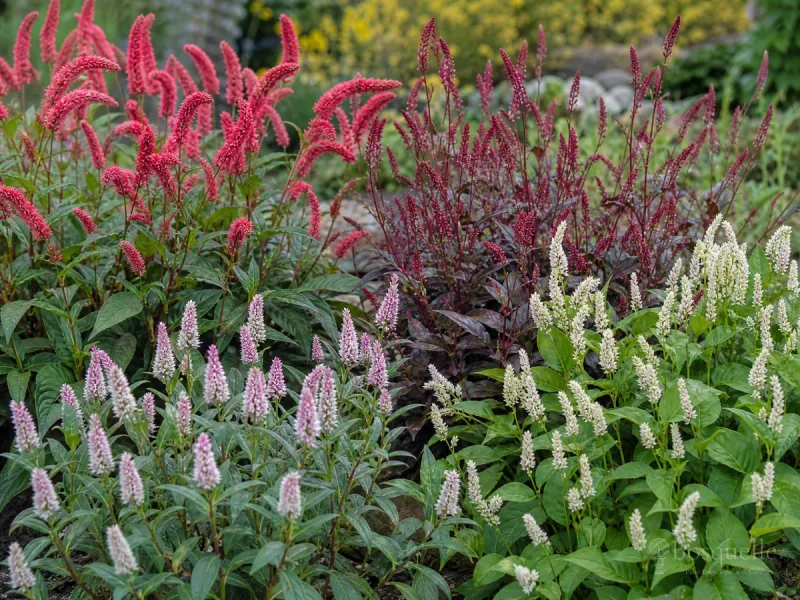
Recommended plants

References
- [1] NC State Extension Gardener -
https://plants.ces.ncsu.edu/plants/bistorta-amplexicaulis/ - [2] Fine Gardening -
https://www.finegardening.com/plant/bistort-persicaria-amplexicaulis - [3] Royal Horticultural Society -
https://www.rhs.org.uk/plants/513837/bistorta-amplexicaulis-firetail/details - [4] Chicago Botanic Garden -
https://www.chicagobotanic.org/sites/default/files/2023-12/FG183_Persicarias%20Deserve%20Your%20Love.pdf
This note is part of Persicaria Guides.
More first-season notes by plant are gathered in How to Grow Guides.
Updated: Reviewed by Bosquelle Editors