
Grow partridge pea in full sun, in soil that drains. It is also sold as prairie senna, sleepingplant, or sensitive plant. It is not the tropical houseplant and not wild senna.
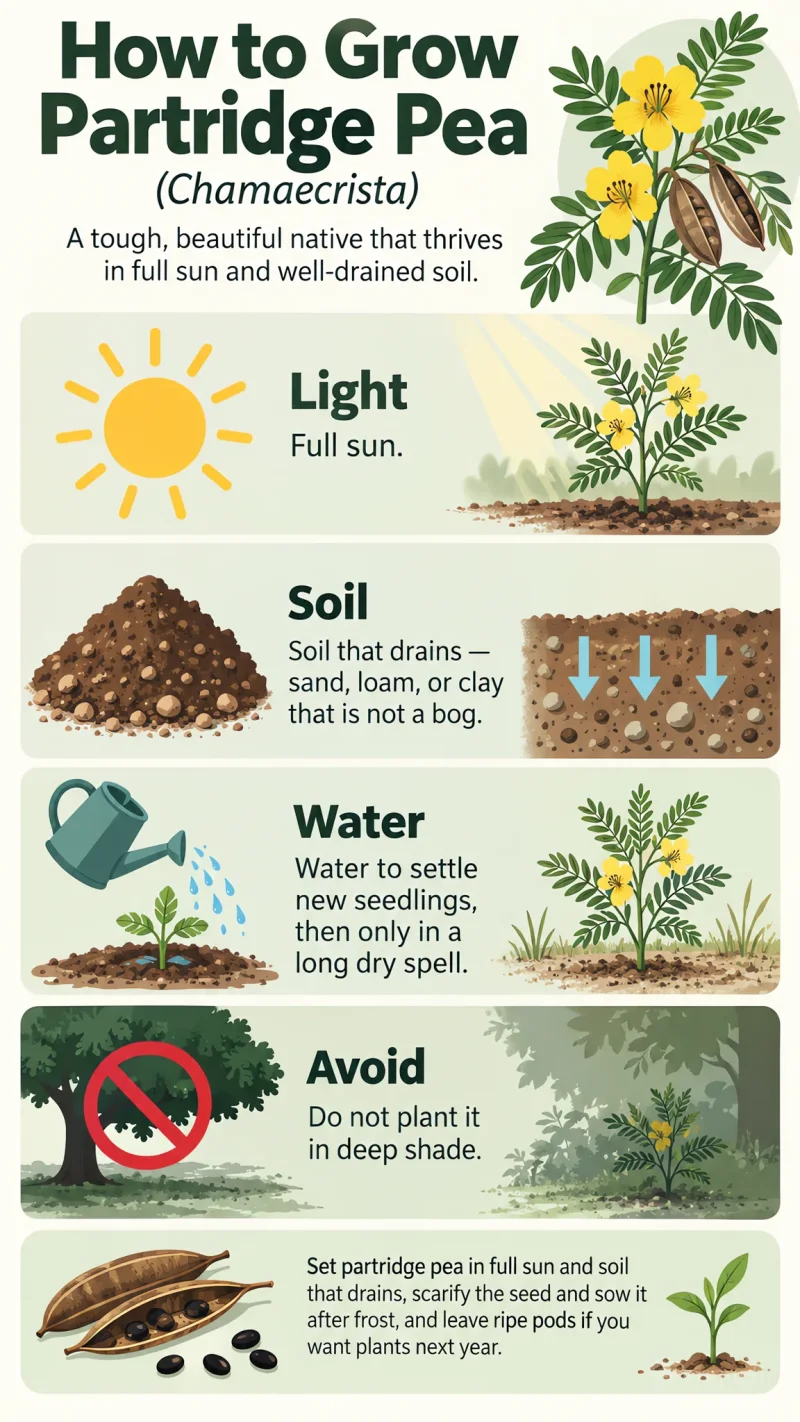
Give it full sun and soil that drains, and water only in a long dry spell
| Factor | Recommended | Avoid |
|---|---|---|
| Light | Full sun | Do not plant it in deep shade |
| Water | Water to settle new seedlings, then only in a long dry spell | Do not keep the roots soggy |
| Soil | Soil that drains — sand, loam, or clay that is not a bog | Do not plant it in a wet low spot |
| Habit | Annual, about 1 to 3 ft; leaflets fold when touched | Do not treat it as a perennial senna shrub |
| Come-back | Let ripe pods drop if you want plants next year | Do not deadhead every pod if you want it back |
Partridge pea wants open sun and soil that drains at once. A wet low spot rots the roots, because this native annual lives in dry meadows and sandy fields, not in a bog. [1] partridge pea uses that site as many small leaflets and yellow flowers about an inch across. Stems reach about 1 to 3 ft, and taller plants sprawl.
How much sun does partridge pea need?
Give it full sun. It may live in some shade, but flowers stay fewer there.
How wet should the soil stay?
Water to settle new seedlings, then only in a long dry spell. Soggy soil around the roots is the usual cause of rot.
Scarify the seed and sow after frost
Plant after the last frost, once the soil has warmed. Nick or scrape the hard seed coat, or soak the seed until it swells, then sow it about a quarter inch to three-quarters of an inch deep in soil that drains. [2] Fall sowing on open ground lets weather work the coat, so you can skip the nick. Seed is the usual start.
- Wait until after the last frost, in soil that has warmed.
- Nick or scrape the hard seed coat, or soak the seed until it swells.
- Sow it about a quarter inch to three-quarters of an inch deep in soil that drains.
- Water to settle the soil, then let it dry except in a long dry spell.
How do I plant partridge pea?
Nick or soak the seed, then sow it after frost about a quarter inch to three-quarters of an inch deep in soil that drains.
Let the pods drop if you want plants next year
This is an annual. Frost kills the plant. Next year's patch comes from seed that dropped, not from a living crown. [3] Leave ripe pods on the stems if you want seedlings. Pull extras in spring if the patch is thicker than you need.
- Let the narrow pods turn brown and split, so seed drops nearby.
- Leave those stems through fall if birds will use the seed.
- Pull extra seedlings in spring if the patch is thicker than you need.
- Do not treat it as a perennial senna that returns from the crown.
Will partridge pea come back next year?
The plant dies after frost. It comes back if ripe pods dropped seed. Leave the pods if you want a patch next year.
Not the houseplant sensitive plant — and not wild senna
A tag that says sensitive plant is often Mimosa, a tropical houseplant with leaves that snap shut when you touch them. Partridge pea is Chamaecrista: an outdoor annual with yellow flowers and leaflets that fold more slowly. [4] See How to Grow Sensitive Plant.
Wild senna is Senna, a hardy perennial three to six feet tall with the same yellow five-petal look — see How to Grow Wild Senna. Golden cassia on a spice label is cinnamon, not this meadow annual — see How to Grow Cinnamon Tree. Sensitive partridge pea is a smaller wild species with flowers about half an inch across, not a second kind of this shop plant.
Is this the same as a sensitive plant?
No. The houseplant sold as sensitive plant is Mimosa. Partridge pea is a native annual for a sunny meadow.
Is this the same as wild senna?
No. Wild senna is a hardy perennial three to six feet tall. Partridge pea is an annual about one to three feet tall that dies after frost.
Set partridge pea in full sun and soil that drains, scarify the seed and sow it after frost, and leave ripe pods if you want plants next year.
FAQ
Can I grow partridge pea in a pot?
You can, in a pot with a hole and mix that drains, in full sun. Let the mix dry between waterings. It is happier in open ground once it is rooted.
Can I grow it indoors?
No. Indoor pots sold as sensitive plant are almost always Mimosa. Partridge pea is a native outdoor annual.
Can I start it from a cutting?
No. Start it from seed. Nick or soak the seed and sow it after frost.
Is there more than one partridge pea?
Chamaecrista fasciculata is the plant here. Sensitive partridge pea is a smaller wild species with flowers about half an inch across, not a second kind on this list.
Can livestock eat a lot of it?
Cattle that eat a lot of the foliage can get an upset stomach. Grow it for the meadow and the birds, not as forage.
Recommended plants
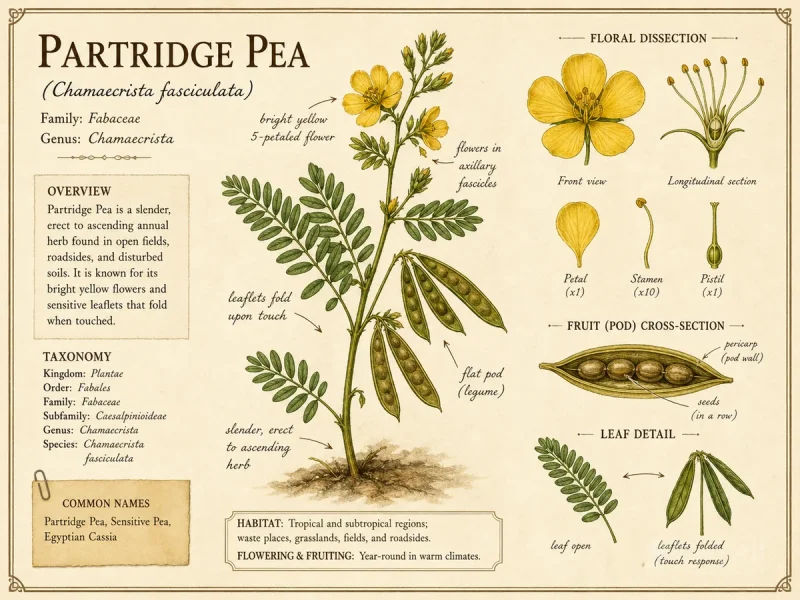
References
- [1] NC State Extension -
https://plants.ces.ncsu.edu/plants/chamaecrista-fasciculata/ - [2] NRCS Plant Guide -
https://plants.sc.egov.usda.gov/DocumentLibrary/plantguide/pdf/pg_chfa2.pdf - [3] Lady Bird Johnson Wildflower Center -
https://www.wildflower.org/plants/result.php?id_plant=chfa2 - [4] Missouri Department of Conservation -
https://mdc.mo.gov/discover-nature/field-guide/showy-partridge-pea
More first-season notes by plant are gathered in How to Grow Guides.
Updated: Reviewed by Bosquelle Editors