
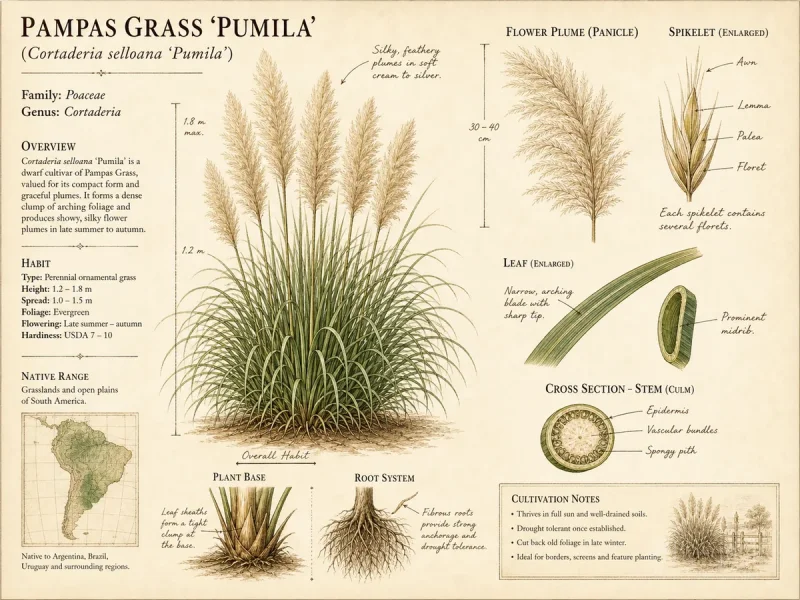
Grow pampas grass in full sun on soil that drains, with room away from buildings. Shops also list dwarf pampas for ‘Pumila’. Cut the clump to the ground in late winter, and wear gloves.

Full sun, soil that drains, and space away from buildings
| Factor | Recommended | Avoid |
|---|---|---|
| Light | Full sun — at least a half day of direct light | Deep shade that thins the clump and weakens plumes |
| Soil | Ground that drains after rain; sand, loam, or improved clay | A low wet pocket that keeps the crown soggy |
| Water | Even moisture the first season, then drier | Constant wet once the clump is established |
| Site | A specimen or backdrop well away from walls, decks, and wood fences | Dry foliage packed against a building — it is a fire hazard |
| Law | Check county or state rules before you buy, especially in the West | Planting where Cortaderia is restricted because a tag says sterile |
| Size | Dwarf ‘Pumila’ for a 4 to 7 foot clump; full-size selloana only where a large mound fits and rules allow it | A species plant in a small bed, or a dwarf treated like a giant |
Pampas grass wants full sun and soil that drains. Give it a half day of direct light at least, and keep the clump off walls and wood structures because dry foliage carries a high fire rating. [1] Leaf edges are razor-serrated, so site it off a play edge and a path you brush past. [2] Once roots take, the plant handles drought, salt spray, and heat. [3] Water through the first dry season, then taper. Cortaderia selloana is invasive in parts of the western United States, including California and Hawaii. Extension guidance in the Southeast often treats it as less of a weed there — still check local rules before you plant. In a cold-margin winter, a light mulch after the ground freezes helps a young crown; a pot you can move is safer where the clump will not overwinter in the ground.
How much sun does pampas grass need?
Full sun is best — at least a half day of direct light. Deep shade thins the clump and weakens the plumes.
Is pampas grass invasive?
Yes in parts of the western United States, notably California and Hawaii, and in other flagged counties. Check local rules before you plant. A sterile tag is not a free pass.
When does pampas grass bloom?
Late summer into fall, with plumes that can hold into winter. Timing shifts with heat and moisture.
What is Cortaderia selloana ‘Pumila’?
A dwarf pampas selection — usually about 4 to 7 feet of foliage with creamy plumes. It still has sharp leaves, and it is not fully seed-free.
Cut to the ground in late winter — wear gloves
Cut last year's foliage before new shoots rise. The leaf margins slice skin, so treat the job as a gloved cut, not a bare-hand tidy-up.
- Wait until late winter, before new growth hardens.
- Wear gloves, long sleeves, and eye protection. Do not grab handfuls of blades bare-handed.
- Cut the clump close to the ground with hedge shears or a powered cutter.
- Rake the cut thatch away from buildings. Do not burn the clump in place as a cleanup shortcut.
When do you cut back pampas grass?
Late winter, before new shoots rise, cutting the clump close to the ground. Wear gloves, long sleeves, and eye protection.
Are pampas grass leaves sharp?
Yes. Serrated margins cut unprotected hands. Wear gloves and long sleeves every time you cut or move the clump.
Not this pampas — jubata grass, fountain grass, and dyed stems
- Jubata grass (Cortaderia jubata) is a more aggressive Cortaderia. Plumes sit higher above the tussock and run pink to violet; it sets seed freely. [4]
- Fountain grass (Pennisetum) is a finer bottlebrush, not a pampas tussock.
- Maiden grass (Miscanthus) has a white midrib on the leaf. Pampas does not.
- Dyed purple or red craft stems are décor. Living pampas plumes are creamy, silvery, or a soft pink blush — not a craft-store dye job.
A vase of dyed plumes is not a care recipe for a living clump. If the tag says fountain grass or maiden grass, that is a different genus.
Is purple pampas a live plant?
Often those listings are dyed dried stems. Live Cortaderia plumes are creamy, silvery, or lightly pink — not a craft dye.
Is pampas the same as jubata grass?
No. Jubata grass is Cortaderia jubata, a more aggressive species with taller pink-violet plumes and free seed. Garden pampas here is C. selloana.
If a new clump sits against a wall, move it onto open ground that drains — do not wait for dry foliage to sit on the siding.
FAQ
Can I grow pampas grass in a pot?
Yes in a deep, sturdy pot with drainage holes, in sun. Use it on a cold margin or to limit spread. The pot will be heavy, and you still need the late-winter cut.
What else can I plant nearby?
Pair it with large sun perennials or an evergreen screen that will not be swallowed in year two. Leave a path so you can cut the clump without fighting neighbors.
What pests hit pampas grass?
Usually few insects. Rot is wet soil, not a spray job. Sharp leaves cut skin — that is the usual injury, not a bug.
Do we list Gold Band or Pink Feather as extra kinds?
No. Those are other nursery names on the species. We list dwarf Pumila. Variegated or pink-plume forms are not extra catalog cards here.
Is ‘Pumila’ fully sterile?
No. It is often sold as sterile or nearly sterile, but it can set some viable seed. If Cortaderia is restricted where you live, choose another grass.
Related guides

Recommended plants
References
- [1] UGA Extension -
https://fieldreport.caes.uga.edu/publications/C983/pampas-grass/ - [2] NC State Extension Gardener -
https://plants.ces.ncsu.edu/plants/cortaderia-selloana/ - [3] Texas Tech Plant Resources -
https://www.depts.ttu.edu/plantresources/Pages/directories/landscape-info-sheets/herbaceous-info/Cortaderia_selloana.php - [4] California Invasive Plant Council -
https://www.cal-ipc.org/resources/library/publications/ipcw/report35/
This note is part of Cortaderia Guides.
More first-season notes by plant are gathered in How to Grow Guides.
Updated: Reviewed by Bosquelle Editors