
Grow olive in full sun in soil that drains. It is Olea europaea, also sold as common olive or European olive.
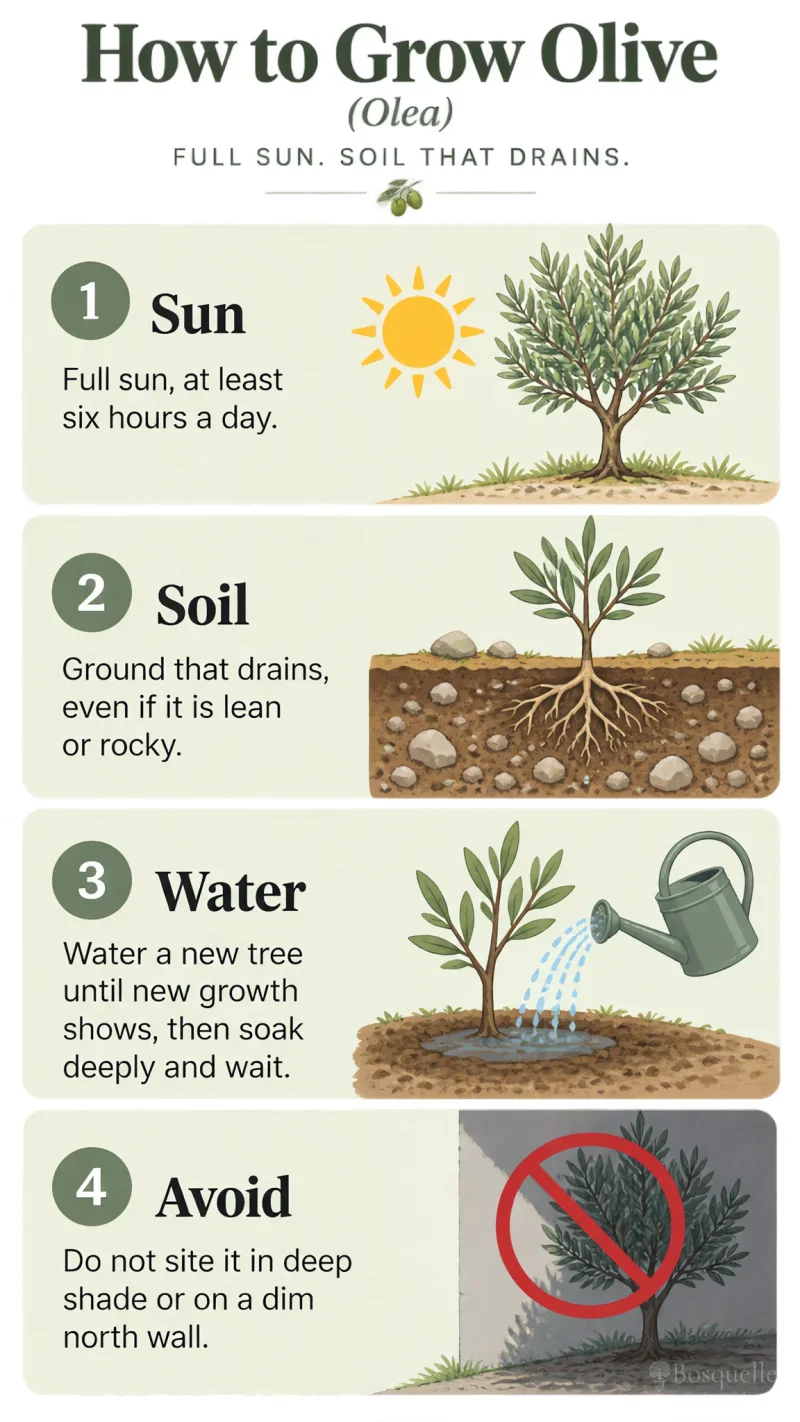
Give it full sun and soil that drains
| Factor | Recommended | Avoid |
|---|---|---|
| Sun | Full sun, at least six hours a day | Do not site it in deep shade or on a dim north wall |
| Soil | Ground that drains, even if it is lean or rocky | Do not plant in a low spot that holds rain |
| Water | Water a new tree until new growth shows, then soak deeply and wait | Do not keep the crown wet, and do not pin a drip head against the trunk |
olive wants a hot, bright site and ground that water can leave. Six hours of sun keeps the canopy dense. A dim corner makes a thin tree that does not set fruit. [1] Soggy soil around the roots is the usual cause of root rot. Sand, loam, or even clay can work if water runs through. A lawn that stays wet after rain is a poor bed. [2] Set a nursery tree after frost on Planting Olive. If a hard freeze will hit the bed, grow it in a pot you can move on Olive in Pots.
How much sun does an olive tree need?
Full sun, at least six hours. Shade makes a thin tree that rarely crops.
Water it while it is young, then let dry spells pass
Water a newly planted tree often enough that the nursery ball never turns to dust, especially in heat, so roots can leave the can. Once new shoots show, switch to a deep soak and then wait until the soil has dried. An established tree takes dry spells better than a week of standing water. [3] Yellow leaves on a tree that sits wet usually start at the roots, not at a missed feeding. Keep mulch a few inches off the trunk so bark stays dry.
How often should I water an olive tree?
Keep a new tree moist until it puts on growth. After that, soak deeply and wait. A pot dries faster than a bed.
Not tea olive — and not oleander or Russian olive
olive is a fruiting evergreen with opposite silvery leaves and a fleshy drupe. Tea olive is How to Grow Osmanthus, a perfume shrub with tiny flowers and no kitchen fruit. Oleander is How to Grow Oleander, a toxic shrub with leaves in threes. Russian olive and autumn olive are How to Grow Oleaster, often thorny, with alternate silver leaves. Desert olive is How to Grow Forestiera. Mexican olive is How to Grow Geiger Tree. [4] If the tag says tea olive, oleander, or Russian olive, you have a different plant.
Is tea olive the same as an olive tree?
No. Tea olive is Osmanthus. This plant is Olea, the tree that bears olives.
Give it full sun and soil that drains, water it while it is young, then let dry spells pass, and do not buy tea olive or oleander for this tree.
FAQ
Is common olive the same as olive?
Yes. Common olive, cultivated olive, and European olive are shop names for the same Olea europaea tree.
Is a fruitless olive a different plant?
No. Fruitless landscape kinds are still this species. They skip the messy crop. They are not tea olive.
Do I need two olive trees for fruit?
Many kinds set some fruit alone, but a second compatible kind nearby usually sets a heavier crop. Wind moves the pollen.
Can I press oil at home from this tree?
Home oil is kitchen work. Grow the tree first, then pick the fruit on Harvesting Olives.
Related guides


Recommended plants
References
- [1] NC State Extension -
https://plants.ces.ncsu.edu/plants/olea-europaea/ - [2] University of Florida IFAS -
https://edis.ifas.ufl.edu/publication/EP515 - [3] Gardeners Path -
https://gardenerspath.com/plants/fruit-trees/grow-olive-trees/ - [4] Texas A&M AgriLife Extension -
https://mytexas.ag.tamu.edu/publications/olives-texas-fruit-and-nut-production/
This note is part of Olea Guides.
More first-season notes by plant are gathered in How to Grow Guides.
Updated: Reviewed by Bosquelle Editors