
Grow monkshood in cool moist soil with afternoon shade in heat. Wear gloves. The tag may also say Aconitum. It is not winter aconite.
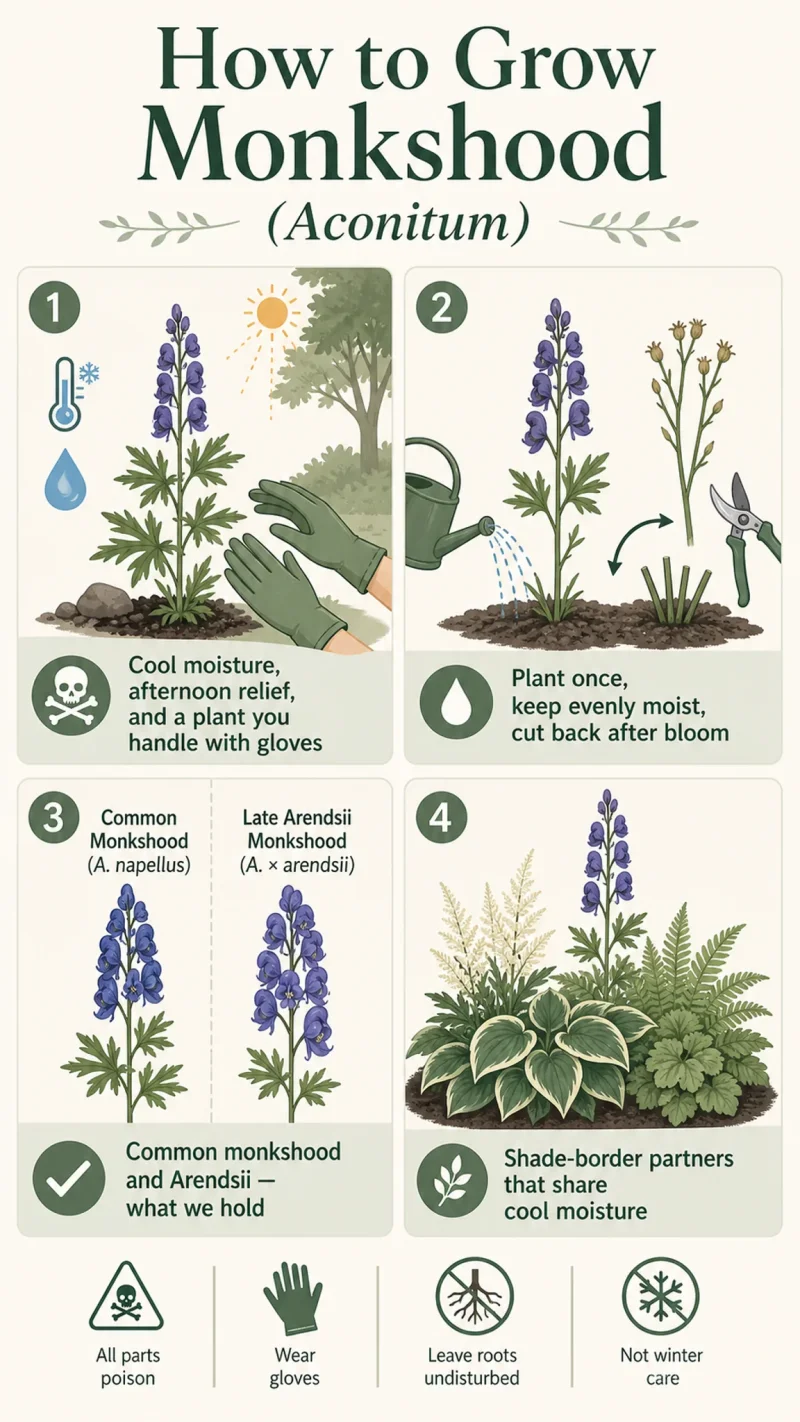
Give it cool moist soil, afternoon shade in heat, and gloves
| Factor | Recommended | Avoid |
|---|---|---|
| Light | Morning sun and afternoon shade in heat. Cool-summer gardens can take more sun if the soil stays moist | All-day south heat on dry ground |
| Soil | Humus-rich, evenly moist soil that still drains | Dusty dry beds, or a swampy crown that sits wet |
| Water | Keep the root zone evenly moist while the plant is in leaf | Letting a new clump bake dry, then flooding the crown |
| Handling | Gloves for every cut, divide, or plant-out. Keep tubers off edible beds | Vegetable rows, unlabeled roots, or bare-hand sap on cuts |
| Clump | Plant once and leave established plants in place | Yearly digging, or treating the tubers like a food crop |
Monkshood is a cool-summer perennial. Humus-rich soil that stays moist and still drains is the site. In the southern part of its range, give it afternoon shade. [1] All parts are poisonous, roots and seeds especially. Wear gloves. Do not plant it in the vegetable garden — fleshy tubers have been mistaken for Jerusalem artichokes. [2] Tops die back in winter. That rest is normal, not a failed evergreen.
Does monkshood need shade?
Afternoon shade in heat, yes. Cool-summer gardens can give it more sun if the soil stays evenly moist. Deep shade thins bloom.
Is it safe to touch monkshood?
Wear gloves for planting, dividing, and cut-back. Brushing a leaf is not the same as eating a tuber. Wash sap off skin and tools.
Is monkshood poisonous?
Yes. All parts are poisonous, roots and seeds most of all. Keep it off edible beds and away from pets that chew plants.
Should I plant monkshood in my garden?
Yes, if you can give cool moist soil, afternoon shade in heat, and gloves — and you will not put the tubers in a vegetable row.
How tall does monkshood get?
Usually 2 to 4 feet of upright stems. Taller spikes may need a stake in wind.
Pair it with other cool-shade plants
Partners should want the same cool moisture and afternoon relief: ferns, hostas, and other woodland-edge perennials you can still reach with gloves. Leave a path so you are not brushing the clump every time you water the bed.
Plant the crown just under the soil, then leave the clump
Plant in fall or spring from a nursery start or a tuber. Set the crown just under the soil surface. Wear gloves. Site it off edible beds. Established clumps resent a move — roots are brittle and slow to settle. [3]
- Confirm garden monkshood (Aconitum), not winter aconite bulbs and not a delphinium start.
- Put gloves on before you open the pot or handle a tuber.
- Pick cool, humus-rich ground that stays moist and drains, with afternoon shade in heat, away from vegetables.
- Dig a hole no deeper than the pot. Set the crown just under the soil surface.
- Backfill with the soil you dug, and water to settle.
- Mulch the root zone, keeping mulch off the stems.
- Keep the soil evenly moist through the first seasons. Leave the clump in place once it takes.
How do you plant monkshood?
Fall or spring. Crown just under the soil. Gloves on. Off the vegetable row. Then leave it.
When should I plant monkshood?
Fall or spring, while roots can take before summer heat or hard freeze.
Can I transplant monkshood?
Avoid it. Established clumps are slow to recover. If you must move one, do it in fall or spring with gloves, and expect a sulk.
Start from seed only if you can wait
Seed is slow. A nursery plant is the usual home job. If you sow, expect a long wait before the first hooded spike. [4]
- Buy a nursery start unless you enjoy a long seed wait.
- If you sow, keep the mix evenly moist and be ready to wait more than one season for a plantable clump.
- Do not treat a seed packet as a same-season spike.
Skip a patio pot except as a nursery hold
Open ground wins. If you must hold a young plant briefly, use a deep pot that drains, keep the mix evenly moist, and plant it out while it is still small. A patio bowl is not a long-term home.
Can I grow monkshood in a pot?
Only as a short nursery hold. Plant it into cool moist ground as soon as you can.
Divide only if you must — roots are brittle
Leave established clumps. Division is possible in fall or spring, but recovery is slow. Wear gloves. Do not split a happy plant for extra starts.
- Skip division unless the clump is failing or you must move it.
- If you divide, work in fall or spring with gloves. Keep each piece with shoots and a tuber, and replant at the same shallow crown depth.
- Water in, and expect a slow return to bloom.
Cut back after bloom, and stake floppy stems
After the spikes fade, cut the spent stalks to encourage a second flush. Tall stems may need a stake in wind, especially on common monkshood. Wear gloves for every cut.
- When the first flush fades, cut spent stalks. Leave the basal foliage until frost blackens it.
- If stems leaned last year, set a stake or a ring while new growth is still short.
- In late fall or early spring, cut dead tops to the ground. Wear gloves and bag the trimmings — do not add them to a salad-bed compost you will spread on vegetables.
Do I need to stake monkshood?
Stake the taller, thinner stems in wind. Later, stiffer selections often stand without a cane.
Should I cut monkshood back after bloom?
Yes. Cut spent stalks after the first flush. Leave green basal leaves until they die back.
Not winter aconite, delphinium, or hellebore
Winter aconite is Eranthis, a low yellow buttercup that blooms in late winter from a tuber. Garden monkshood is a tall summer-to-fall hooded spike. Do not copy winter-aconite bulb care onto this plant.
Delphinium, or larkspur, is a different buttercup cousin with similar blue spikes. Hellebore, or Lenten rose, is a winter-to-spring shade plant with nodding cups. Monkshood is neither. Read the Latin on the tag before you copy either recipe.
Is monkshood the same as winter aconite?
No. Winter aconite is Eranthis. Monkshood is Aconitum. One is a late-winter groundling; the other is a tall summer hood.
Is monkshood a delphinium?
No. Delphinium is a different plant. The spikes can look related from a distance, but the care and the poison story are not a copy-paste.
Is monkshood a hellebore?
No. Hellebore is Helleborus, the Lenten rose. Monkshood is Aconitum.
Common monkshood or later Arendsii
Culture is the same cool moisture and gloves. Bloom time is the choice. Do not treat a shop list of extra names as a different plant.
A. napellus is common monkshood — mid to late summer hooded racemes, usually 2 to 4 feet. A. carmichaelii ‘Arendsii’ blooms later, often into autumn, on thicker stems that usually need less staking.
When does monkshood bloom?
Common monkshood is typically mid to late summer. Arendsii is later, often autumn. Same cool moist soil for both.
Is Arendsii a different plant?
It is a later monkshood on the same cool-moist, gloves-on contract. Thicker stems often stand without a stake.
Set it in cool moist ground with afternoon shade, plant the crown just under the soil, leave the clump, cut spent stalks after bloom, and read the tag so you did not buy winter aconite.
FAQ
Is wolfsbane a different plant?
No. Wolfsbane is another common name for garden monkshood. Read the Latin so you did not buy winter aconite or delphinium.
Is aconite a different plant?
Aconite is another name for this genus. Winter aconite is a different plant (Eranthis).
What is Aconitum?
Aconitum is the Latin genus for garden monkshood.
Is Album a plant we hold?
No. Extra shop whites use the same cool moist soil and gloves. This page covers common monkshood and Arendsii.
Is monkshood deer resistant?
Often left alone by deer and rabbits. That is not a reason to skip gloves or to plant it in a vegetable row.
Is monkshood a medicine plant?
Do not eat it or brew it. All parts are poisonous. Garden culture is the job here, not a dose.
Recommended plants


References
- [1] NC State Extension -
https://plants.ces.ncsu.edu/plants/aconitum/ - [2] University of Arkansas Division of Agriculture -
https://www.uaex.uada.edu/yard-garden/resource-library/plant-week/aconitum-napellus-monkshood-wolfsbane-05-13-2016.aspx - [3] University of Illinois Extension -
https://web.extension.illinois.edu/hortanswers/PlantDetail.cfm?PlantID=699&PlantTypeID=2 - [4] University of Saskatchewan -
https://gardening.usask.ca/articles-and-lists/articles-plant-descriptions/perennials/monkshood.php
More first-season notes by plant are gathered in How to Grow Guides.
Updated: Reviewed by Bosquelle Editors