
Grow marsh St. John's wort in wet ground with part sun or light shade. The catalog plant is Virginia marsh St. Johnswort.
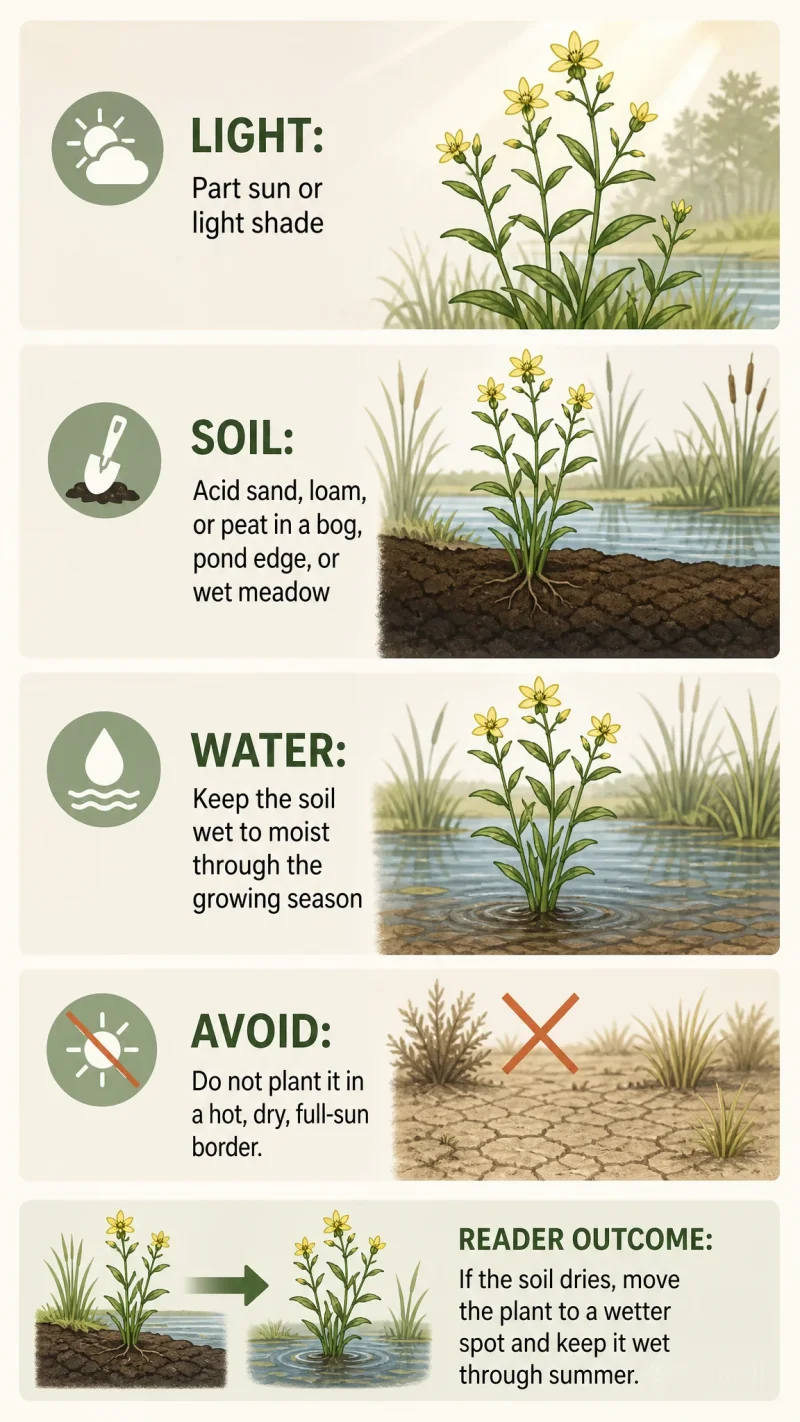
Keep the soil wet, and give it part sun
| Factor | Recommended | Avoid |
|---|---|---|
| Light | Part sun or light shade | Do not plant it in a hot, dry, full-sun border |
| Water | Keep the soil wet to moist through the growing season | Do not let the soil dry out |
| Soil | Acid sand, loam, or peat in a bog, pond edge, or wet meadow | Do not plant it in a drained perennial bed |
| Feed | Skip extra fertilizer in peaty, nutrient-poor ground | Do not treat it as a rich border perennial |
This plant grows in wetlands. Keep the soil wet to moist in a bog, along a pond, or in a wet meadow, and give it part sun or light shade. [1] [2] Virginia Marsh St. Johnswort is Triadenum virginicum, about 1 to 2 feet tall, with opposite leaves that clasp the stem and pink flowers in mid to late summer. It spreads by rhizomes and by stolons. The top dies back in winter, then the plant returns from those rhizomes. A tub works if you keep the mix wet; it is not a windowsill houseplant. [3]
Does marsh St. John's wort need wet soil?
Yes. Keep the soil wet to moist in a bog, pond edge, or wet meadow. Do not let it dry out.
Does it want sun or shade?
Give it part sun or light shade. A hot, dry, full-sun border is the wrong home.
Pair it with other wetland plants
Set it with other plants that stay wet, such as turtlehead, cardinal flower, and pickerelweed.
Leave the stems through winter, then cut them in spring
The plant is winter-dormant. Leave the dead stems until new growth shows, then cut them.
- Leave the stems in place through winter. The plant comes back from the rhizomes.
- Cut the dead stems in spring after new growth shows at the crown.
Do I cut marsh St. John's wort back in fall?
Leave the stems through winter. Cut the dead stems in spring after new growth shows.
Set the crown in wet ground in spring
Plant in spring when the soil is wet and workable. Set the crown at the same level as it grew in the pot, so the paired leaves sit at the surface. [4]
- Set the crown at pot depth. Do not bury the paired leaves.
- Space plants about a foot apart so the rhizomes can spread.
- Water deeply after planting, and keep the soil wet while it settles.
When do I plant marsh St. John's wort?
Plant in spring when the soil is wet and workable. Set the crown at the same depth as the pot.
Lift a rhizome to start more plants
In spring, lift a clump and replant a rooted piece of rhizome at the same depth in wet ground.
- Dig a rooted piece of rhizome in spring.
- Replant it at the same depth in wet soil.
- Keep that piece wet while it settles.
Sow the tiny seed on the surface in fall
The seed is small. Sow it on the surface of wet ground in late fall, and do not bury it. Keep that surface wet until plants show in spring. Germination can be slow and uneven.
- Collect seed from the dry capsules when they split.
- Sow it on the surface of wet ground in late fall. Do not cover it.
- Keep the surface wet until seedlings show in spring.
Can I grow marsh St. John's wort from seed?
Yes. Sow the tiny seed on the surface of wet ground in late fall, and do not bury it. Keep that surface wet. Germination can be slow.
Not yellow St. John's wort — and not marsh marigold
Most St. John's wort at a garden center is a yellow-flowered Hypericum for drained ground — see How to Grow St. John's Wort. This plant has pink flowers and lives in a marsh. Marsh marigold is a yellow spring wetland plant — see How to Grow Marsh Marigold. Culver's root is Veronicastrum virginicum, a tall spike, not this herb — see How to Grow Culver's Root. Do not make tea or oil from this plant. Those recipes use common St. John's wort, a different species.
Is this the same as yellow St. John's wort?
No. Yellow landscape St. John's wort is Hypericum for drained ground. This plant has pink flowers and needs wet soil.
Is this marsh marigold?
No. Marsh marigold is a yellow spring wetland plant. This one blooms pink in mid to late summer.
If the soil dries, move the plant to a wetter spot and keep it wet through summer.
FAQ
Is Hypericum virginicum the same plant?
Yes. Hypericum virginicum is the older name for Triadenum virginicum, Virginia marsh St. Johnswort. It is not yellow landscape St. John's wort.
Is there more than one marsh St. John's wort?
This catalog holds Virginia marsh St. Johnswort, Triadenum virginicum. Related marsh species exist in the flora. Give any of them wet ground and part sun.
Can I make tea or oil from this plant?
No. Tea and oil recipes use common St. John's wort, a different species. Do not harvest this marsh plant for that.
Is this Culver's root?
No. Culver's root is Veronicastrum virginicum, a tall spike. This plant is a short wetland herb with pink flowers.
Can I grow marsh St. John's wort as a houseplant?
No. Keep it outdoors in wet ground. A tub works only if you never let the mix dry.
Recommended plants

References
- [1] Go Botany / Native Plant Trust -
https://gobotany.nativeplanttrust.org/species/triadenum/virginicum/ - [2] Florida Native Plant Society -
https://www.fnps.org/plant/triadenum-virginicum - [3] Lady Bird Johnson Wildflower Center -
https://www.wildflower.org/plants/result.php?id_plant=TRVI2 - [4] Digital Atlas of the Virginia Flora -
https://vaplantatlas.org/index.php?do=plant&plant=2495
More first-season notes by plant are gathered in How to Grow Guides.
Updated: Reviewed by Bosquelle Editors