
Grow majesty palm in bright indirect light, keep the mix moist, and raise the humidity. Majesty palm is Ravenea rivularis, also sold as majestic palm. It is not an areca palm.

Give it bright indirect light, keep the mix moist, and raise the humidity
| Factor | Recommended | Avoid |
|---|---|---|
| Light | Bright indirect light; a little morning sun is fine | Do not stand it against hot afternoon glass, and do not leave it in a dark corner |
| Water | Soak the pot when the top inch of mix is dry, then empty the saucer; never let the root ball go bone-dry | Do not leave the pot standing in water |
| Humidity | About 50 percent or more; a pebble tray or a humidifier | Do not set it in the blast from a heater or an air conditioner |
| Warmth | A warm room, about 65 to 85 F, away from drafts | Do not set it in a cold draft |
majesty palm is Ravenea rivularis, a solitary feather palm from Madagascar riverbanks. Shops sell it for rooms, but it wants more moisture and more humid air than parlor palm or kentia, so it declines in a dim, dry pot. [1] Put it in the brightest spot that does not scorch the leaflets. An east window, or a few feet back from a south or west window, is the usual home. It will live for a while in lower light, but new fronds come slowly, the mix stays wet longer, and the plant thins out. [2] Soak the pot when the top inch of mix feels dry, let the extra run out, then dump the saucer. Do not wait until the whole root ball is dry, because this palm came from stream edges and the leaflets brown from the tip down when the mix goes dry. In winter the plant uses less water, so wait a little longer, but still do not let it go dry to the bottom. Brown leaflet tips are often dry heat, hard tap water, or fertilizer salt, not a cue to leave the pot sitting in a saucer. [3] Aim for humid air around the fronds. A pebble tray, a bathroom with a bright window, or a room humidifier works better than a daily mist. Feed lightly two or three times in spring and summer with a palm or balanced fertilizer, then stop in fall. Wipe dust off the fronds with a damp cloth so they can use the light they get. If you have frost-free ground outdoors, the plant-out is on Planting Majesty Palm. [4]
How much light does majesty palm need?
Bright indirect light. A little morning sun is fine. Hot afternoon glass scorches the fronds, and a dark corner leaves a thin, wet plant.
How often do I water majesty palm?
Water when the top inch of mix is dry, then empty the saucer. Do not let the root ball go bone-dry, and do not keep the pot wet all the time. Water a little less in winter.
Why are the leaflet tips brown?
Usually dry indoor air, a root ball that went dry, or salt from tap water and fertilizer. Raise the humidity, keep the mix evenly moist, and trim only the brown tissue. The brown tips will not turn green again.
Should I bring it in for winter?
If the pot spent the summer outside, bring it in before nights stay near 50 F. Indoors, keep it in the brightest room, raise the humidity, and water a little less.
Plant it in a pot with a hole, and repot only when it is root-bound
Most people start with a nursery plant. Move it into a pot with a drainage hole so extra water can leave and the mix can still stay evenly moist. The roots are fragile, and this palm likes a snug pot, so do not size up until you have to.
- Choose a pot with a hole, only about two inches wider than the nursery pot.
- Fill it with a palm mix that holds moisture and still drains. Do not use a cachepot with no hole as the only pot.
- Set the root ball at the same depth it sat in the nursery pot, and handle the roots as little as you can.
- Water once to settle the mix, wait about half an hour, then empty the saucer.
- Wait until roots show at the hole, or the plant is unstable, before you size up again. That is often every two or three years.
How often should I repot majesty palm?
Only when roots come out of the hole or the plant rocks in the pot. Size up one pot at a time in spring. It does not like its roots disturbed.
Cut only fully brown or yellow fronds, and never the growing point
The crown grows from one point at the top of the trunk. If you cut that point, the palm will not put out a new top. Pruning is only cleanup of dead or dying fronds.
- Wait until a frond is fully brown or fully yellow. A frond that is only fading at the tips is still feeding the plant.
- Cut the stem close to the trunk with clean, sharp shears. Do not yank the base off, because that can tear the trunk.
- If only the leaflet tips are brown, trim the brown tissue and leave a thin brown edge. Do not cut into green tissue.
- Do not cut a green, healthy frond to shorten the plant, and do not cut the top of the trunk.
Can I prune majesty palm to keep it shorter?
No. Cutting the growing point kills the top. Cut only fully brown or yellow fronds at the base, and trim brown tips without cutting into green tissue.
Not an areca palm — and not a parlor palm or kentia
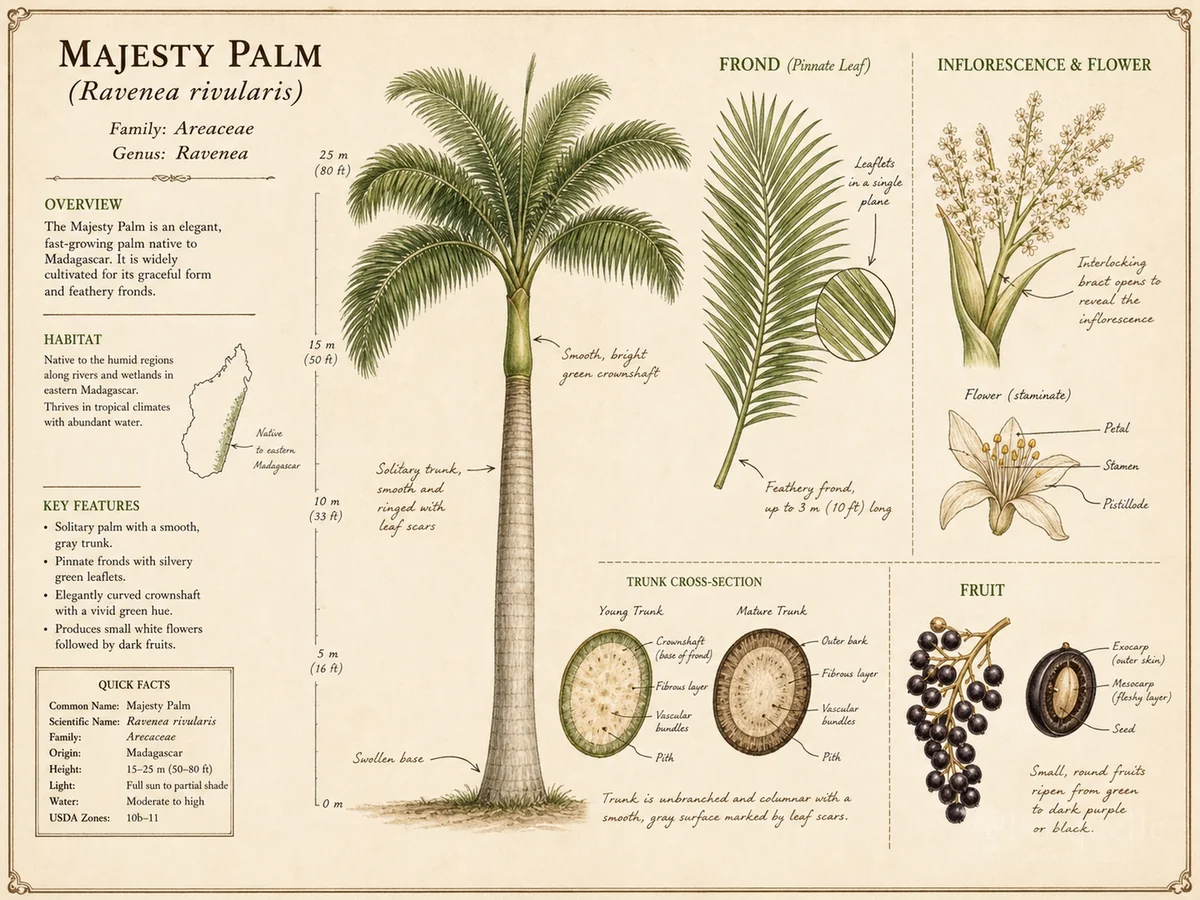
Areca palm is Dypsis, a clustering palm with many slender, yellowish stems and finer leaflets. Majesty is a thirstier, solitary palm with broader, arching fronds and one trunk, even when the shop pot holds several seedlings. If the tag says areca or golden cane, that is a different plant.
Parlor palm is Chamaedorea, a smaller indoor palm that takes lower light; if that is the tag, read How to Grow Parlor Palm. Kentia is Howea, a slower palm that forgives a missed watering better than this one; see How to Grow Kentia Palm. Pygmy date is Phoenix; see How to Grow Date Palm. Fishtail palm is Caryota; see How to Grow Fishtail Palm. Christmas palm is Adonidia; see How to Grow Christmas Palm. Alexandra palm is Archontophoenix; see How to Grow Alexandra Palm. Sago is a cycad, not a palm, and it is toxic if eaten. Do not treat a sago like this plant.
Is majesty palm the same as areca palm?
No. Areca palm is a clustering Dypsis with many yellowish stems. Majesty is a solitary Ravenea with broader, arching fronds, even when several seedlings share one pot.
If the fronds brown from the tips or the mix swings from dry to soggy, give it brighter indirect light, water when the top inch is dry, empty the saucer, and raise the humidity.
FAQ
Is there more than one kind of majesty palm?
Ravenea rivularis is the plant here, the usual majesty palm. Ravenea glauca is a slimmer sister species sometimes sold as mini-majesty. It is not in this catalog.
Why does my majesty palm have several stems in one pot?
Shops often pot three or more seedlings together so the pot looks full. It is not a suckering palm. Each stem is its own plant.
Is majesty palm toxic to pets?
It is listed as non-toxic to cats, dogs, and horses. Still keep pets from chewing the fronds, because any plant material can upset a stomach. Sago is a different, toxic plant.
Will it flower indoors?
Almost never. Outdoors a mature plant can make small yellowish-white flowers hidden in the foliage in spring and summer, then orange-red fruit.
Can I grow majesty palm from a cutting?
No. A cut frond will not root. The usual way to make more plants at home is to tease apart the extra seedlings in a shop pot in spring, if each has its own roots. Fresh seed is possible, but indoor plants rarely fruit.
Related guides
Recommended plants
References
- [1] NC State Extension -
https://plants.ces.ncsu.edu/plants/ravenea-rivularis/ - [2] New York Botanical Garden -
https://www.nybg.org/planttalk/how-to-keep-your-majesty-palm-looking-majestic/ - [3] Clemson Cooperative Extension -
https://hgic.clemson.edu/factsheet/indoor-palms/ - [4] Gardening Know How -
https://www.gardeningknowhow.com/ornamental/trees/majesty-palm-care
This note is part of Ravenea Guides.
More first-season notes by plant are gathered in How to Grow Guides.
Updated: Reviewed by Bosquelle Editors