
Grow lyonia as a native evergreen shrub in acid soil. Shining fetterbush wants a moist, shady bed; rusty staggerbush wants dry sun.
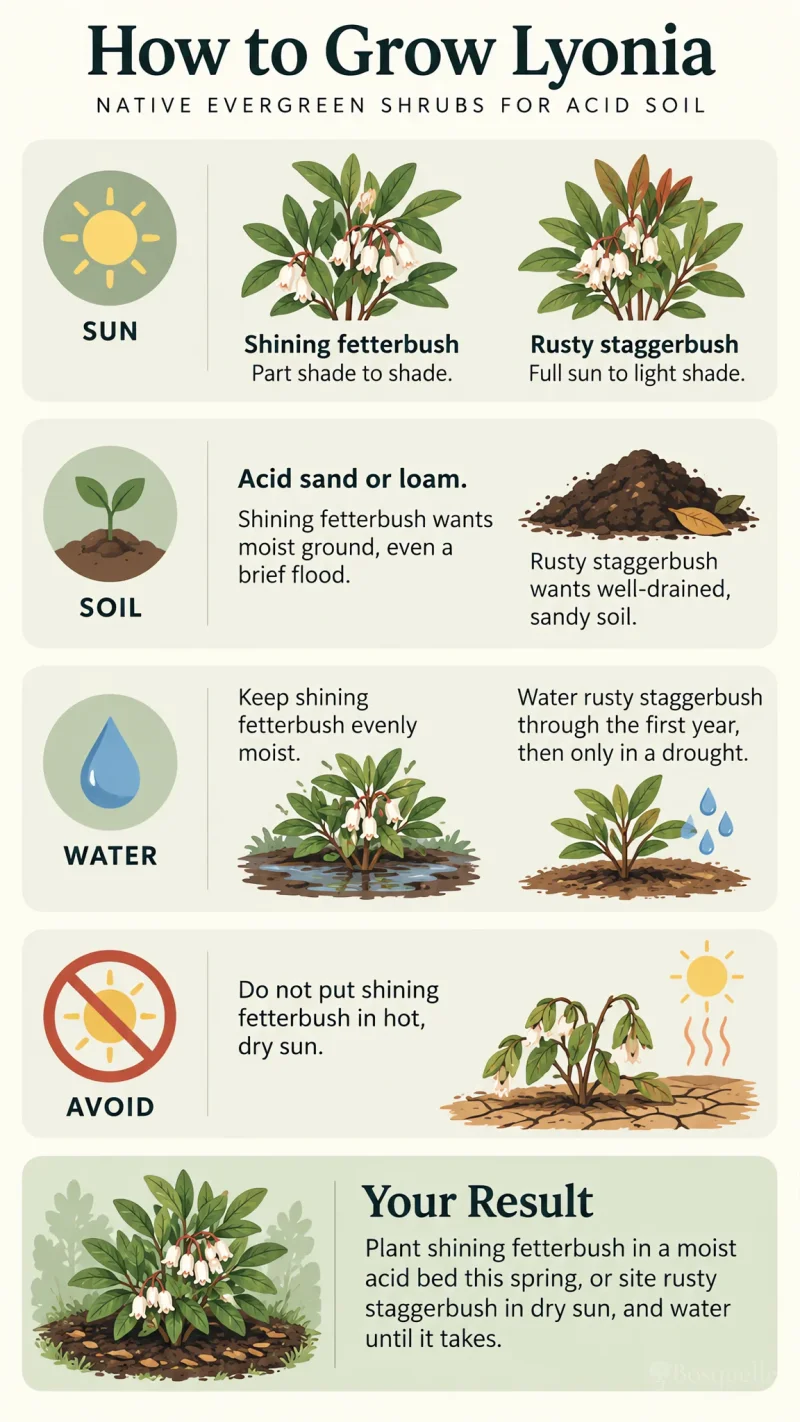
Give shining fetterbush moist shade, or rusty staggerbush dry sun
| Factor | Recommended | Avoid |
|---|---|---|
| Sun | Part shade to shade for shining fetterbush; full sun to light shade for rusty staggerbush | Do not put shining fetterbush in hot, dry sun |
| Soil | Acid sand or loam. Shining fetterbush wants moist ground, even a brief flood. Rusty staggerbush wants sand that drains | Do not add lime. Do not plant shining fetterbush in a dry alkaline bed |
| Water | Keep shining fetterbush evenly moist. Water rusty staggerbush through the first year, then only in a long drought | Do not run a lawn sprinkler on shining fetterbush. Do not keep rusty staggerbush soaked |
| Kind | Shining fetterbush for a three-to-six-foot wet hedge. Rusty staggerbush for a ten-to-twenty-foot dry-sun small tree | Do not give both plants the same watering |
| Feed | A pine-bark or leaf-mold mulch; keep mulch off the stems | Do not use lime or wood ash |
Match the kind to the water on the site. shining fetterbush wants even moisture in part shade, and it can take a brief flood in a rain garden. [1] rusty staggerbush wants full sun on sand that drains, and it holds a dry spell once the roots are down. [2] Both want acid soil. Lime yellows the leaves.
Does shining fetterbush need wet soil?
It wants soil that stays moist, and it can take a brief flood. Do not let a lawn sprinkler keep the crown soggy, and do not plant it in a dry alkaline bed.
Does rusty staggerbush need full sun?
Full sun to light shade. It is the dry-sun kind. Do not bury it in a wet, shady hole.
Do both kinds want the same watering?
No. Keep shining fetterbush evenly moist. Water rusty staggerbush through the first year, then only in a long drought.
Plant at the same depth as the pot, in spring or fall
Plant a container shrub in spring, or in fall if your winter is mild. Dig a hole about twice as wide as the root ball, and set the top of the root ball level with the soil. Too deep and the crown stays wet. Too high and the roots dry out. [3]
- Water the pot, then let it drain. Dig a hole about twice as wide as the root ball, on the site that matches the kind you bought.
- Set the plant so the top of the root ball sits level with the soil. Backfill, firm gently, and water well.
- Mulch around the shrub, not against the stems. Keep shining fetterbush moist until new growth shows. Water rusty staggerbush through the first year, then ease off.
When should I plant lyonia?
Plant in spring, or in fall if your winter is mild. Set the root ball at the same depth as the pot, and water until it is established.
Prune after the flowers fade
Urn-shaped flowers open in spring on last season's wood, so wait until they fade before you cut. Then thin crowded stems and shorten the shrub to the height you want. Do not shear it in late summer.
- Wait until the spring flowers fade. Do not cut in late summer, or you will remove next year's buds.
- Cut dead or crossing stems back to a live side shoot or to the ground.
- Shorten the remaining stems if you need a lower hedge or a smaller tree. Leave healthy green wood.
When should I prune lyonia?
After the flowers fade. Cut dead wood and shorten stems to the height you want. Do not shear in late summer.
Not doghobble, Japanese andromeda, or a houseplant dragon tree
Fetterbush is a shared nickname. If the tag says fetterbush and the leaves have a network of veins and a few teeth on the margin, you have doghobble — see How to Grow Leucothoe. Shining fetterbush has a smooth leaf margin and a raised midvein, with the side veins hard to see. [4]
Japanese andromeda is Pieris, another urn-flowered evergreen for acid shade — see How to Grow Japanese Andromeda. Mountain laurel is Kalmia — see How to Grow Mountain Laurel. If you searched for a houseplant dragon tree, you want Dracaena, not rusty staggerbush — see How to Grow Dracaena. Deciduous staggerbush and maleberry are other Lyonias we do not list. If the tag says lyonia and the leaves are evergreen, you still have this genus.
Is this doghobble?
No. Doghobble is Leucothoe. Its leaves have a network of veins and a few teeth. Shining fetterbush has a smooth margin and a raised midvein.
Is this a dragon tree?
No. A houseplant dragon tree is Dracaena. Rusty staggerbush is an outdoor native shrub or small tree with rusty scales on the leaf undersides.
Is this Japanese andromeda?
No. Japanese andromeda is Pieris. Lyonia is a southeastern native with either glossy wet-shade leaves or rusty leaf undersides.
How to start a new plant from a sucker or seed
Shining fetterbush and rusty staggerbush both send up suckers. In spring or fall, cut a rooted sucker from the parent, keep some roots on it, and replant it at the same depth. You can also sow fresh seed on the surface of a moist, acid mix in spring. Seedlings are slow.
- Choose a rooted sucker at the edge of the clump in spring or fall. Cut it free with a sharp spade, and keep roots on the piece.
- Replant at the same depth, water well, and keep the soil moist until new growth shows.
- To sow, scatter seed on a moist acid mix in spring. Do not bury it. Keep the mix moist until seedlings are large enough to pot on.
How do I start a new lyonia?
Lift a rooted sucker in spring or fall, or sow seed on the surface of a moist acid mix in spring. Cuttings are slower and less reliable than a sucker.
Plant shining fetterbush in a moist acid bed this spring, or site rusty staggerbush in dry sun, and water until it takes.
FAQ
Can I grow lyonia in a pot?
A large pot that drains can hold a young rusty staggerbush on a sunny patio for a year or two, if you use an acid mix. It wants to become a small tree in the ground. Shining fetterbush is happier in a moist bed than in a pot.
Is this poor-grub or maleberry?
No. Poor-grub and maleberry are other Lyonias we do not list. This page covers shining fetterbush and rusty staggerbush.
When does lyonia bloom?
Urn-shaped flowers open in spring, usually from March into early summer. Shining fetterbush can be pink, red, or white. Rusty staggerbush is usually white.
Is lyonia poisonous if eaten?
Yes. Leaves and flowers are toxic if eaten. Keep pets, children, and livestock from chewing the shrub.
Will rusty staggerbush stay a small shrub?
Not for long. It becomes a small tree, often ten to twenty feet, with a crooked trunk. Give it room, or keep shortening it after bloom.
Recommended plants


References
- [1] NC State Extension Gardener -
https://plants.ces.ncsu.edu/plants/lyonia-lucida/ - [2] Florida Wildflower Foundation -
https://www.flawildflowers.org/flower-friday-lyonia-ferruginea/ - [3] Lady Bird Johnson Wildflower Center -
https://www.wildflower.org/plants/result.php?id_plant=lylu3 - [4] N.C. Cooperative Extension -
https://craven.ces.ncsu.edu/news/what-is-fetterbush/
More first-season notes by plant are gathered in How to Grow Guides.
Updated: Reviewed by Bosquelle Editors