
Grow Ludwigia in full sun on wet mud or still water. Ludwigia is also sold as marsh seedbox and mosaic flower.

Keep it in full sun, on wet mud or still water that never dries
| Factor | Recommended | Avoid |
|---|---|---|
| Light | Full sun, about six hours or more | Do not site it in deep shade and expect compact red growth |
| Water | Wet mud, a bog, a pond margin, or still fresh water that never dries. Mosaic flower wants water around 72°F | Do not let the ground or the shelf dry, even once |
| Soil | Poorly drained loam, sand, or heavy pond loam that stays wet or floods | Do not plant it in a mix that dries in a day |
| Spread | Keep extras in a pond basket so the colony stays on your shelf | Do not toss scraps into a lake, ditch, or storm drain |
| Feed | A pond tablet under a rooted mosaic basket is enough | Do not dump nitrogen into a small pond and thicken algae |
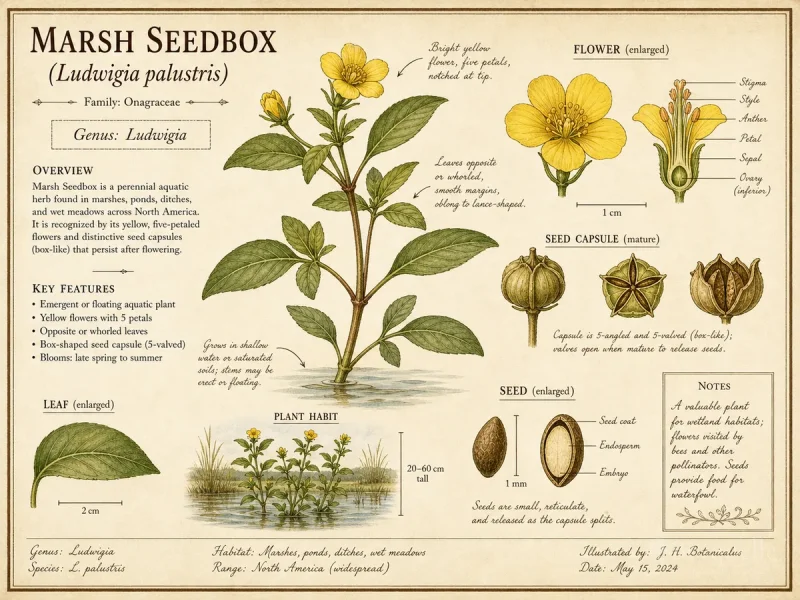
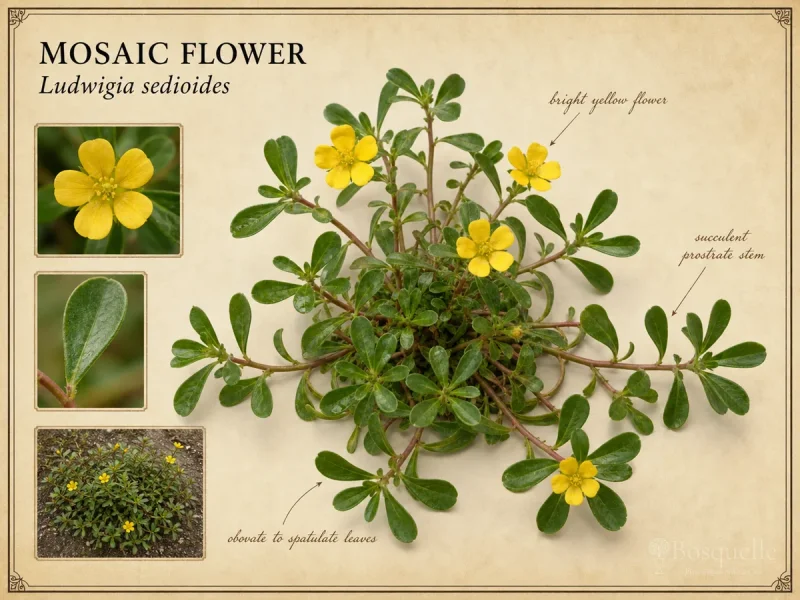
Ludwigia wants full sun and wet ground or still water. Heat is fine; a dry week is not. Give it loam or sand that stays wet along a pond, ditch, or bog, and the stems stay succulent instead of going crisp. [1] marsh seedbox uses that wet mud as a low creeping mat, with succulent stems that redden in sun and tiny flowers that have no petals. mosaic flower uses still, warm water so diamond-shaped leaves sit on the surface in a rosette. Both plants share the same need for wet. Neither one is a dry succulent or a windowsill houseplant. [2]
How much sun does Ludwigia need?
Give it full sun, about six hours or more. Deep shade stretches the stems and fades the red.
How wet does it need to stay?
Keep the ground or the shelf wet. Wet mud, a bog, or still fresh water around the stems is the home. Mosaic flower also wants water around 72°F. A dry week crisps the leaves.
Plant marsh seedbox on the mud, or mosaic flower in a basket
Read the tag before you plant. Marsh seedbox is the creeping kind: press the stems so the nodes touch wet mud, or set them under a few inches of clear water. Mosaic flower is the floating kind: root it in a pond basket of heavy loam with the crown at the soil, then sink the basket under about six to eighteen inches of still water, or let a rooted piece float. [3] Waves and fish will break mosaic stems, so a sheltered shelf is safer than open water.
- For marsh seedbox, plant into wet mud, a bog, or a pond shelf once the water will stay up.
- Press the stems so the nodes touch the mud. Keep a few inches of clear water over them, not a deep drop-off.
- For mosaic flower, use a mesh pond basket and heavy loam or clay, not a light mix that floats. Set the crown at the soil line.
- Sink that basket under about six to eighteen inches of still water, or float a rooted piece on a calm shelf. Keep the water around 72°F.
How do I plant marsh seedbox vs mosaic flower?
Press marsh seedbox onto wet mud or under a few inches of water. Root mosaic flower in a heavy-loam basket under about six to eighteen inches of still, warm water, or float a rooted piece.
Thin the mats, and never dump extras in a lake
The stems root wherever they touch wet mud, and mosaic rosettes can cover a small pond. Lift what leaves the basket before it fills the shelf. Compost extras on dry ground. Never toss them into a lake, ditch, or storm drain, because a scrap about as long as a fingernail will root.
- Lift runners or rosettes that leave the basket or the wet bed as soon as they wander.
- Cut dense mats so they do not cover the whole pond.
- Compost extras on dry ground, or bag them for the trash. Do not dump them in a lake or storm drain.
Will it take over a small pond?
Yes, if you plant it loose. Keep extras in a pond basket, thin mats that cover the water, and never dump scraps in a lake.
Split a rooted stem or a mosaic rosette
Most gardeners start a new patch from a rooted stem, not from seed. For marsh seedbox, lift a piece in spring while the mud is wet. For mosaic flower, cut a floating rosette and leave a short piece of stem attached; a new rosette forms on the parent stem.
- Lift a rooted marsh-seedbox stem in spring while the mud is wet and workable, or cut a mosaic rosette with a short piece of stem.
- Keep at least one leaf on the piece, and keep the cut wet.
- Replant marsh seedbox on wet mud, or set the mosaic piece to float or in a fresh basket of heavy loam, and keep it wet while it takes.
Not garden purslane — and not a nerve plant or evening primrose
A shop tag that says water purslane is often this plant, but garden purslane is Portulaca, a dry, hot-bed succulent — see How to Grow Moss Rose. Marsh seedbox has tiny flowers with no petals and lives in wet mud. [4]
A tag that says only mosaic plant is often the nerve plant, Fittonia, a humid houseplant with veined leaves, not a floating pond rosette. Evening primrose is Oenothera, a dry-bed plant in the same family — see How to Grow Evening Primrose. False loosestrife on a pond tag is still Ludwigia; garden loosestrife is Lysimachia — see How to Grow Lysimachia. Showy yellow water primrose in a lake is usually Ludwigia peploides or hexapetala, not marsh seedbox. Do not plant those in a natural waterway, and do not dump pond extras there.
Is this the same as garden purslane?
No. Garden purslane is Portulaca for hot, dry beds. Marsh seedbox is Ludwigia for wet mud, and its flowers have no petals.
Is mosaic plant a houseplant?
The houseplant sold as mosaic plant is usually Fittonia, the nerve plant. Mosaic flower is Ludwigia for still, warm pond water.
Lift mosaic flower before the water turns cold
Marsh seedbox is a hardy wet-mud plant. Mosaic flower is tropical. When pond water falls much below about 70°F, mosaic growth stalls, and below about 65°F the rosettes die. Lift the basket before that cold snap, or treat mosaic flower as an annual and buy a new piece in spring.
- Watch the water, not the calendar. When it cools toward 70°F, lift mosaic flower.
- Move the basket into a bright indoor tub or a large aquarium of about 72°F water, with the crown still under several inches of water, or compost the plant and start again in warm weather.
- Leave marsh seedbox in the wet mud. After a freeze the top may brown, and new stems come from the nodes in spring if the mud stayed wet.
Do I lift it for winter?
Lift mosaic flower before the water turns cold, or treat it as an annual. Marsh seedbox can stay in wet mud through winter if the ground does not dry.
Set Ludwigia in wet sun, plant marsh seedbox on the mud or mosaic flower in a basket, and keep extras out of the lake.
FAQ
Is mosaic flower a different plant?
Mosaic flower is Ludwigia sedioides, the floating diamond-leaf rosette. Marsh seedbox is Ludwigia palustris, the creeping wet-mud mat. Use wet sun for both. Mosaic flower also needs still, warm water.
Can I grow Ludwigia in a pot?
Yes, if the mix stays wet. Stand a pot in a tray of water, or set a pond basket on a shelf. A mix that dries in a day crisps the leaves. Mosaic flower still wants several inches of warm water over the crown.
Can I grow it in an aquarium?
Marsh seedbox is sold as a stem plant for tanks, but pond and bog culture outdoors is the usual garden job. Mosaic flower is a poor indoor plant because it wants strong light and warm water over the crown.
Can I grow it from seed?
Marsh seedbox can come from seed, but most gardeners plant a rooted stem. Mosaic flower is started from a rosette cutting. Shop seed packets are often the wrong plant.
Can I eat marsh seedbox?
Some extension cards list marsh seedbox leaves as edible. Garden purslane is Portulaca, a different plant. Do not treat a ditch scrap as a salad green.
Will fish break mosaic flower?
Koi and goldfish can snap the brittle stems. Mosaic flower is safer on a sheltered shelf without fish. It is not known to be toxic.
Recommended plants
References
- [1] NC State Extension Gardener -
https://plants.ces.ncsu.edu/plants/ludwigia-palustris/ - [2] NC State Extension Gardener -
https://plants.ces.ncsu.edu/plants/ludwigia-sedoides/ - [3] Pond Informer -
https://pondinformer.com/mosaic-plant-ludwigia-sedioides/ - [4] Texas A&M AgriLife AquaPlant -
https://aquaplant.tamu.edu/plant-identification/alphabetical-index/water-primrose/marsh-seedbox/
More first-season notes by plant are gathered in How to Grow Guides.
Updated: Reviewed by Bosquelle Editors