
Grow lilac hibiscus in full sun, on soil that drains, and water it until it is established. Lilac hibiscus is Alyogyne, not a garden hibiscus.

Give it full sun, soil that drains, and water until it is established
| Factor | Recommended | Avoid |
|---|---|---|
| Light | Full sun for the most flowers; inland afternoon shade is fine in a hot garden | Do not tuck it in deep shade, where it opens up and blooms less |
| Soil | Sand, loam, or clay that drains; lime is fine | Do not plant it in a hole that stays wet |
| Water | Water a new shrub until it is established, then only in a long dry spell | Do not keep the soil wet once the plant is established |
| Wind | A site with some shelter from strong wind | Do not use a tall open shrub as the first line of a windbreak |
| Frost | A short dip to about 25°F; the plant may resprout from the ground | Do not count on it through a long freeze |
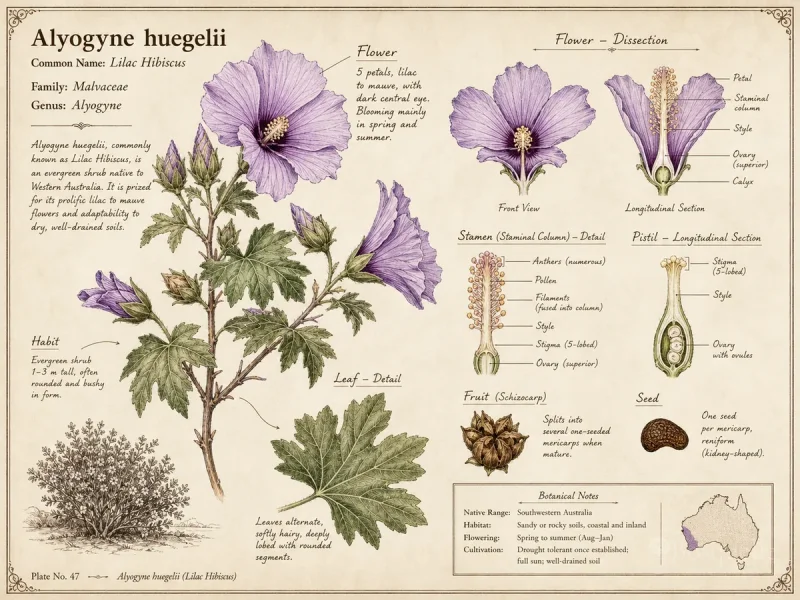
Lilac hibiscus wants full sun and a hole that still drains. Water a new shrub until it is established, then ease off. An established plant takes missed water better than a wet hole, and it keeps better bloom with an occasional soak only in a long dry spell. [1] lilac hibiscus is Alyogyne huegelii, a fast evergreen about 4 to 8 feet tall and wide. Some selections run taller, to about 10 feet. In a hot inland garden, afternoon shade is fine. [2]
- Choose full sun and soil that drains. A wet pocket is the usual reason stems die back from the ground up.
- Water a new shrub until it is established. After that, water only in a long dry spell.
- Give some shelter from strong wind so the open frame does not snap.
Does lilac hibiscus need full sun?
Yes. Full sun gives you the most flowers. Afternoon shade is fine inland in a hot garden, but deep shade opens the shrub and cuts bloom.
How often should I water lilac hibiscus?
Water a new shrub until it is established, then only in a long dry spell.
Will a freeze kill it?
A short dip to about 25°F may burn the top and the plant can resprout from the ground. A long freeze often kills it. In a colder garden, treat it as a summer shrub, not as a houseplant.
How long does each flower last?
Each flower opens in the morning and lasts about one day. The shrub keeps opening new ones from spring into fall, so the show does not stop with a single bloom.
Plant in a hole that drains, and leave room for a large shrub
Plant in spring, or in fall where winters stay mild. Set the root ball even with the surrounding soil, and leave room so a 4-to-8-foot shrub can open without sitting in a wet pocket.
- Dig a hole as deep as the root ball and about twice as wide. Loosen circling roots.
- Set the top of the root ball even with the surrounding soil. Do not bury the stems.
- Leave about 6 feet of room, more if the tag points to a large selection.
- Water in, then keep mulch a few inches off the stems so the crown stays dry. Choose a spot with some shelter from strong wind.
How far apart do I plant lilac hibiscus?
Leave about 6 feet, more for a large selection. Do not pack it into a wet hole.
After the main flowers, prune hard — it reshoots from old wood
After the main flush, prune hard. Lilac hibiscus sends new shoots from old wood, so you can keep it compact. If you skip pruning, the lower limbs go sparse and the shrub looks open at the base. [3]
- Wait until the main spring-to-summer flush has finished.
- Cut back hard into old wood if the shrub is open at the base, or tip the shoots lightly during the season for a denser mound.
- Do not skip pruning for years. An open, woody frame still reshoots, but it looks thin until the new growth fills in.
When do I prune lilac hibiscus?
After the main flowers finish. Cut hard if the shrub is sparse at the base. It reshoots from old wood, so a hard cut is how you keep it compact.
How to take a cutting
Nurseries start named kinds from cuttings, and a home cutting is a reliable way to copy a shrub you already like. Seed comes up without a special soak, but a named kind will not come true. [4]
- Take a half-hardened tip about 3 inches long during the growing season.
- Strip the leaves from the lower part of the stem.
- Push the stripped end into a mix that drains.
- Keep the mix barely moist, in bright light out of hot direct sun, until roots form.
- Pot the rooted cutting, then plant it out once it is growing.
Can I grow lilac hibiscus from a cutting?
Yes. Take a half-hardened tip about 3 inches long, strip the lower leaves, and stick it in a mix that drains. Named kinds do not come true from seed.
Not a garden hibiscus — and not Rose of Sharon
A tag that says hibiscus may be tropical hibiscus or Rose of Sharon, which are Hibiscus. Lilac hibiscus is Alyogyne, an Australian evergreen for a dry, draining bed. It used to be sold as Hibiscus huegelii, and that old name still shows up. Rose of Sharon kinds such as Blue Bird and Blue Chiffon are deciduous and hardy; they are not this evergreen. Flowering maple is Abutilon. See How to Grow Hibiscus and How to Grow Flowering Maple.
Is lilac hibiscus a hibiscus?
No. Lilac hibiscus is Alyogyne. Garden hibiscus and Rose of Sharon are Hibiscus. Blue Bird and Blue Chiffon are Rose of Sharon, not this evergreen.
Set lilac hibiscus in full sun, on soil that drains, water it until it is established, prune hard after the main flush, and leave garden hibiscus to the hibiscus bed.
FAQ
Can I grow lilac hibiscus in a pot?
Yes, for a few seasons in a large pot with a drainage hole. It is still an outdoor shrub. Move it into the ground before it outgrows the pot, or treat it as a summer plant where winters stay below a short 25°F dip.
Do you list Santa Cruz or West Coast Gem?
This catalog holds lilac hibiscus (Alyogyne huegelii). Santa Cruz, West Coast Gem, White Swan, and red-centered hakeifolia are extra names, not extra cards here. They want the same sun and the same dry interval.
Will a named kind come true from seed?
Seed comes up without a special soak, but seedlings vary. Start a named kind from a cutting if you want the same flower.
Recommended plants
References
- [1] San Marcos Growers -
https://www.smgrowers.com/products/plants/plantdisplay.asp?plant_id=129 - [2] Boething Treeland Farms -
https://www.boethingtreeland.com/plants/alyogyne-huegelii/ - [3] Australian National Botanic Gardens -
https://anbg.gov.au/gnp/gnp6/aly-hueg.html - [4] Australian Plants Society NSW -
https://resources.austplants.com.au/plant/alyogyne-huegelii/
More first-season notes by plant are gathered in How to Grow Guides.
Updated: Reviewed by Bosquelle Editors