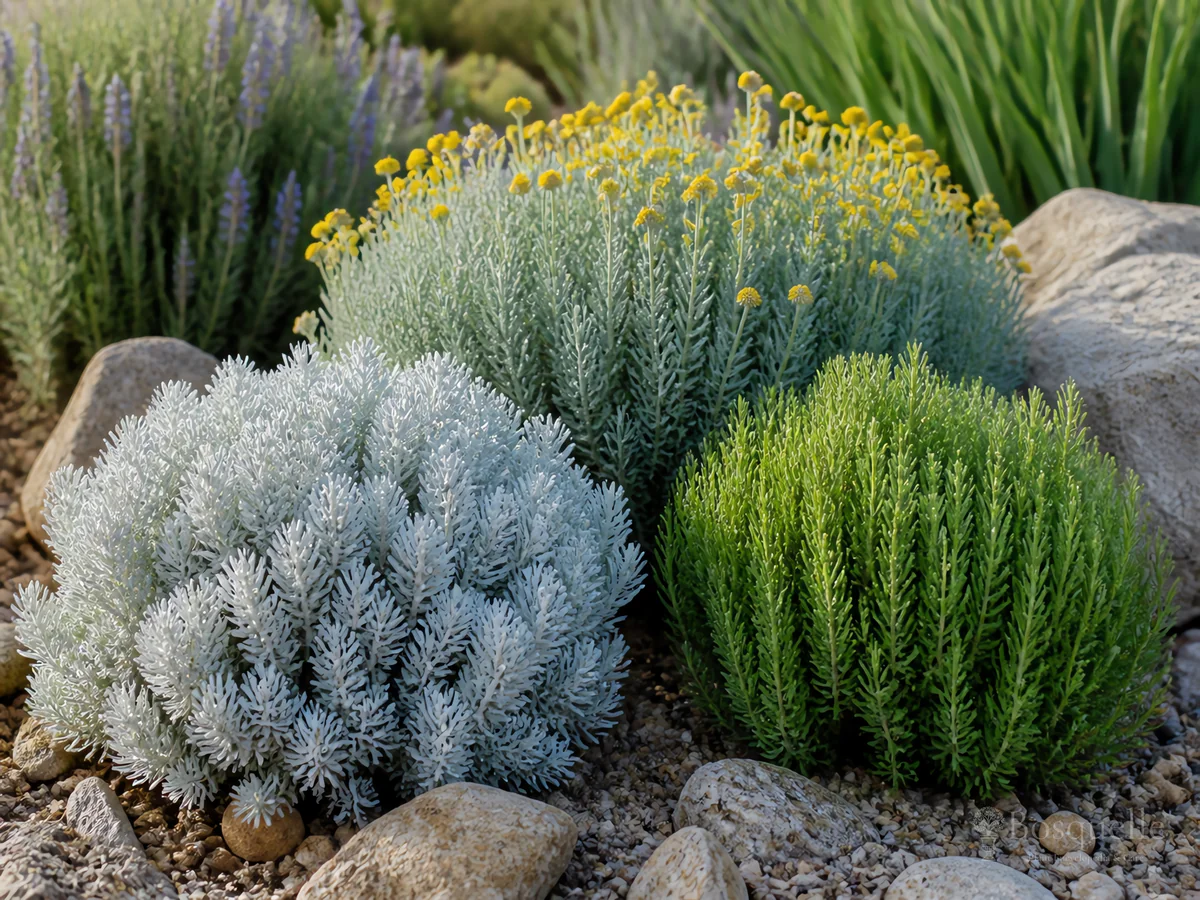
Give lavender cotton full sun and soil that drains, then keep it on the dry side after the first year. Lavender cotton is also called cotton lavender, or Santolina. It is not lavender, and it is not French lavender.
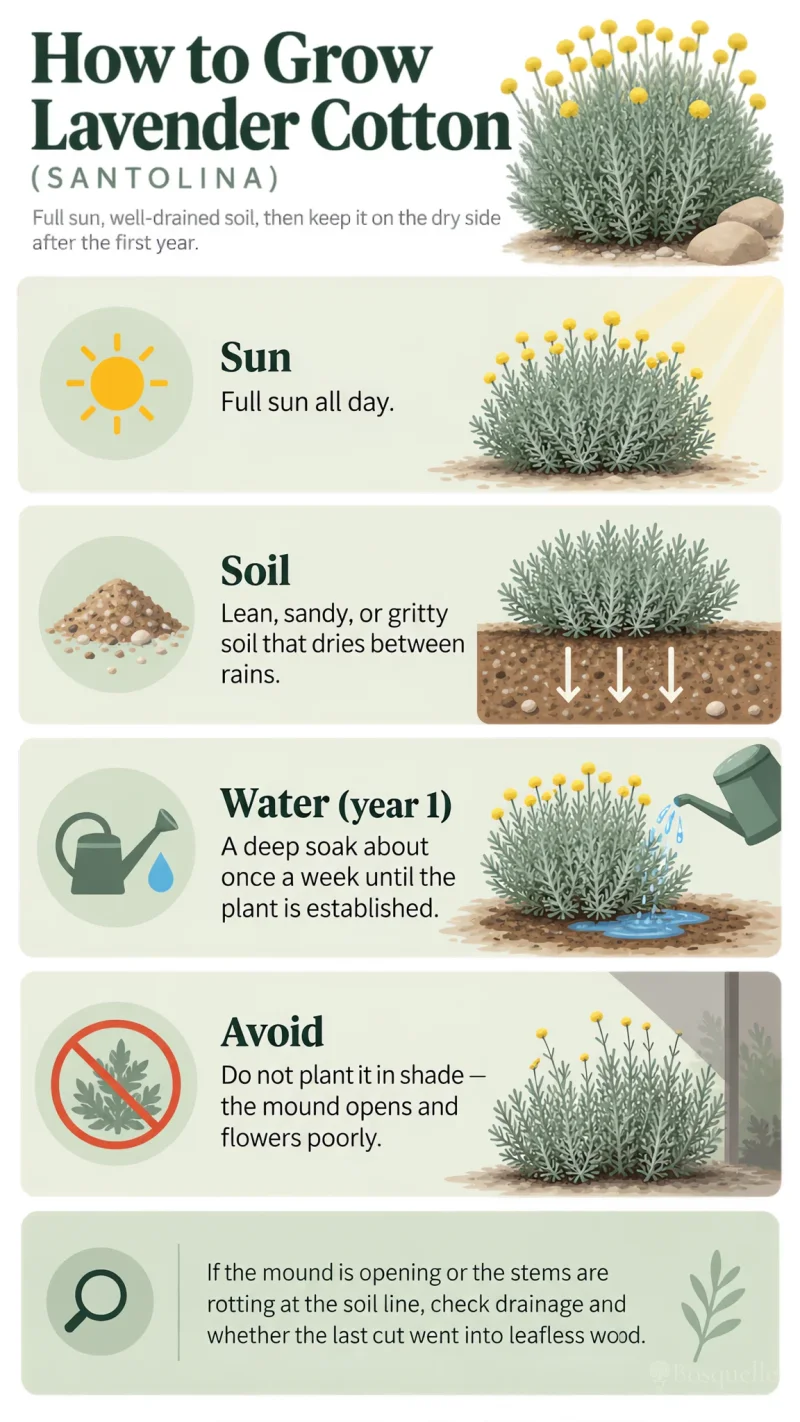
Give it full sun and lean soil that drains, and water the first year
| Factor | Recommended | Avoid |
|---|---|---|
| Sun | Full sun all day | Do not plant it in shade — the mound opens and flowers poorly |
| Soil | Lean, sandy, or gritty soil that dries between rains | Do not leave it in heavy clay that stays wet, or pile rich compost on the crown |
| Water (year 1) | A deep soak about once a week until the plant is established | Do not water a little every day, and do not leave standing water at the crown |
| Water (established) | Infrequent deep soaks in a hot, dry summer — about twice a month | Do not run regular summer irrigation — wet soil in heat causes root rot |
| Fertilizer | None; poor soil is what this plant wants | Do not feed it on a schedule — soft growth splits in the middle |
| Mulch | Coarse gravel around the crown | Do not pack bark or compost against the stems |
| Hardiness | Zones 6–9 for gray and green kinds; rosemary-leaved santolina is safer in Zone 8–10 | Do not site it in a wet winter frost pocket on unimproved clay |
| Deer and rabbits | Usually left alone because the foliage is aromatic | Do not treat that as a guarantee in a hungry winter |
Root rot from wet soil is the usual reason a plant dies. Lavender cotton comes from sandy Mediterranean hillsides, so rain should run through, not sit. On clay, mix horticultural grit into the backfill, or use a raised bed. Water regularly through the first growing season, then cut back. For more drought-tolerant planting ideas, see Drought-Tolerant Plants. [2]
Does lavender cotton need watering once it is established?
Rarely. After the first year, water deeply only in a long dry spell — about twice a month in hot summers. Wet soil in summer is what kills it.
Why didn't my lavender cotton come back after winter?
Cold, wet soil around the roots is the usual cause, not ordinary frost. Raise the bed or add grit so winter rain does not sit on the crown.
How to plant lavender cotton
Plant in spring where winters are cold, so roots settle before wet, freezing weather. In a mild-winter garden, fall planting is fine if the bed drains.
- Choose the sunniest, driest spot you have. A south- or west-facing bed or a gravel strip is better than a lawn that stays wet.
- Loosen the soil. On sand, leave it unamended. On clay, dig a hole about twice as wide as the root ball and mix the backfill with horticultural grit. Do not add fertilizer.
- Set the plant at the same depth it sat in the pot. Do not bury the crown — a buried stem rots at the soil line.
- Space plants about 18 to 24 inches apart so air can move through the mounds as they fill in.
- Water in well, then mulch with gravel kept off the stems. Keep up weekly soaks through the first season.
Grow it in a pot that drains
A pot works when the mix stays lean and the holes stay clear. Unglazed terracotta dries faster than plastic, which helps in a rainy climate. This is an outdoor plant — it is not a houseplant.
- Use a pot at least as wide as the root ball, with open drainage holes. Elevate it so water can run out.
- Fill a gritty mix — cactus mix, or potting mix cut with sand or perlite. Do not use garden soil or a moisture-holding houseplant mix.
- Water when the top of the mix is dry. In winter, keep the mix almost dry so cold and wet do not rot the roots.
- In a climate colder than Zone 6, move the pot to an unheated garage, cold frame, or bright frost-free spot for the hardest weeks, then bring it back out after the last hard frost.
Shear after it flowers, and do not cut into old wood
The mound stays tight only if you cut it every year. Skip that, and the center opens onto bare, woody stems that rarely leaf out again. You can cut hard in mid-spring, and you can tidy after the yellow buttons fade — but every cut must stay in green growth that still has leaves or visible buds. [4]
- In mid-spring, when new shoots are starting, cut the mound back by about half. Stop where the stem is still green and budded. Do not cut into dark, leafless wood at the base.
- After the summer flush, clip spent flower stalks as low as you can, then lightly shear the whole plant to a rounded shape.
- If you grow it as a low hedge, shear once or twice a year the same way — always above green buds, never below them.
- Do not renovate a neglected plant by cutting it to the ground in one go. Take a few of the oldest stems back to green buds each year, or replace the plant from a cutting.
Why is the center of my lavender cotton opening up?
The plant got woody because it was not sheared. Cut this year’s green growth, and start a replacement from a cutting if the old mound is already bare in the middle.
Can I cut lavender cotton back into old wood?
No. Leafless old wood often does not resprout. Leave a sleeve of green tissue above the woody base.
How to start a new plant from a cutting
Lavender cotton is short-lived. When the center opens onto bare wood, a cutting is faster than trying to cut the old plant to the ground.
- In summer, take a three- to four-inch green stem that is starting to firm. In a mild-winter garden, a fall cutting also works if you can keep it barely moist and warm at the base.
- Strip the lower leaves. Leave a few at the tip.
- Stick the stem in a gritty mix that stays barely moist — cactus mix, or potting mix cut with sand. Do not keep it soggy, or the stem rots before it roots.
- Set the pot out of hot afternoon sun until new growth shows, then pot it on and plant it out the next spring.
Choose silver or green foliage before you buy
All three kinds want the same sun, drain, and shear. Buy for the color of the mound and for how cold your winters get, not for a different watering method.
| Kind | Foliage | What to know |
|---|---|---|
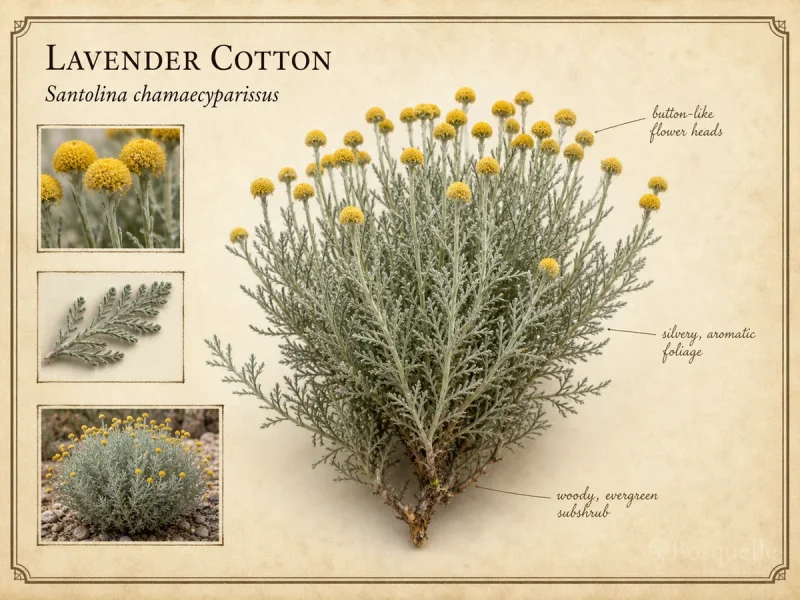
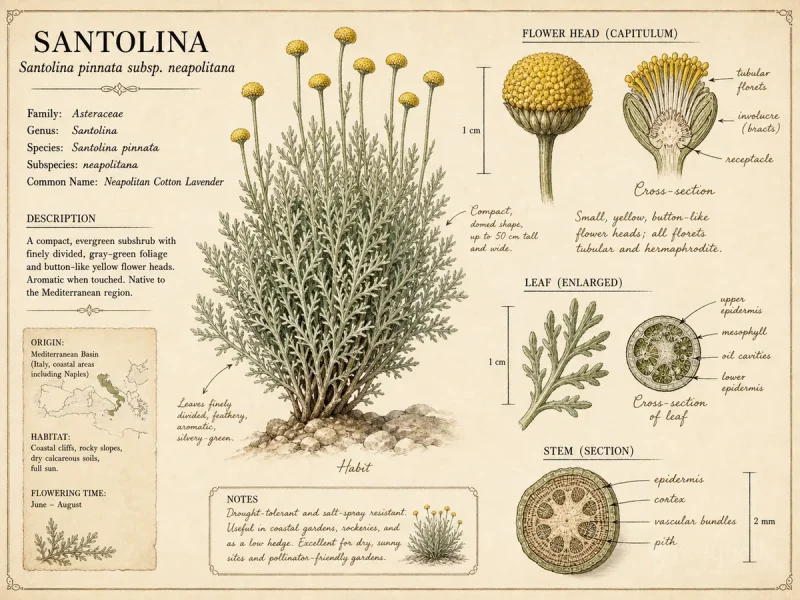
| gray lavender cotton | Silver-gray, finely cut | The classic lavender cotton. Zones 6–9. The gray kind is the one that handles coastal salt. |
| green lavender cotton | Bright green, needle-like | Same care. A little taller. Zones 6–9. Needle leaves can look like rosemary until the yellow buttons open. |
| rosemary-leaved santolina | Green, rosemary-leaved | Same sun and drain, but it wants milder winters — Zone 8–10. |
Read the tag for silver or green, then plant that mound in the same lean, sunny spot. Do not pick a kind because the tag says French lavender — that name belongs to a different plant.
Not lavender — and not French lavender
Lavender cotton is in the daisy family. True lavender (Lavandula) is in the mint family. The shop names sound alike, and both like sun and dry soil, but they are not the same plant. Lavender carries purple flower spikes and a sweet scent. Lavender cotton carries yellow button heads and a sharper, camphor or oregano scent when you bruise a leaf. For true lavender, see How to Grow Lavender.
French lavender is a true lavender — usually Lavandula dentata, sometimes Spanish lavender (L. stoechas) in shop talk — with toothed leaves and purple spikes. Some tags also print French lavender on Santolina. If the plant has yellow buttons and a silver or green mound, you have lavender cotton, not French lavender. Needle leaves on the green kind can look like rosemary until those yellow buttons open — still Santolina, still the same sun and drain.
Is lavender cotton the same as lavender?
No. Lavender cotton is Santolina, a daisy-family shrub with yellow button flowers. Lavender is Lavandula, with purple spikes. They want similar sun and drain, but they are different plants.
Is French lavender a kind of lavender cotton?
No. French lavender is a true lavender. If a Santolina tag says French lavender, ignore that name and grow it as lavender cotton.
If the mound is opening or the stems are rotting at the soil line, check drainage and whether the last cut went into leafless wood.
FAQ
How long does lavender cotton live?
Often five or six years in a garden, sometimes longer if you shear every year. When the center opens onto bare wood, take a cutting and replace the plant.
Can I grow it as a low hedge or knot garden?
Yes. Shear once or twice a year to keep the line low, and always cut above green buds. The yellow flowers will not show if you shear before they open — that is a foliage hedge, not a bloom hedge.
Is lavender cotton salt-tolerant?
The gray kind is. Do not assume the green kinds are, unless your tag says so. All of them still need soil that drains.
Can I grow lavender cotton from seed?
Seed is slow, and a named kind will not come true. A green cutting in summer is the usual way to replace a woody plant.
What else likes the same sun and lean soil?
Other Mediterranean shrubs that want full sun and sharp drain — lavender, rosemary, and germander in a knot. Do not pair it with plants that need a wet summer bed.
Can pets chew lavender cotton, and can I cook with it?
Keep pets from chewing the aromatic foliage. Dried stems are sometimes used in moth sachets. Do not treat this plant as a kitchen herb or a medicine.
Recommended plants

References
- [1] North Carolina Extension Gardener Plant Toolbox -
https://plants.ces.ncsu.edu/plants/santolina-chamaecyparissus/ - [2] UC Master Gardener Program of Sonoma County -
https://ucanr.edu/site/mg-sonoma/santolina-lavender-cotton - [3] Epic Gardening -
https://www.epicgardening.com/santolina-chamaecyparissus/ - [4] BBC Gardeners' World Magazine -
https://www.gardenersworld.com/plants/santolina-chamaecyparissus/
More first-season notes by plant are gathered in How to Grow Guides.
Updated: Reviewed by Bosquelle Editors