
Grow jewel orchid in bright indirect light, in a mix that stays moist and drains. Jewel orchid here is Ludisia discolor. A grocery moth orchid sits in chunky bark; this one grows in soil.
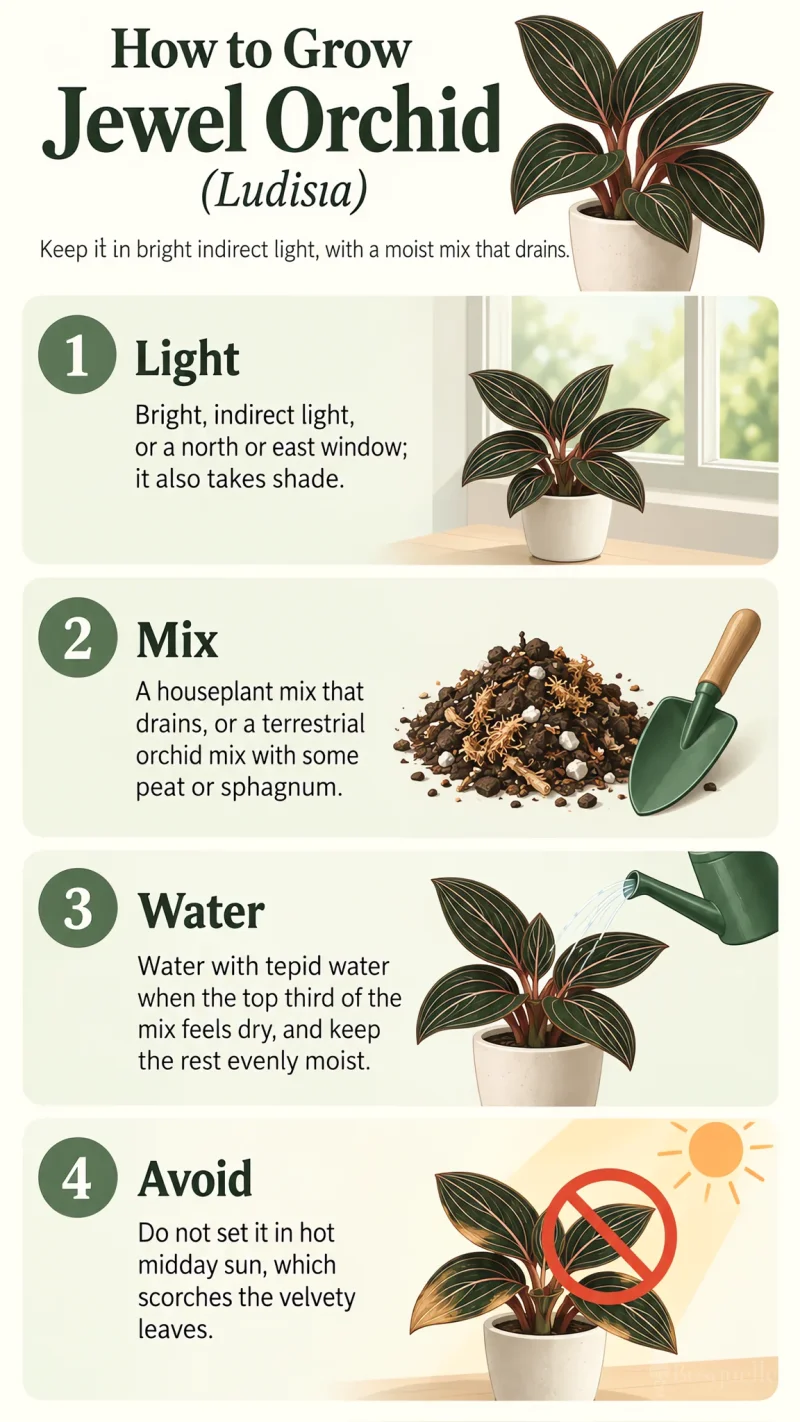
Give it bright indirect light, keep the mix moist, and skip orchid bark
| Factor | Recommended | Avoid |
|---|---|---|
| Light | Bright, indirect light, or a north or east window; it also takes shade | Do not set it in hot midday sun, which scorches the velvety leaves |
| Water | Water with tepid water when the top third of the mix feels dry, and keep the rest evenly moist | Do not let the mix go bone-dry, and do not leave the pot sitting in a saucer of water |
| Mix | A houseplant mix that drains, or a terrestrial orchid mix with some peat or sphagnum | Do not use chunky moth-orchid bark made for plants that grow on trees |
| Warmth | Keep it above about 59°F, away from drafts, vents, and cold glass | Do not let the room drop below about 59°F during the growing season |
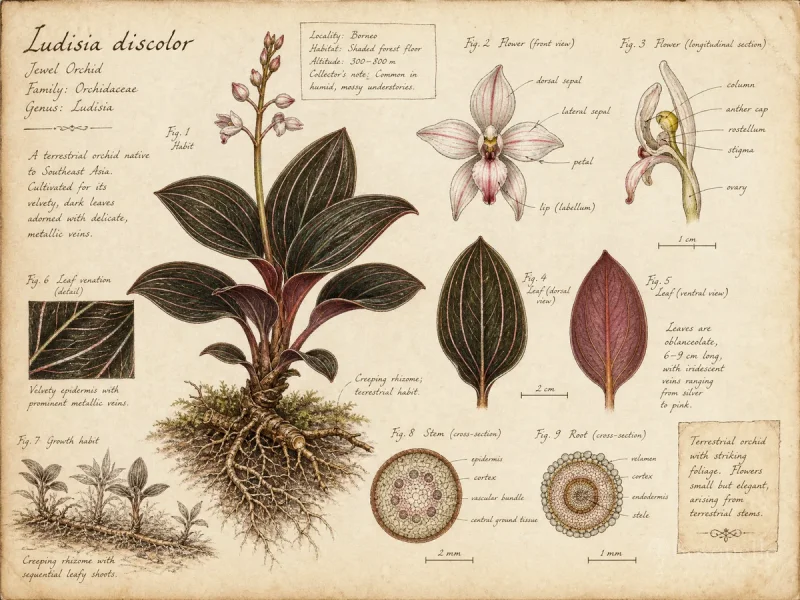
jewel orchid is Ludisia discolor, a terrestrial orchid from the forest floor in Southeast Asia. Creeping fleshy stems carry velvety dark green to purplish-brown leaves with gold or red veins. It stays low, about eight inches tall, and can spread about a foot or two in a wide pot. Set it in bright, indirect light. A north or east window, or a spot a few feet back from a brighter sill, keeps the leaves from bleaching. [1] Keep the room above about 59°F, and keep the pot off cold glass and away from heater vents. Average home humidity is enough if you water well. A pebble tray, a humidifier, a steamy bathroom, or a terrarium helps in dry furnace air. Keep air moving so wet leaves do not sit still and mildew. [2]
Keep the mix evenly moist, and water with tepid water when the top third feels dry. If the leaves go limp and the mix is dry, water until it runs through, then empty the saucer. If the leaves go limp while the mix is still wet, the roots are rotting, so do not add more water. Chunky bark made for moth orchids dries too fast for this plant, so use a houseplant mix that still drains. [3]
- Place it in bright, indirect light, or a north or east window, out of hot midday sun.
- Water with tepid water when the top third of the mix feels dry. Empty the saucer after water runs through.
- Use a houseplant mix that drains, not chunky moth-orchid bark.
- Keep the room above about 59°F. If the leaves go limp and the mix is dry, water it; if the mix is wet and it still wilts, check the roots for rot.
How often should I water a jewel orchid?
Water when the top third of the mix feels dry. Keep the rest evenly moist, not soggy, and empty the saucer.
Why are the leaves limp?
If the mix is dry, water it thoroughly. If the mix is still wet, the roots may be rotting, so check the pot and do not add more water.
Water a little less in winter, and keep it above about 59°F
Growth slows in short winter days. Water a little less, still without letting the mix go bone-dry, and skip fertilizer until new leaves show. Keep the plant indoors. A summer holiday in outdoor shade is fine if nights stay warm; bring the pot in before the room would drop near 59°F.
Plant it in a shallow, wide pot with a hole
The stems creep sideways, so a shallow, wide pot with a drainage hole fits better than a deep cup of old mix. A terrarium with mix that drains works if you want extra humidity around the leaves. [4] Fill it with a houseplant mix loosened with perlite, or a terrestrial orchid mix with some peat or sphagnum, so water moves through and the mix still holds moisture. Set the creeping stems at the same depth as before, with leaves above the mix. Wait to repot until the plant is top-heavy or has filled the pot, and step up only a little wider. Rooting a stem cutting is a separate job on How to Propagate Jewel Orchid.
- Choose a shallow, wide pot with a drainage hole.
- Fill it with houseplant mix that drains, not chunky moth-orchid bark.
- Set the creeping stems at the same depth as before, with leaves above the mix.
- Water with tepid water until it runs out, then empty the saucer.
Can I grow it in a terrarium?
Yes. A terrarium holds humidity around a small plant. Use mix that drains, and do not leave standing water in the bottom.
It can send a white flower spike in autumn or winter
A mature plant can send a thin upright spike of small white flowers, usually in autumn or winter, and sometimes at other times. A cooler spot in the room at that time of year makes a spike more likely. The flowers are a bonus. You bought this plant for the dark, veined leaves, so a spike that never comes is not a failed plant. Feed with a dilute orchid fertilizer every few weeks from spring through fall, and skip it in winter even if a spike is open.
When does jewel orchid bloom?
Often in autumn or winter, on a thin white spike above the leaves. Cooler nights help. The plant is still worth growing if it never flowers.
Cut the flower stalk at the base when the blooms fade
When the flowers are spent, cut the whole stalk at the base with clean snips. Pull off yellow lower leaves as they age. If you want a denser pot of leaves instead of a spike, pinch the new stalk off as soon as you see it. To root a stem you cut, use How to Propagate Jewel Orchid.
- Wait until the flowers fade, then cut the stalk at the base.
- Remove yellow or brown leaves at the stem.
- Pinch a new spike early only if you want more leaf instead of bloom.
Not a moth orchid — and not a gold-vein Macodes
A grocery moth orchid is Phalaenopsis. It has thick aerial roots and sits in chunky bark; see How to Grow Phalaenopsis if that is the plant you bought. Jewel orchid here is Ludisia discolor, with dark velvety leaves and pink or gold pinstripes. Macodes petola is also sold as a jewel orchid. It has brighter green leaves with lightning-bolt gold veins and wants steadier humidity; do not copy that terrarium-only routine onto this easier houseplant. Nerve plant is Fittonia, a small veined houseplant that is not an orchid; see How to Grow Nerve Plant. Native rattlesnake plantain is Goodyera, a woodland orchid, not this pot plant. A giant tiger orchid with spotted yellow flowers is Grammatophyllum, not the tiger-orchid alias on a Ludisia tag.
Is this a moth orchid?
No. A moth orchid is Phalaenopsis in bark. Jewel orchid is Ludisia discolor, a terrestrial plant with dark veined leaves.
Is every jewel orchid Ludisia?
No. Macodes petola is another genus with gold lightning veins and wants more humidity. Jewel orchid here is Ludisia discolor.
Keep it in bright indirect light, with moist mix that drains and no chunky bark. Take a stem cutting if you want a second pot.
FAQ
What about Alba, or other named jewel orchids?
Alba and similar names are leaf-color forms of the same creeping plant. Bright indirect light, moist mix that drains, and a shallow pot still apply.
Is jewel orchid toxic to cats or dogs?
Jewel orchid is listed as non-toxic to cats, dogs, and horses. Still keep pets from chewing the leaves, because a stomach upset can come from any plant material.
What about mealybugs or other sucking insects?
Wipe them off the leaves as soon as you notice them, and keep the mix from staying soggy.
Related guides

Recommended plants
References
- [1] NC State Extension -
https://plants.ces.ncsu.edu/plants/ludisia-discolor/ - [2] Royal Horticultural Society -
https://www.rhs.org.uk/plants/10545/ludisia-discolor/details - [3] BBC Gardeners' World -
https://www.gardenersworld.com/house-plants/jewel-orchid-ludisia-discolor/ - [4] American Orchid Society -
https://www.aos.org/orchids/orchids-a-to-z/letter-l/ludisia.aspx
This note is part of Ludisia Guides.
More first-season notes by plant are gathered in How to Grow Guides.
Updated: Reviewed by Bosquelle Editors