
Grow Jerusalem sage in full sun and soil that drains after rain. Tags may also say Phlomis. It is not culinary sage.
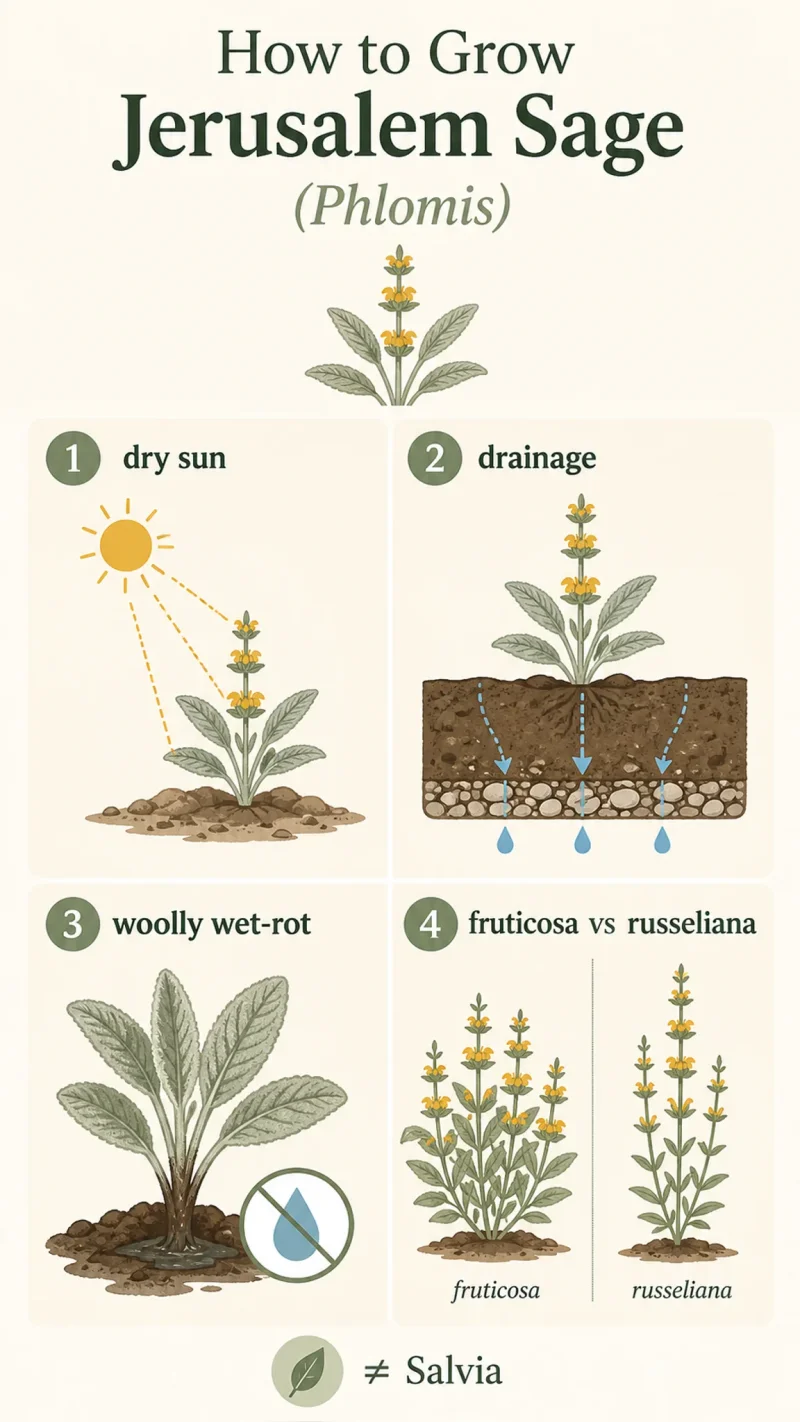
Give it full sun and soil that drains after rain
| Factor | Recommended | Avoid |
|---|---|---|
| Light | Full sun, six hours or more | Shade that stretches stems and thins bloom |
| Soil | Ground that drains after rain. Lean to average. Clay is fine if water still moves | A wet winter bowl around the woolly crown |
| Water | Water to establish, then little extra once roots take. Drought is tolerated | Standing water on felted leaves and the crown |
Jerusalem sage is a mint-family ornamental for a dry, sunny bed. Woolly leaves rot when the crown sits wet through winter. [1] Shade makes floppy, leggy stems. Once it is established, extra water is optional — a soak in a long hot spell is enough.
Does Jerusalem sage need full sun?
Yes. Full sun keeps stems stocky and the yellow whorls open. Shade makes it leggy.
Does Jerusalem sage like wet soil?
No. It needs soil that drains after rain. A wet crown in winter is the usual failure.
Is Phlomis drought tolerant?
Yes, once roots take. Water through the first season, then taper. A long hot spell still gets a soak.
Can Jerusalem sage grow in clay?
Yes, if water still moves through the bed. A low clay bowl that stays wet will rot the crown.
What are common Jerusalem sage problems?
Wet-crown rot and shade-leggy stems. Keep the site sunny and drained. Leafhoppers are occasional; they are not a separate how-to here.
Pair it with other dry-sun Mediterranean plants
Partners should want the same sun and sharp drainage: ornamental grasses, rosemary, and other low-water shrubs. Leave a path so you can cut spent stems without trampling neighbours.
Plant at pot depth after frost, or in early fall
Plant a nursery start after frost in spring, or in early fall with enough weeks for roots to take. Set the crown at the same depth it grew in the pot.
- Pick full sun and ground that drains after rain.
- Dig a hole as deep as the pot and a little wider. Do not bury the crown in a compost collar.
- Set the plant at pot depth, backfill with the soil you dug, and water to settle.
- Space shrubby kinds about 3 to 4 feet apart so the mound can fill. Carpet kinds can sit a little tighter.
- Water through the first weeks, then taper to drought-lean once new growth takes.
When should I plant Jerusalem sage?
After frost in spring, or in early fall while the soil is still warm enough for roots. Avoid planting into a wet winter bed.
Will Jerusalem sage spread?
The shrubby kinds stay in a mound. Turkish sage spreads by rhizomes as a carpet. Deadhead if you do not want seedlings.
Is Jerusalem sage invasive?
No. The carpet kinds fill a bed by rhizomes. That is not a farmland pest. Edge it if you want a fixed line.
Grow a compact kind in a pot that drains
A pot works for compact woolly kinds if it is at least about 12 inches across, with drainage holes, and a gritty mix that dries between waterings. Empty the saucer after rain. Full sun still applies. Ground is easier than a small bowl that stays wet.
Does sage grow better in pots or ground?
Jerusalem sage is happier in the ground if the soil drains. Use a pot for a compact kind on a patio. Kitchen sage in a herb pot is a different plant.
Divide a carpet clump in spring, or take a softwood cutting
Herbaceous carpet kinds divide in spring. Shrubby kinds root from a softwood cutting in summer.
- For a carpet clump, dig it when the soil is workable and not waterlogged. Split pieces that each have shoots and roots, and replant at the same depth.
- For a shrub, take a softwood cutting in summer, strip the lower leaves, and stick it in a sharp, draining mix. Keep the mix barely moist until roots take.
- Seed also works for the species, but named compact forms are usually cloned.
Can you split Phlomis?
Yes — the herbaceous carpet in spring. Softwood cuttings in summer clone the shrubby kinds. Kitchen sage water cuttings are a different job.
Cut after bloom for more flowers, or cut woody stems in winter for size
A light cut as the first yellow whorls fade can bring another flush if you water a little. Woody kinds also take a harder winter cut for size. Carpet kinds can keep their seed heads through winter, then you clean the dead top as new leaves emerge. [2]
- As the first flush fades, snip spent stems lightly if you want more bloom. Water moderately after that cut.
- After the last bloom on a woody shrub, cut stems back by about half if the plant has outgrown the spot. Winter is the usual time for that size cut.
- On the herbaceous carpet, leave the brown seed heads for winter structure if you like them. In spring, pull off the dead foliage as new growth starts.
- Do not shear it like a hedge. Cut back to a pair of leaves or to the woody frame — not into old bare wood that has no buds.
When should I cut Jerusalem sage back?
Lightly as flowers fade if you want a second flush. Harder in winter on woody kinds for size. Clean carpet dieback in spring.
Is it okay to deadhead Jerusalem sage?
Yes, for more bloom and fewer seedlings. Leave the carpet seed heads if you want winter structure.
Does Jerusalem sage bloom all summer?
The first show is late spring into summer. A light cut after that flush can bring more yellow later. It is not a nonstop bedding plant.
Should you cut back Jerusalem sage?
Yes, for size and a second flush on the shrubby kinds. The carpet can wait until spring cleanup.
Not culinary sage — and not Jerusalem artichoke
Culinary sage is Salvia. Jerusalem sage is Phlomis. The leaves look sage-like and felted, but they have no kitchen aroma or taste. Do not cook from this plant, and do not copy a sage-herb watering or harvest calendar onto it. [3]
Jerusalem artichoke is Helianthus — a sunflower relative grown for tubers. It is not this genus. A tag that says Turkish sage is the herbaceous carpet Phlomis, not a second kitchen sage.
Is Jerusalem sage the same as culinary sage?
No. Culinary sage is Salvia. This is Phlomis, a dry-sun ornamental with no kitchen flavor.
Is Jerusalem sage safe to eat?
Do not use it as a cooking herb. The felted leaves have no kitchen aroma or taste.
Is Jerusalem sage the same as Jerusalem artichoke?
No. Jerusalem artichoke is Helianthus, grown for tubers. This plant is Phlomis.
Shrubby yellow, Turkish sage carpet, or woolly compact
Culture is the same sun and drain. Habit is the choice. Do not treat a shop list of twenty names as a different plant. [4]
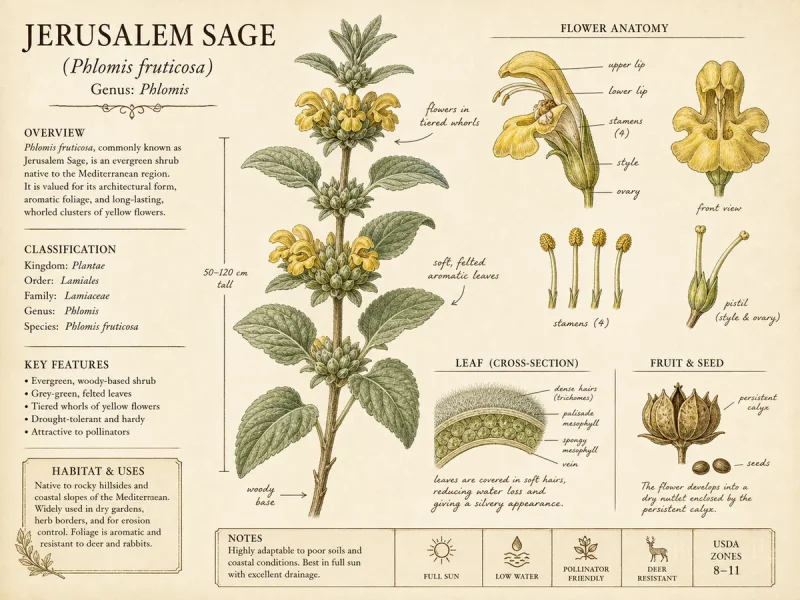
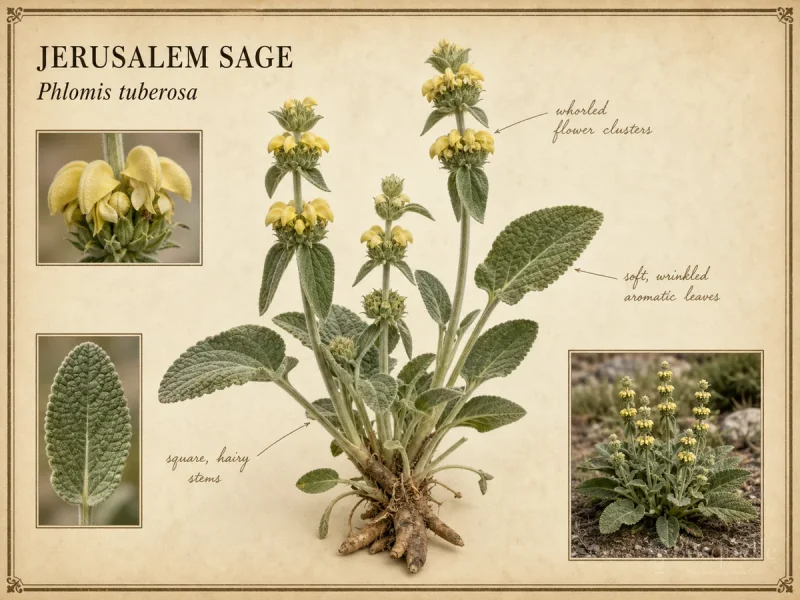
shrubby yellow is the classic 3 to 4 foot yellow shrub — evergreen in a mild winter, dying to the ground in a cold one with the roots still alive. Turkish sage is the herbaceous carpet: heart- shaped leaves, pale yellow whorls on tall stalks, rhizomes, and seed heads that hold through winter. woolly Jerusalem sage is a shorter woolly shrub; ‘Pygmy’ is the compact lanata for a small pocket. Italian Jerusalem sage is a warmer-zone pinkish form with the same sun and drain. tuberous Jerusalem sage is a taller summer stack on lean ground — not a sunchoke vegetable.
Is Phlomis fruticosa different from russeliana?
Yes in habit. Fruticosa is the woody yellow shrub. Russeliana is the hardy rhizome carpet with winter seed heads. Same sun and drainage.
Is Turkish sage the same as Jerusalem sage?
Turkish sage is the usual shop name for the herbaceous carpet, Phlomis russeliana. It is this genus, not a second kitchen sage.
What are the best Jerusalem sage varieties?
Match habit to the spot. Shrubby yellow for a mound, Turkish sage for a carpet, woolly compact for a small pocket. Extra shop names use the same sun and soil.
Set it in full sun, plant at pot depth, cut after bloom or in winter for size, and read the tag so you did not buy culinary sage.
FAQ
Is Edward Bowles a plant we hold?
It is a fruticosa × russeliana hybrid some nurseries sell. This catalog does not keep a separate card for it. Grow it like the shrubby yellow if that is what you bought.
Will deer eat Jerusalem sage?
Deer usually leave the felted leaves alone. Do not plant it as a guaranteed deer-proof hedge.
Can I use Jerusalem sage as a cut flower?
Yes — the yellow whorls and later seed heads hold in a vase or a dry bunch. This page is for keeping the plant alive in the border.
What is Jupiter's Distaff?
An old common name for the shrubby yellow Phlomis. Same plant, same sun and drainage.
Recommended plants




References
- [1] NC State Extension Gardener -
https://plants.ces.ncsu.edu/plants/phlomis-fruticosa/ - [2] UC Master Gardener Program of Sonoma County -
https://ucanr.edu/site/mg-sonoma/phlomis-jerusalem-sage - [3] Illinois Extension -
https://extension.illinois.edu/blogs/hort-home-landscape/2015-06-05-plant-week-jerusalem-sage - [4] Missouri Botanical Garden -
https://www.missouribotanicalgarden.org/PlantFinder/PlantFinderDetails.aspx?taxonid=241499
More first-season notes by plant are gathered in How to Grow Guides.
Updated: Reviewed by Bosquelle Editors