
Grow Japanese umbrella pine in moist, acidic soil that drains, and keep it out of a drying winter wind. Japanese umbrella pine is Sciadopitys verticillata, also sold as umbrella pine.
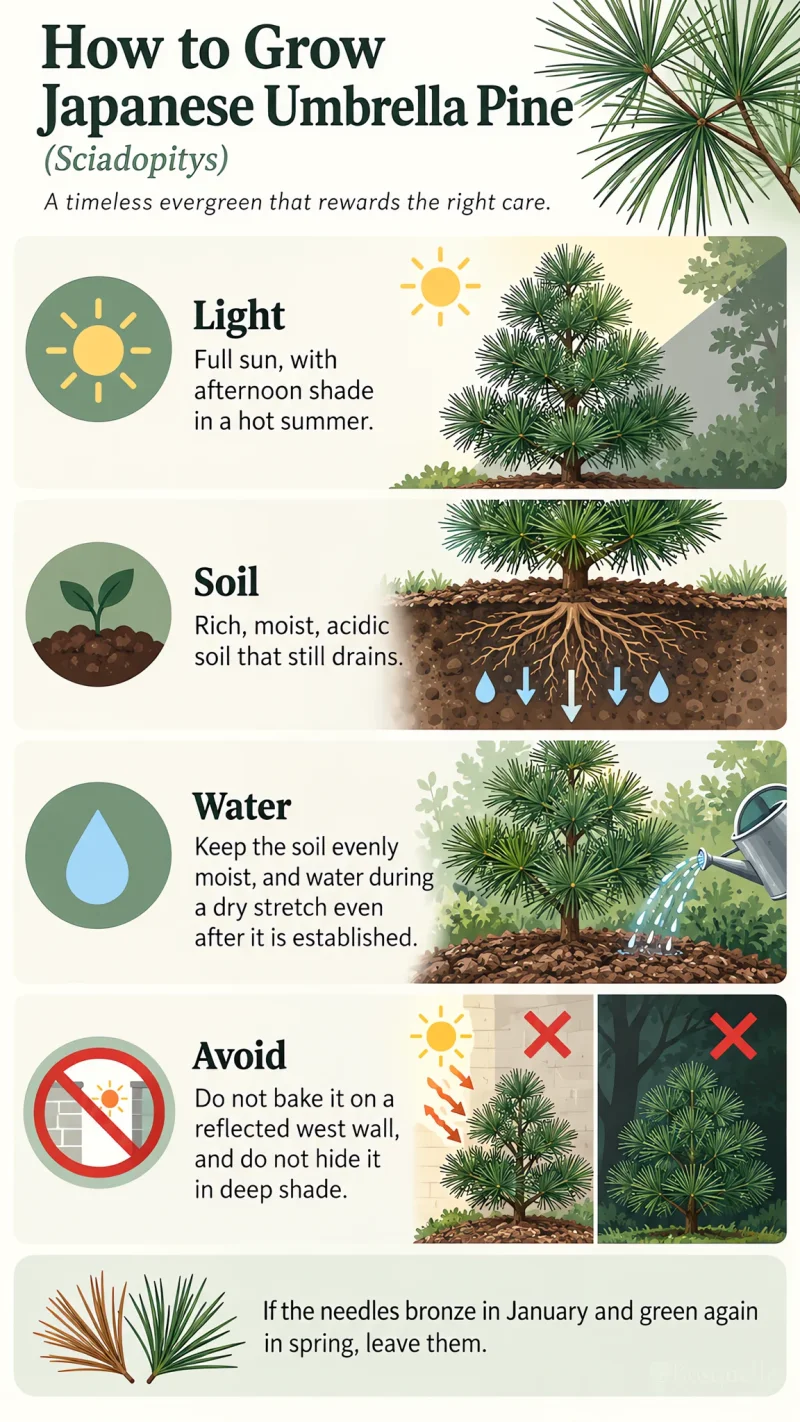
Give it moist, acidic soil that drains, and shelter from winter wind
| Factor | Recommended | Avoid |
|---|---|---|
| Light | Full sun, with afternoon shade in a hot summer | Do not bake it on a reflected west wall, and do not hide it in deep shade |
| Soil | Rich, moist, acidic soil that still drains | Do not plant it in a heavy clay hole that stays wet, and do not let the root zone dry out |
| Water | Keep the soil evenly moist, and water during a dry stretch even after it is established | Do not treat it as drought-proof, and do not leave standing water around the trunk |
| Wind | A site with some shelter from drying winter wind | Do not put a young tree on an open, windy corner |
| Size | About 25 to 30 feet tall and 15 to 20 feet wide, growing only a few inches a year | Do not crowd it against a walk if you need that spread |
Japanese umbrella pine wants cool, humid air and soil that stays moist without turning into a bog. Site it in full sun in a mild summer, and give it afternoon shade where summers run hot. [1] It is not drought-tolerant, so a dry bank or a week of forgotten water in clay can kill a tree that looked settled. [2] Leave room for a 15- to 20-foot spread even though the first decade looks slow, about six to nine inches of new growth in a good year. [3]
How much sun does Japanese umbrella pine need?
Give it full sun. In a hot summer, afternoon shade keeps the thick needles from scorching.
How often should I water Japanese umbrella pine?
Keep the soil evenly moist. Water during a dry stretch, even after the tree has been in the ground a few years.
Plant a container or balled-and-burlapped tree with the flare at the soil
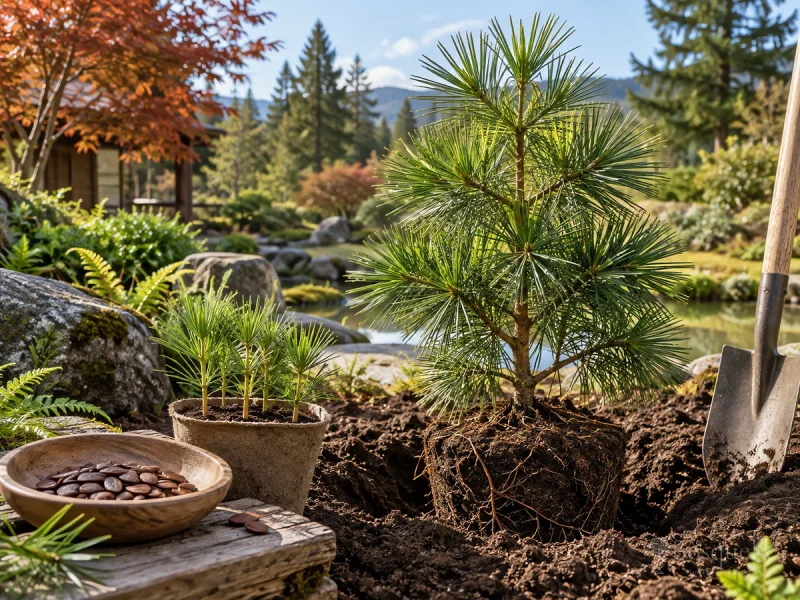
Buy a nursery tree and plant it in spring or fall, when the soil is workable and the tree is not pushing a flush of new growth. Set the root flare at the soil line, or a little above it, so the hole cannot pond water against the bark. Water it in, then keep the first season from going dry.
- Dig a hole about twice as wide as the root ball and no deeper than the ball itself.
- Set the tree so the flare sits at the soil, or slightly above it. Do not bury the flare.
- Backfill with the soil you took out. Mix in compost if the ground is poor, but do not make a wet sump in heavy clay.
- Water thoroughly to settle the backfill, then spread two to three inches of mulch, pulled back several inches from the trunk.
- Water whenever the top of the root zone dries through the first growing season, and during later droughts. This tree does not shrug off a dry month.
When should I plant Japanese umbrella pine?
Plant in spring or fall, when the soil is workable and the tree is not in a flush of new growth.
How far apart do I plant it?
Leave about 12 to 24 feet, enough for a 15- to 20-foot mature spread. Do not treat the slow first years as a reason to crowd it.
Winter bronze is normal, and brown crispy needles after spring are winter burn
Needles may dull or bronze in cold, bright weather and then green again when growth starts. That color change is not a death sentence. If the needles stay brown and crispy after new growth appears, winter wind dried them while the ground was frozen. Site the tree out of that wind in the first place. On a newly planted tree, water until the ground freezes, keep mulch off the trunk, and put a burlap screen on the windward side, about eight to twelve inches out from the branch tips, then take the screen down in spring. [4]
Is my Japanese umbrella pine dead if it turns bronze in winter?
Not if the needles green up when growth starts. Brown, crispy needles that stay dead after spring are winter burn from wind.
Keep one leader on a young tree, and do not cut into old brown wood
This tree needs little pruning. A young plant is safer with one central leader, because a narrow crotch packed with snow can split. Cut only dead, broken, or rubbing wood, and stop at wood that still has green needles. Old brown wood will not sprout a new skirt.
- Wait until spring growth shows before you call a bronze branch dead.
- Cut dead or storm-broken wood just outside the branch collar.
- On a young tree, keep one upright leader. If two compete, cut the weaker one.
- Do not shear it like a hedge, and do not cut back into wood that has no needles.
Does Japanese umbrella pine need pruning?
Almost never. Keep one leader on a young tree, and cut only dead or broken wood. Do not cut into old brown wood.
Not a true pine, and not the Italian stone pine sold as umbrella pine
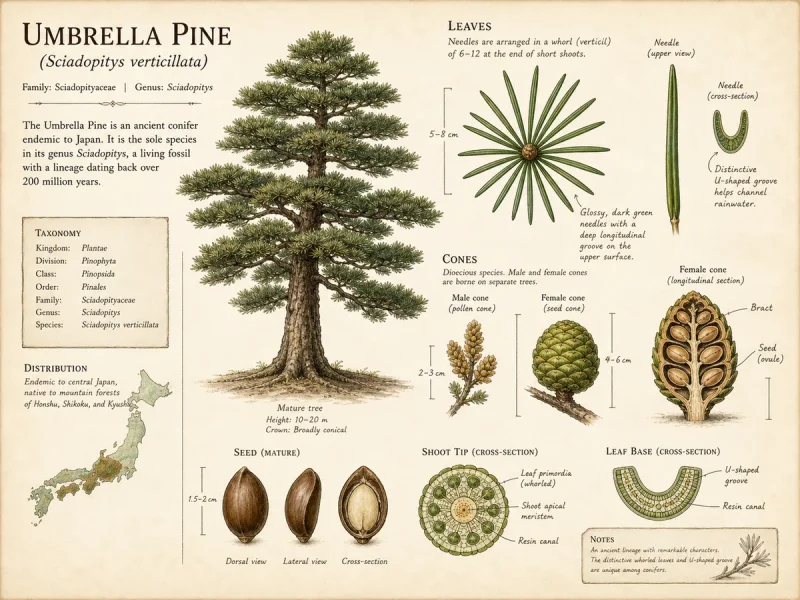
Japanese umbrella pine is not a pine. The thick needles sit in whorls of about twenty to thirty at the shoot tips, like the spokes of an umbrella, instead of in the two-to-five needle bundles of a true pine. If the tag says pine and the plant is Pinus, read How to Grow Pine.
Italian stone pine (Pinus pinea) is also sold as umbrella pine and parasol pine. That tree is a true pine with an umbrella-shaped crown of branches, not spokes of needles, and it wants a hotter, drier Mediterranean site. Do not put this moist-soil Japanese tree in a stone-pine hole.
Parasol fir is a shop name for this plant, not a true fir. If the tag is fir, read How to Grow Fir. An umbrella plant in a living room is usually a Schefflera, not this outdoor conifer.
Is Japanese umbrella pine a true pine?
No. It is Sciadopitys, in its own family. The needles radiate in umbrella-like whorls, not in pine bundles.
Is this the same as Italian stone pine?
No. Italian stone pine is Pinus pinea, a true pine with a broad umbrella crown. This tree is Sciadopitys, and it wants moist, sheltered ground.
If the needles bronze in January and green again in spring, leave them. If they stay crispy after new growth, the wind got there first — move the next tree into shelter.
FAQ
Is there more than one kind of Japanese umbrella pine?
This shop holds one species, Sciadopitys verticillata. Named forms such as Wintergreen stay greener in winter, but they use the same moist soil and wind shelter.
Can I grow Japanese umbrella pine in a pot?
A nursery pot is how a young tree is sold. It can sit in a large container for a few years if the mix stays moist and drains, then it needs the ground. It is not a houseplant.
Can I grow it as bonsai?
Collectors do, outdoors, with even moisture and winter wind shelter. That is a specialist craft, not the landscape method.
What pests hit Japanese umbrella pine?
It has no regular insect or disease problem. Brown needles are usually dry soil or winter wind, not a spray job.
Related guides
Recommended plants
References
- [1] NC State Extension -
https://plants.ces.ncsu.edu/plants/sciadopitys-verticillata/ - [2] The Morton Arboretum -
https://mortonarb.org/plant-and-protect/trees-and-plants/japanese-umbrella-pine/ - [3] Virginia Cooperative Extension -
https://pubs.ext.vt.edu/content/dam/pubs_ext_vt_edu/HORT/HORT-29/HORT-29.pdf - [4] Ask Extension -
https://ask.extension.org/kb/faq.php?id=434355
This note is part of Sciadopitys Guides.
More first-season notes by plant are gathered in How to Grow Guides.
Updated: Reviewed by Bosquelle Editors