
Grow Italian bugloss in full sun, in soil that drains. Italian bugloss is Anchusa azurea — a short-lived perennial with bristly leaves and bright blue flowers that look like forget-me-nots on a 3–5 ft stem.

Give it full sun and soil that drains, and stake tall stems
| Factor | Recommended | Avoid |
|---|---|---|
| Sun | Full sun; afternoon shade in a hot summer | Do not site it in shade that stretches the stems |
| Soil | Average soil that drains; lean sand or grit is fine | Do not plant in a winter-wet low spot — the crown rots |
| Water | Water the first season until the taproot is in; after that, only in a long dry spell | Do not keep the crown soggy, especially in winter |
| Support | Stake tall stems in spring before they flop | Do not wait until the plant is already on the ground |
| Handling | Wear gloves on the bristly leaves | Do not handle the leaves with bare skin if you get a rash |
Italian bugloss wants full sun and soil that drains. [1] It will rot unless the water can leave the crown. [2] Water while it is settling in. Once the taproot is down, the plant can take a dry spell, but a wet winter crown rots. Leaner ground keeps the stems upright. Rich, wet soil makes them tall and floppy, so a stake in spring is cheaper than a fallen clump in June. Italian bugloss is the species form at about 3–5 ft. Wear gloves on the bristly leaves. [3]
How much sun does Italian bugloss need?
Full sun. Six hours of direct light is the default. Afternoon shade helps in a hot summer. Deep shade stretches the stems and cuts the bloom.
Does Italian bugloss need staking?
Tall plants often do, especially in rich soil. Stake in spring, while the stems are still upright. Lean, draining ground needs less help.
Cut the stems back after bloom so the plant lasts
Italian bugloss is short-lived if you leave every stem to set seed. Cut spent stems after the first flush so a basal rosette can form, and you often get more bloom and a plant that lasts into the next year.
- Deadhead spent flower stems as they finish if you want more bloom and fewer seedlings.
- After the first flush, cut the stems back to the crown, or to about 6–8 inches, so a basal rosette can form.
- Leave a few seed heads only where you want volunteers. Named forms do not come true from seed.
- Mulch the roots for winter, but keep mulch off the crown so it does not stay wet.
Self-sown seedlings show up near the parent. Pull them if you do not want a second clump. Dropmore and Loddon Royalist want the same cut-back; they are not a different watering rule.
When do I cut Italian bugloss back?
After the first bloom flush, cut stems back to the crown or to about 6–8 inches. Deadhead sooner if you do not want seedlings.
Does Italian bugloss come back every year?
It can, if you cut it back after bloom so a basal rosette forms. Skip that cut and the plant often acts like a short-lived biennial.
Not Siberian bugloss — and not a forget-me-not or common bugloss
Italian bugloss is Anchusa azurea. Siberian bugloss is Brunnera: moist shade and heart-shaped leaves, on How to Grow Brunnera. An old tag that says Anchusa myosotidiflora is Brunnera, not this plant. True forget-me-not is Myosotis, a much shorter plant, on How to Grow Forget-me-not.
Common bugloss is Anchusa officinalis, a listed noxious weed in parts of the West. It is not the tall garden plant sold as Italian bugloss. [4] Viper’s bugloss is Echium, on How to Grow Echium. Cape forget-me-not is a different species — a shorter annual or biennial.
Is Italian bugloss the same as Siberian bugloss?
No. Siberian bugloss is Brunnera, a shade plant with heart-shaped leaves. Italian bugloss is Anchusa azurea for full sun.
Is Italian bugloss a forget-me-not?
No. The flowers look similar, but forget-me-not is Myosotis. Italian bugloss is a 3–5 ft Anchusa for sun.
If the stems flopped, give it more sun and leaner ground — then cut it back after bloom so a rosette can form.
FAQ
Can I grow Italian bugloss in a pot?
Yes, in a deep pot with a drainage hole, if you need to move it. Keep the mix on the dry side in winter so the crown does not rot.
Can I grow Italian bugloss from seed?
Yes. Sow in the bed in spring or fall. Named forms such as Dropmore do not come true from seed.
Are Dropmore and Loddon Royalist different species?
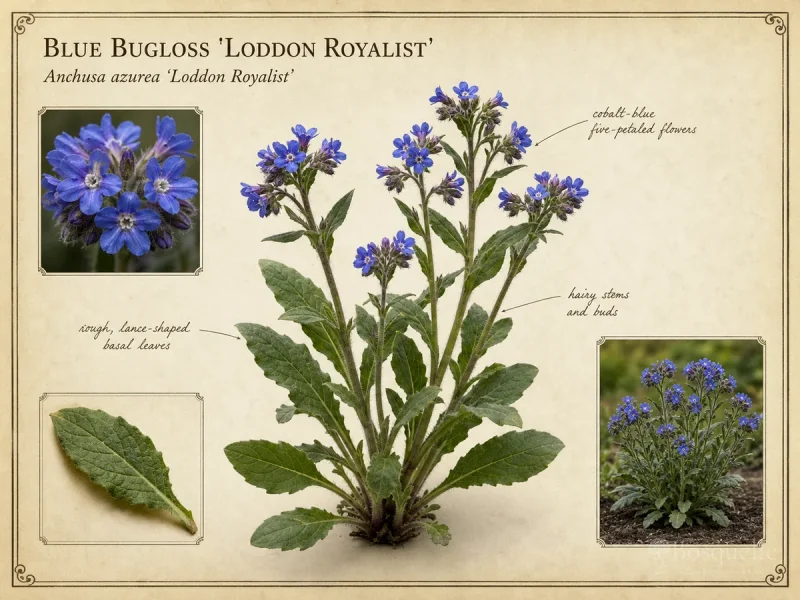
No. Both are Anchusa azurea. Dropmore is the taller deep-blue form. Loddon Royalist is shorter, about 2–3 ft. They want the same sun and drain.
Is Cape forget-me-not the same plant?
No. Cape forget-me-not is Anchusa capensis, a shorter annual or biennial. Italian bugloss is the tall perennial Anchusa azurea.
What pests hit Italian bugloss?
Crown rot in wet soil is the main problem. Powdery mildew shows up when stems are crowded. Give it air and drainage. Do not spray as a default.
What else can I plant with it?
Pair it with other full-sun flowers that can take the height. Keep shorter plants toward the front so the stems do not shade them out.
Related guides

Recommended plants


References
- [1] North Carolina Extension Gardener Plant Toolbox -
https://plants.ces.ncsu.edu/plants/anchusa-azurea/ - [2] Purdue Extension -
https://ag.purdue.edu/department/hla/extension/extension-publications-library/ext-pubs/ho-79-w.html - [3] Gardening Channel -
https://www.gardeningchannel.com/how-to-grow-anchusa-flowers/ - [4] Washington State Noxious Weed Control Board -
https://www.nwcb.wa.gov/weeds/common-bugloss
This note is part of Anchusa Guides.
More first-season notes by plant are gathered in How to Grow Guides.
Updated: Reviewed by Bosquelle Editors