
Grow Ipomopsis as a biennial in full sun and soil that drains. Ipomopsis is also called scarlet gilia and standing cypress.
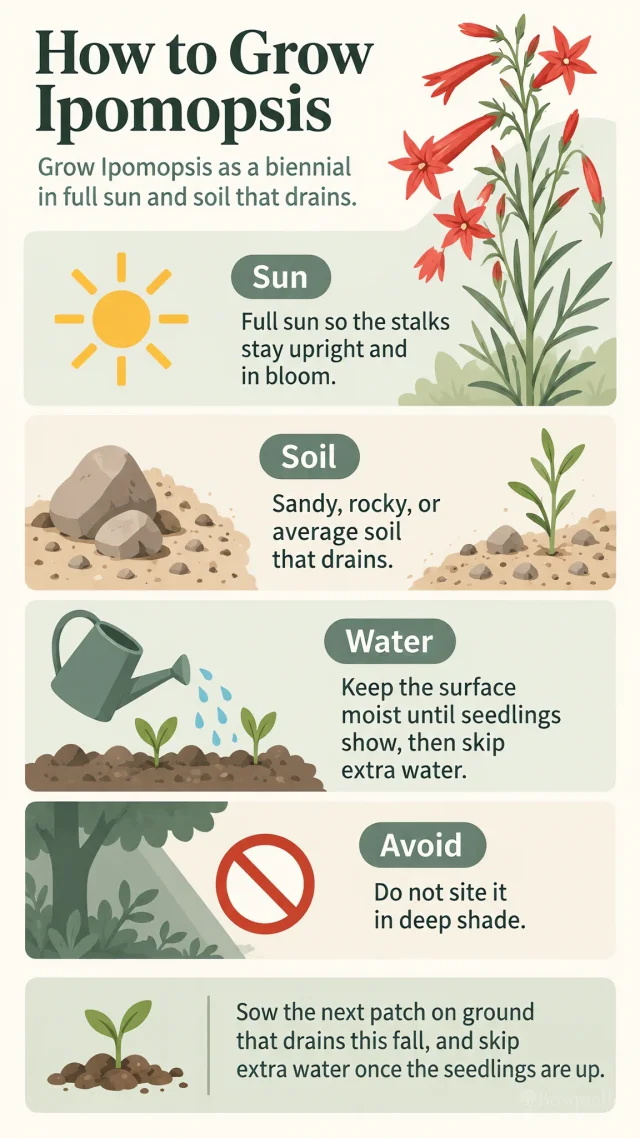
Give it full sun, soil that drains, and little extra water
| Factor | Recommended | Avoid |
|---|---|---|
| Sun | Full sun so the stalks stay upright and in bloom | Do not site it in deep shade |
| Soil | Sandy, rocky, or average soil that drains | Do not plant it where water stands after rain |
| Water | Keep the surface moist until seedlings show, then skip extra water | Do not water an established plant on a weekly calendar |
| Kind | Standing cypress for a tall unbranched spike; scarlet gilia for western branched trumpets | Do not expect bloom the first year from seed |
| Feed | Little or no fertilizer in draining ground | Do not dump extra nitrogen that pushes soft growth |
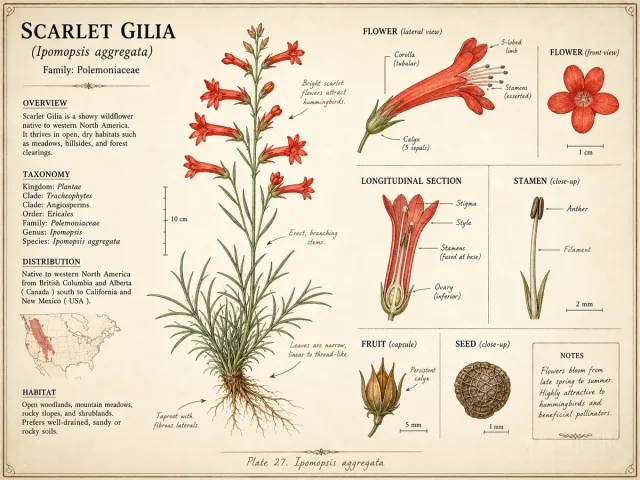
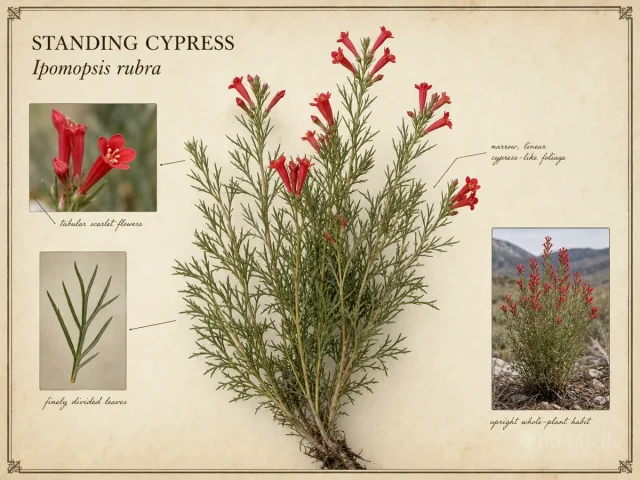
Ipomopsis is a biennial. It wants full sun and soil that drains, then it usually dies after the seed ripens. Keep the seedbed moist until the plants show, then ease off. Soggy soil around the roots is the primary cause of root rot. [1] [2] standing cypress is the tall unbranched spike, often 2 to 6 feet, with red tubes that open from the tip downward. scarlet gilia is the western plant with branched trumpets and foliage that can smell skunky when you crush it. Both want the same sun and drain.
Does Ipomopsis need full sun?
Yes. Full sun. Deep shade makes a thin, floppy stalk with fewer flowers.
How often should I water Ipomopsis?
Keep the surface moist until seedlings show. After that, skip extra water unless the plants wilt in a long dry spell, and do not leave the roots in standing water.
Which Ipomopsis should I buy?
Buy standing cypress for a tall unbranched spike. Buy scarlet gilia for western branched trumpets. Both want sun and drain, and both bloom the second year from seed.
Will it bloom the first year?
Usually no. The first year is a ferny rosette. The bloom stalk comes the second year. Sow two years in a row if you want flowers every summer.
Sow in fall, barely cover, and sow two years so you have bloom every year
Sow where the plants will bloom. The taproot does not like a move, so trays and later transplanting often fail. Scatter seed in fall on ground that drains, and press it in so it is barely covered. The seed wants light, and buried seed often fails to sprout. Sow again the next fall so a second set of rosettes is coming on while this year's stalks bloom. [3] [4]
- Clear a patch of bare ground that drains. Pull weeds so the tiny seedlings are not lost.
- Scatter the seed in fall. Mix it with dry sand if it is too fine to spread evenly. Press it in so it is barely covered, or leave it on the surface. Do not bury it.
- Keep the surface moist until seedlings show, usually in two to four weeks.
- Sow again the next fall. Leave later flowers to drop seed on bare soil if you want the patch to keep itself going. Do not lift a flowering stalk if you can help it. A first-year rosette can move only if you keep the taproot intact.
When should I sow Ipomopsis seed?
Sow in fall on the bed where the plants will bloom. In a cold-winter garden you can also sow in early spring after the seed has had a cold spell.
Can I transplant Ipomopsis?
Avoid moving a flowering stalk. The taproot usually fails after a move. If you must move a first-year rosette, dig deep enough to keep the taproot intact.
Not cypress vine — and not a cypress tree or cardinal flower
Standing cypress on a tag is this biennial, not a twining vine. Cypress vine is Ipomoea, a morning glory that climbs a trellis — see How to Grow Morning Glory. If you searched for a scarlet vine and landed here, you want cypress vine, not Ipomopsis. It is also not a cypress tree. Bald cypress is Taxodium — see How to Grow Bald Cypress. True cypress is Cupressus — see How to Grow Cypress.
Scarlet gilia on a packet may be this genus, but annual gilia is Gilia, a cool-season plant with open cups or powder-blue puffballs — see How to Grow Gilia. Cardinal flower is Lobelia, a moist-soil scarlet spike — see How to Grow Lobelia. If the tag says scarlet gilia or standing cypress and the plant is a dry-sun biennial with tubular red flowers, you still have Ipomopsis.
Is this cypress vine?
No. Cypress vine is a morning-glory climber. Ipomopsis is an upright biennial that does not need a trellis.
Is this a cypress tree?
No. Standing cypress is a wildflower with ferny leaves. It is not bald cypress and not a woody cypress.
Is this the annual gilia?
No. Annual gilia has open cups or puffballs and blooms the first season. Ipomopsis has tubular flowers and usually blooms the second year.
Cut a spent bloom spike, or leave seed so the patch returns
The plants usually die after the seed ripens. A patch returns only if some flowers are left to set seed and that seed can hit bare ground. You can cut the first spent spike if you want a replacement stalk, then stop so later flowers can drop seed.
- When the first bloom spike is through flowering, cut it so a replacement stalk can grow. Do not strip every stalk if you want seedlings next year.
- Leave later flowers to ripen. Seed needs to fall on bare soil, not on a thick mulch.
- Leave the ferny rosettes that show in fall. They are next season's bloom stalks, not weeds.
Should I cut the spent spike?
You can cut the first spent spike if you want another flush of flowers. Leave some heads if you want the patch to return from seed.
Will it come back next year?
The plants usually die after seed. A patch returns if seed can hit bare soil. Thick mulch blocks the seedlings.
Sow the next patch on ground that drains this fall, and skip extra water once the seedlings are up.
FAQ
Can I grow Ipomopsis in a pot?
A deep pot that drains can hold a few plants on a patio. The taproot wants depth, so a shallow bowl fails. Use a lean mix, keep it in full sun, water when the mix is dry, and empty the saucer. A meadow strip in the ground holds a patch better.
Can I start it indoors?
Sow where the plants will bloom. The taproot does not like a move, so trays and later transplanting often fail.
Can I cut stems for a vase?
You can cut a few bloom stalks for the house. Leave most of the patch standing if you want seed, and do not treat this as a cutting garden.
Is Spanish larkspur garden larkspur?
No. Spanish larkspur is a shop name for standing cypress. Garden larkspur is a different plant.
Do you list pink or white skyrocket?
No. This catalog holds scarlet gilia and standing cypress. Pink or white color forms are other packets. Treat tubular red spikes as this genus.
Recommended plants
References
- [1] NC State Extension Gardener -
https://plants.ces.ncsu.edu/plants/ipomopsis-rubra/ - [2] Utah State University Extension -
https://extension.usu.edu/rangeplants/forbs-herbaceous/scarlet-gilia - [3] Lady Bird Johnson Wildflower Center -
https://www.wildflower.org/plants/result.php?id_plant=IPRU2 - [4] Gardening Know How -
https://www.gardeningknowhow.com/ornamental/flowers/standing-cypress/growing-standing-cypress.htm
More first-season notes by plant are gathered in How to Grow Guides.
Updated: Reviewed by Bosquelle Editors