
Hedgehog cactus fails most often in winter: wet soil plus cold rots the crown, and a warm moist winter skips the rest that sets spring cups. Give Echinocereus blazing sun and grit, then a cold, nearly bone-dry dormancy.
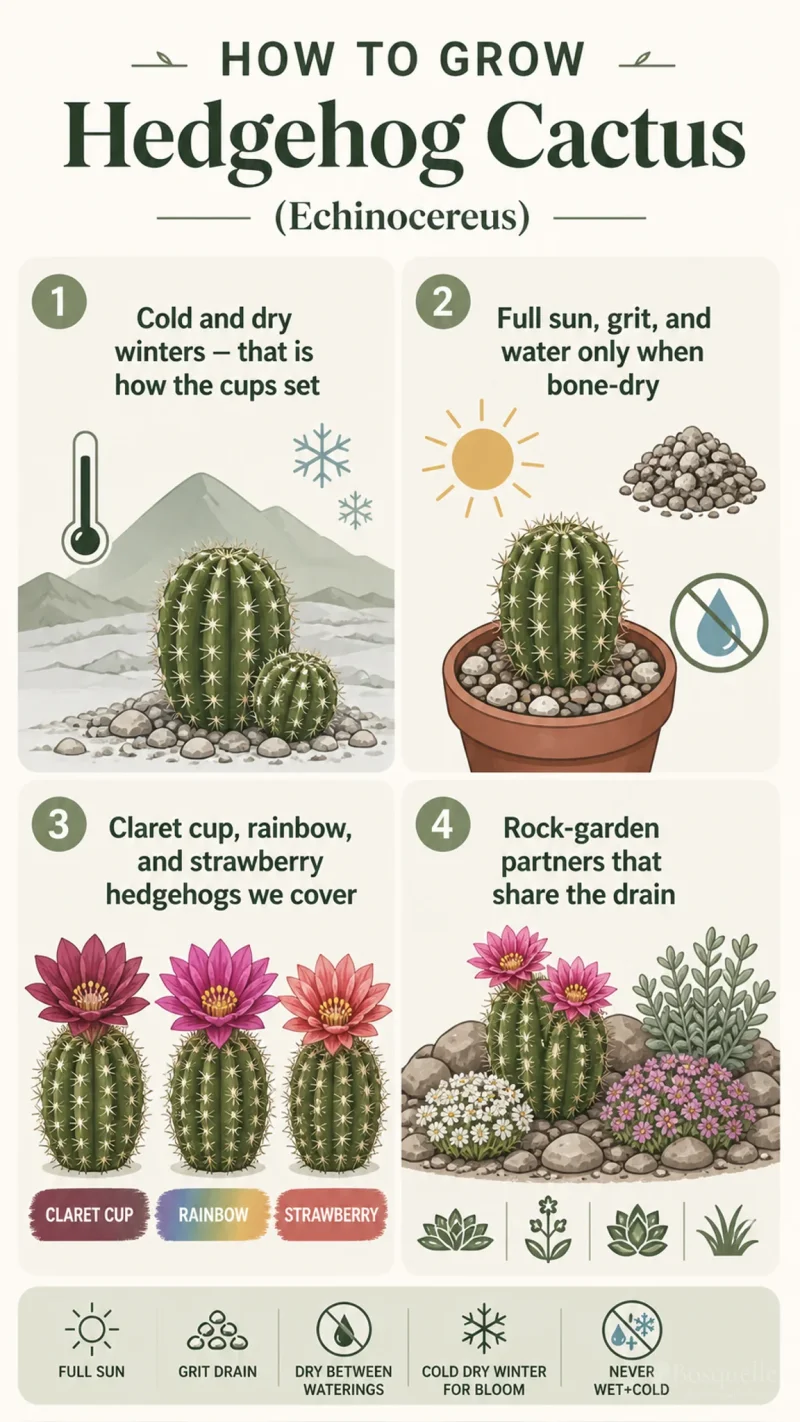
We cover claret cups like E. triglochidiatus and E. coccineus, rainbow kinds like E. rigidissimus and E. dasyacanthus, and strawberry hedgehogs E. engelmannii / E. stramineus, plus lace E. reichenbachii. Dry cold first; flower chase second.
Cold and dry winters — that is how the cups set
| Season habit | What you get | What fails |
|---|---|---|
| Fall–winter: almost no water; bright cold rest | Spring bud set on mature clumps | Warm moist winters with weak or missing bloom |
| Never water a cold, wet crown | Hardy stems that shrug dry frost | Soft black rot at the base |
| Spring: first soak after buds show, then dry thoroughly | Clean wake-up without drowning | Weekly winter “just in case” drinks |
| Summer: deep soak only when bone-dry | Firm growth and energy for next year’s flowers | Constant damp cactus mix |
| Gloves for every handle — spines are real | Safe dividing of offsets | Bare-hand scooping of pups |
Many hedgehog species are surprisingly cold-tolerant when dry. Mimic outdoor dormancy indoors with a bright cool room for several weeks (roughly the mid-30s to 50°F range many growers use) and keep the pot bone-dry. Skip that rest and you often keep a green plant that never cups.
Full sun, grit, and water only when bone-dry
Site outdoors in full sun (six-plus hours) on a mound or rock pocket so water sheds. Indoors, use the brightest south or west window you have — weak light stretches stems and cuts bloom.
Soil must be a mineral-heavy cactus mix: grit, pumice, coarse sand, and only a little organic matter. Containers need drainage holes and a snug pot; these are slow growers that dislike wet feet.
Water deeply, then wait until the mix is dry top to bottom before watering again in spring and summer. Stop scheduled watering by early fall. A gravel mulch around outdoor crowns sheds splash. Feed lightly with a dilute low-nitrogen cactus fertilizer a few times in warm growth only — never in dormancy.
Propagate by separating rooted offsets in spring with thick gloves, or by seed from ripe fruit. Let any cut surfaces callus before planting on dry mix.
Claret cup, rainbow, and strawberry hedgehogs we cover
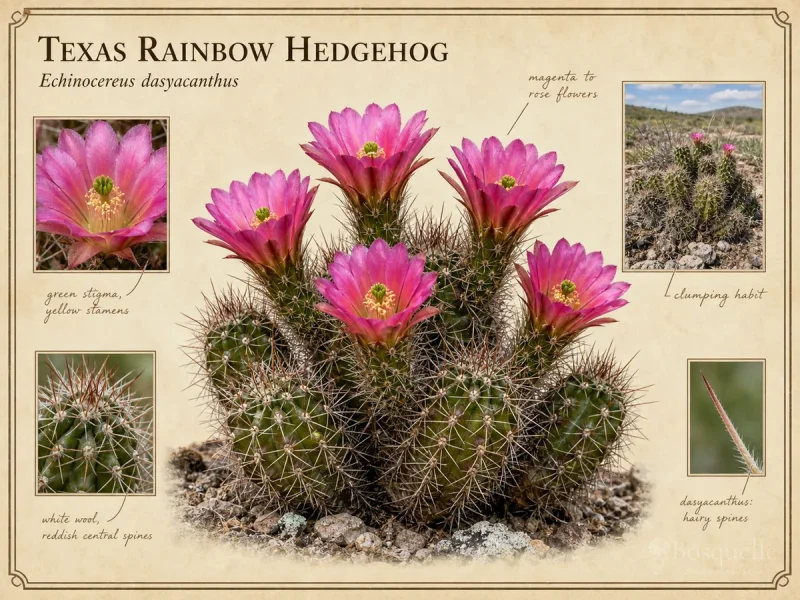
Claret cups (E. triglochidiatus, E. coccineus) are the scarlet to orange-red funnel flowers that light Southwest rock gardens and draw hummingbirds. Rainbow hedgehogs (E. rigidissimus, E. dasyacanthus) are grown for banded spines and often yellow to pink cups.
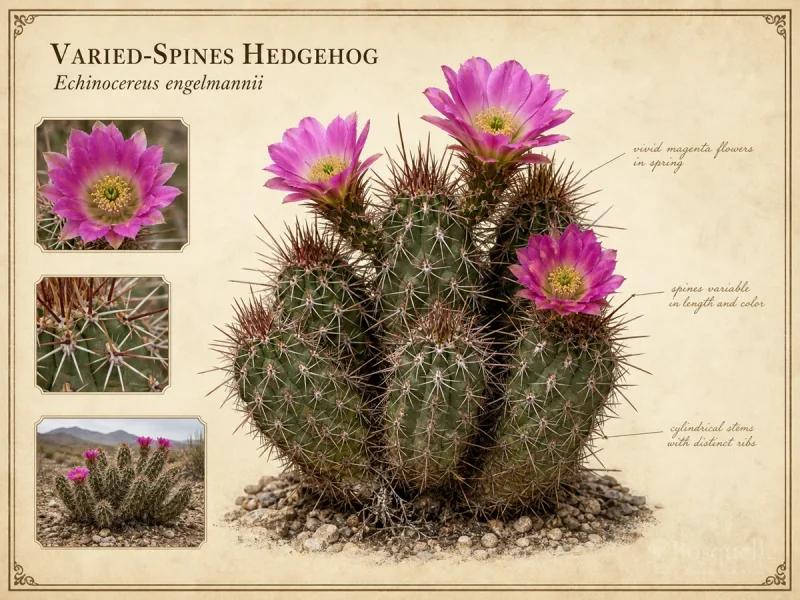
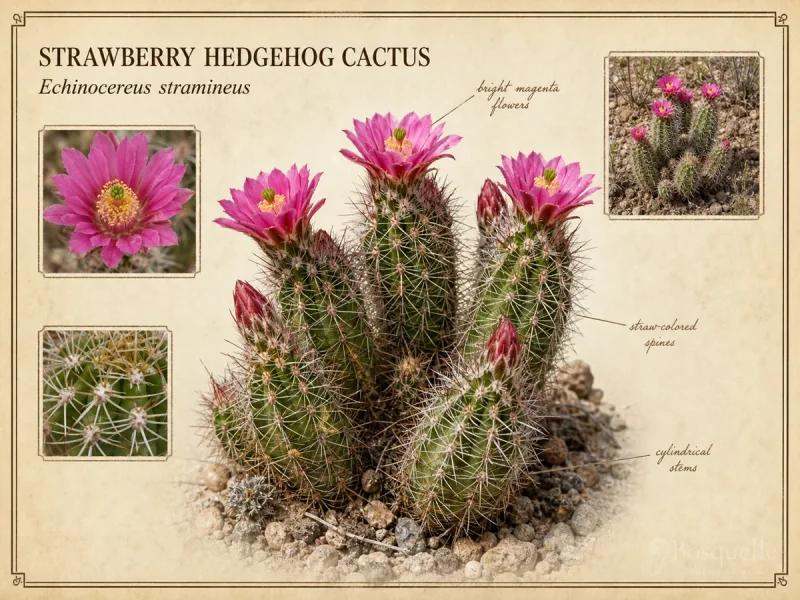
Strawberry hedgehogs (E. engelmannii, E. stramineus) lean toward clumping desert mounds with showy spring bloom. Lace (E. reichenbachii) adds a finer-spined look in the same dry-sun framework.
Care overlap is high across the genus. Species hardiness and flower color differ — read the tag — but the shared rules are sun, grit, and dry winters. Do not confuse hedgehog cactus with golden barrel (*Echinocactus*), a different genus with a different silhouette.
Rock-garden partners that share the drain
Pair with other sharp-draining desert plants — agaves, smaller opuntias with clear walking gaps, cold-hardy ice plants — and leave air around the mound so crowns dry after rain. Companions stay short here; this page owns Echinocereus culture.
FAQ
Why won’t my hedgehog cactus bloom?
Usually weak light, a young single stem, or a warm moist winter. Mature clumps need strong summer sun and a cold, nearly bone-dry rest to set cups.
How often should I water hedgehog cactus?
Only when the mix is dry through. In warm growth that may be every couple of weeks; in winter, rarely or not at all.
Can hedgehog cactus take frost?
Many species tolerate dry cold. Wet soil plus freezing is what kills — keep drainage sharp and stop watering before winter wet.
Claret cup vs rainbow cactus — what’s the difference?
Claret cups (such as E. triglochidiatus / coccineus) are grown for scarlet to orange-red funnels. Rainbow kinds (such as E. rigidissimus / dasyacanthus) are prized for banded spines and varied cup colors. Shared care: sun, grit, dry winters.
Is hedgehog cactus the same as golden barrel?
No. Golden barrel is usually Echinocactus (or related barrel genera). Hedgehog cactus is Echinocereus — typically smaller clumping stems with large spring flowers.
How do I propagate offsets?
In spring, wear gloves and separate a rooted pup from the mound, or unpot and divide. Replant on dry cactus mix and wait before the first soak.
Can I grow it indoors?
Yes in a very bright window with a cool dry winter rest. Without strong light and dormancy, bloom is uncommon.
When do claret cups bloom?
Typically spring into early summer after a proper winter rest, with scarlet to orange-red funnel flowers.
What fails Echinocereus fastest?
Winter watering, shade, rich soggy soil, or buying a golden barrel when you wanted a clumping hedgehog.
Recommended plants



More first-season notes by plant are gathered in How to Grow Guides.
Updated: Reviewed by Bosquelle Editors