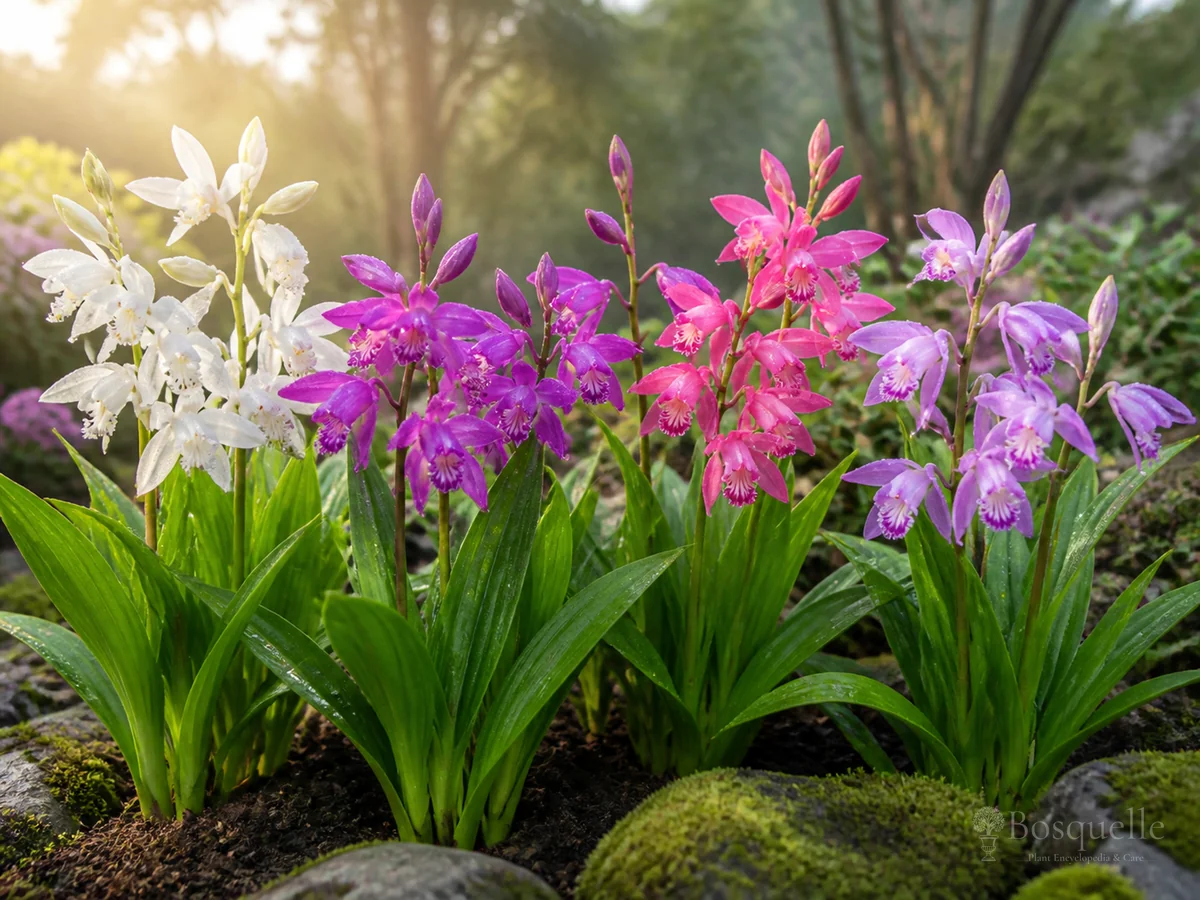
Hardy orchid is the everyday name for Chinese ground orchid — mostly B. striata and its selections — a terrestrial orchid that grows from fleshy rhizomes in open ground, not strapped to bark in a steamy glasshouse.
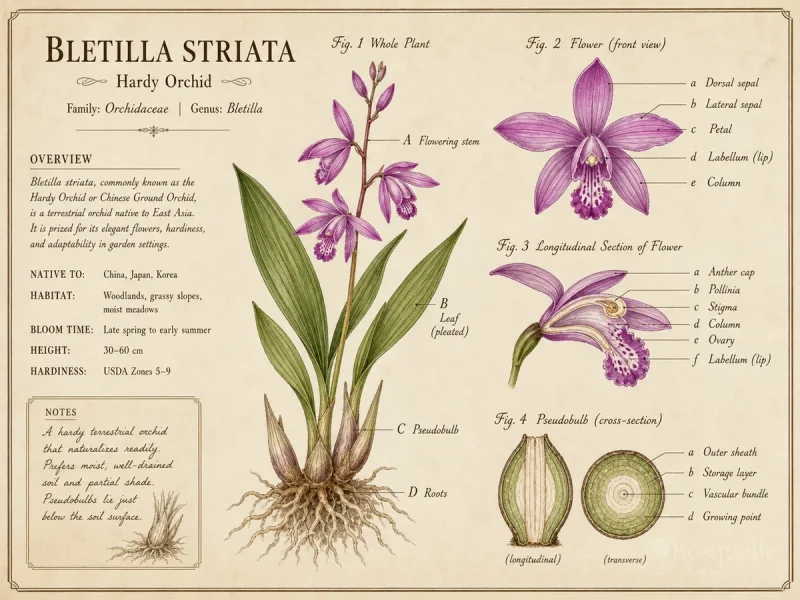
Searchers also say hyacinth orchid or Bletilla; the garden job is the same: spring plicate leaves, soft pink or white flower sprays,
and a plant that can overwinter outdoors in the right zones if you treat it like a woodland perennial instead of a tropical house orchid.
It is not the “Chinese orchid tree” (Bauhinia) sold as a flowering tree.
This page opens with the hardiness question, then moist shade and leaf-mold care, planting depth for pseudobulbs, and a browse of B. striata ‘Alba’, B. striata ‘Big Bob’, lipstick B. striata ‘Kuchibeni’, B. striata ‘Shi-Ran’, and B. formosana.
Companions stay short in the FAQ — the page stays on rhizomes, moisture, and which kind you bought.
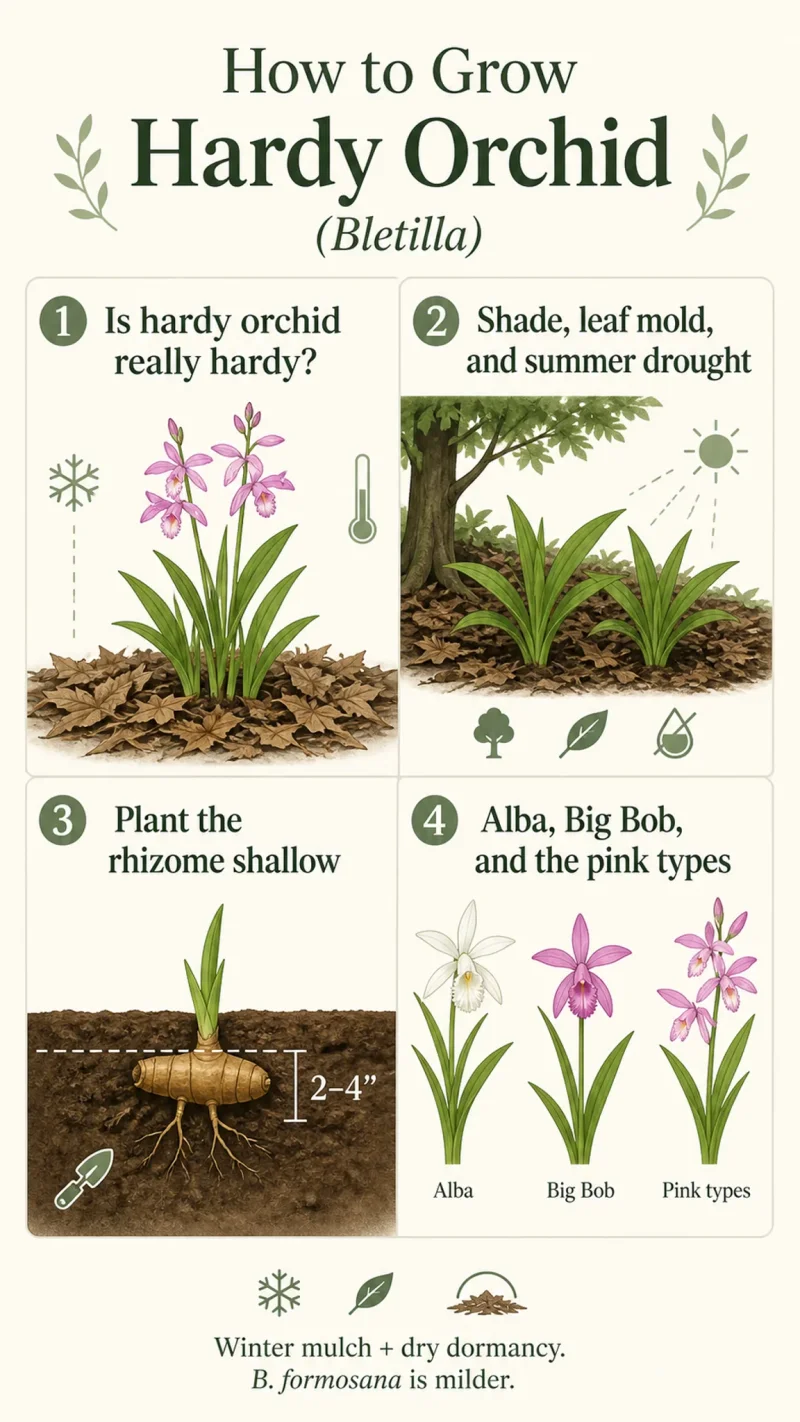
Is hardy orchid really hardy?
| Claim you hear | What usually holds | What fails |
|---|---|---|
| “Orchid” means greenhouse only | Bletilla is a terrestrial rhizome orchid for open beds in suitable zones | Buying Phalaenopsis culture advice for ground orchid rhizomes |
| Hardy everywhere once planted | Often reliable roughly USDA 6–9 with winter mulch and drainage that is moist, not swampy | Bare rhizomes in zone 5 without mulch, or wet clay that freezes solid |
| Same care as cattleyas | Leaf mold, part shade, even moisture in growth; summer drought hurts more than cool nights | Bark chips, daily mist, and hot dry sun |
| All Bletilla equal | B. striata selections dominate hardy gardens; B. formosana may need milder winters | Assuming every label overwinters the same |
“Hardy” here means outdoor perennial rhizomes in temperate gardens, not frost-proof on every patio. B. striata is the workhorse Chinese ground orchid: deciduous foliage rises in spring, flower racemes open in late spring to early summer, then plants rest as underground storage organs.
In the colder edge of its range, a loose winter mulch over the rhizome bed is insurance, not optional decoration — and the dormant bed should stay on the dry side under that mulch, not a winter swamp. In the warmer edge, shade and summer water matter more than frost cloth.
A cool winter chill helps trigger spring bloom; tropical house warmth year-round is the wrong rhythm.
Do not confuse catalogue hardiness with tropical orchid mythology. If a seller shows a windowsill moth orchid next to a Bletilla label, ignore the shared family name for cultural purposes. Ground orchid wants soil, cool roots, and a woodland rhythm. Greenhouse epiphyte advice will rot rhizomes or bake foliage.
Read your winter minimum, then decide mulch depth and whether containers must move to an unheated garage.
Flower colour does not change hardiness. White B. striata ‘Alba’ and big pink B. striata ‘Big Bob’ follow the same outdoor contract as species B. striata. B. formosana (Taiwan ground orchid) can be a different climate bet — treat it as potentially less forgiving in cold snaps until you know your microclimate.
Shade, leaf mold, and summer drought
Once hardiness is settled, culture is woodland-simple. Give morning sun or bright dappled shade; harsh afternoon sun scorches pleated leaves and shortens flower life. Soil should be rich in leaf mold or compost, open enough that water moves through, yet never bone-dry in the growing season.
Catalogue lines often say moist but well drained — that is the whole story. Standing water in winter kills; summer drought after leaf-out collapses the season.
Water deeply when the top of the bed dries in spring and early summer. Keep watering after bloom until foliage naturally yellows toward dormancy — summer drought after leaf-out cuts next spring’s flower count. Ease off once plants are fully dormant; winter wet under mulch is a rot risk.
A light organic mulch in summer keeps roots cool; switch to a looser protective mulch after frost cuts the leaves in colder gardens. Skip high-nitrogen lawn feed that pushes soft growth and ignores flower set. A modest spring compost top-dress is enough for established clumps.
Containers work if the pot is wide rather than deep, the mix is organic and open, and you never leave saucers of stagnant water under the crown in winter.
Outdoor pots freeze harder than in-ground beds — sink pots, mulch heavily, or move them to a cold but frost-buffered spot where rhizomes stay just above freezing without cycling wet and frozen every week.
Pests are usually light: slugs on soft spring shoots, occasional deer browse on flowers. The bigger failures are cultural — hot dry exposure, compacted clay with no organic matter, or rhizomes planted like tulips six inches deep and forgotten.
In mixed shade borders, keep thirsty annuals and automatic drip that runs daily away from the rhizome zone. Bletilla likes even moisture, not a perpetual mud puddle. If neighbouring hostas or ferns are lush while orchid fans yellow early, check competition for water before you blame cold hardiness.
Plant the rhizome shallow
Plant or divide in early spring as buds swell, or when flowering-stem counts level off and the clump is still visible. Set fleshy pseudobulbs horizontally about two to four inches deep in enriched soil — deeper than a dusting of mulch, shallower than a tulip trench.
Eyes / growing points should sit near the surface cover. Deep planting delays emergence and invites rot in heavy soil; leaving them bare on wet clay also fails.
Space clumps so fans can expand; Bletilla slowly forms colonies when happy. Water in once, then keep evenly moist while roots reattach. Label the bed: dormant patches look empty and are easy to dig through by accident.
Division every few years — or when stem counts stop doubling — refreshes crowded centres and gives you extras for shade pockets. Keep at least two or three sound pseudobulbs per division.
Nursery plants in pots can go out after hard frost risk passes in colder zones, or in a mild autumn window where winters are gentle. Harden foliage to outdoor light; soft indoor growth scorches.
Do not tease every last root hair off the ball — settle the plant at the same depth it grew in the pot, then confirm rhizomes are not sitting on a perched water table.
Common failure modes: planting rhizomes deep in wet clay; full baking sun; letting pots dry hard in July; expecting tropical orchid bark culture; skipping winter mulch on the cold edge of the range.
If shoots fail to appear by late spring, dig gently — soft rotted rhizomes mean drainage and depth need a reset before you buy again.
Alba, Big Bob, and the pink types
Six kinds cover white, classic pink, larger blooms, lipstick lips, species striata, and Taiwan formosana. Browse by flower colour and stature, not by inventing separate care recipes for every pink.
White and classic pink
B. striata ‘Alba’ is the clean white hardy orchid many shade gardeners want for evening glow — often a bit less vigorous than the purple-pink species. B. striata ‘Shi-Ran’ and species B. striata carry the familiar soft pink to lavender sprays that made Chinese ground orchid a cottage favourite.
Same shade and moisture contract; Alba is the colour change, not a different plant.
Bigger and lipstick selections
B. striata ‘Big Bob’ is the large-flowered pink/lavender selection for impact in a small woodland bed. B. striata ‘Kuchibeni’ (lipstick ground orchid) brings a bicolor lip that reads richer up close — still a shallow-rhizome Bletilla, not a different genus.
Taiwan lane
B. formosana widens the genus story. Use it when you want Taiwan ground orchid character and can match a milder winter or give container protection. Do not assume it shrugs off the same cold nights as a well-mulched B. striata clump.
Browse rule: pick colour and size after you confirm outdoor rhizome culture and shade. Switching Alba for Big Bob is a flower decision; switching into formosana can be a climate decision.
FAQ
What hardiness zones suit Chinese ground orchid outdoors?
Many gardens succeed roughly in USDA zones 6–9 with moist shade and winter mulch on the cold edge. Colder sites need heavier protection or containers moved to a frost-buffered spot.
Is Bletilla the same as moth orchids on the windowsill?
No. Bletilla is a terrestrial rhizome orchid for open ground. Phalaenopsis-style bark and mist culture does not translate.
How deep should I plant hardy orchid rhizomes?
About two to four inches deep in enriched soil — not a dusting, not a deep tulip trench. Set pseudobulbs horizontally with growing points near the surface cover.
Does hardy orchid need full sun?
No. Morning sun or bright dappled shade. Hot afternoon sun scorches leaves and shortens bloom.
Why did my Bletilla fail after a dry summer?
Even moisture during active growth matters, including after bloom until foliage dies back. Summer drought after leaf-out collapses next spring’s flower count.
What is the difference between Alba and Big Bob?
Alba is a white B. striata selection (often less vigorous); Big Bob is a large pink/lavender selection. Care matches; flower colour and stature differ.
Can I grow Bletilla in a pot?
Yes in a wide pot with an open organic mix. Protect pots from hard freeze cycles; they chill faster than in-ground beds. Keep dormant pots drier in winter.
When should I divide hardy orchid?
Early spring as buds swell, or when flowering-stem counts stop increasing. Keep two or three sound pseudobulbs per piece; replant at the same shallow depth and keep moist while roots reattach.
Is Bletilla formosana as hardy as B. striata?
Not always. Treat Taiwan ground orchid as a milder-winter or container bet until your microclimate proves otherwise.
What companions suit hardy orchid?
Other moist-shade woodland plants that will not steal every drop of summer water — ferns, hostas in moderated sun, spring ephemerals — kept as a short list, not a crowded matrix.
Do deer eat Bletilla?
Pressure varies. Flowers and soft spring growth can be browsed; fencing or repellents help where deer are heavy.
Should I fertilise Chinese ground orchid?
A light spring compost top-dress is usually enough. Heavy nitrogen feed pushes soft leaves without lasting bloom gain. Skip feed in the first settle season.
Is Bletilla a true orchid?
Yes — a terrestrial hardy orchid in Orchidaceae, not the same culture as indoor moth orchids (Phalaenopsis).
Is hardy orchid winter hardy?
In fitting climates (often roughly zones 5–9) with mulch and drainage, Bletilla striata often returns from pseudobulbs. Cold-wet winters without protection are the risk.
Should I mulch Bletilla in winter?
Yes in colder sites — mulch after ground cools. Keep the dormant bed on the dry side under the mulch; winter swamp is worse than cold alone.
Can Bletilla grow indoors like a moth orchid?
It is a garden terrestrial; outdoor bright shade culture is the job. Do not paste Phalaenopsis bark rituals onto it.
Does Bletilla like wet soil?
Moist yes; stagnant wet no. Sharp drainage with organic matter is the contract year-round, especially in winter dormancy.
Is Chinese ground orchid the same as Chinese orchid tree?
No. Chinese orchid tree usually means Bauhinia, a woody tree. Bletilla is a low terrestrial orchid from pseudobulbs.
Recommended plants


More first-season notes by plant are gathered in How to Grow Guides.
Updated: Reviewed by Bosquelle Editors