
Grow goat's beard in evenly moist soil and shade to part sun. Give it afternoon shade in the South. It is also called goatsbeard or bride's feathers. Shop tags may sit next to Astilbe.

Moist soil, shade, and afternoon sun
| Factor | Recommended | Avoid |
|---|---|---|
| Light | Shade to part sun; afternoon shade in the South; fuller sun in a cool North garden if the soil stays moist | Hot southern full sun |
| Moisture | Evenly moist soil through the growing season; mulch that holds water off the crown | A border that bakes dry between waterings |
| Soil | Rich, organic soil that drains after a soak | Compacted dry clay that sheds water past the roots |
| Pace | Two to three seasons before a mature plume wall | Judging a first summer against a catalog photo |
Missouri Botanical Garden: foliage declines fast if the soil dries. In the South, afternoon shade is survival. In a cool northern bed that stays wet, fuller sun can work.
Does goat's beard need shade?
In warm southern regions, yes — afternoon shade prevents scorch, and full sun is often fatal. In a cool northern site with constant moisture, fuller sun can work.
Can goat's beard tolerate dry soil?
No. Brief drought damages foliage quickly. Keep moist, organic-rich soil. Dry shade may keep a plant alive, but it stays smaller.
Why are goat's beard leaves scorching?
Too much hot sun, or dry surface soil. Water deeper, add mulch, and cut afternoon exposure before assuming disease.
How to plant goat's beard
North Carolina Extension: space plants 2–3 feet apart, and expect two to three seasons before the clump looks mature.
- Pick moist shade to part sun. In the South, that means afternoon shade.
- Dig a hole as deep as the nursery pot. Set the crown at the same level as in the pot.
- Backfill with soil mixed with compost. Water thoroughly to settle the roots.
- Space tall kinds 2–4 feet apart. Dwarf and lace kinds still need air around the foliage.
- Mulch to hold cool moisture. Keep the mulch off the crown.
Plant in spring, or in fall about six weeks before your frost date, so roots settle without extreme heat.
When should I plant goat's beard?
Spring, or early fall into moist enriched soil, avoiding extreme heat. Space for mature width from day one.
How long does goat's beard take to establish?
Often two to three seasons before plumes match catalog photos. Year one is roots and foliage more than a finished wall of bloom.
After bloom, divide, and what fails
University of Wisconsin Extension: plants are either male or female, and tags almost never say which. The plume show peaks for about ten days. Moving an established clump is very difficult.
After bloom
Goat's beard is dioecious — separate male and female plants. Male plumes are usually fuller. Female plants can hold ornamental dried seed plumes; those seed capsules are poisonous, so keep them away from pets and children. Cutting spent stalks does not prolong bloom. Tidy for appearance, or leave the female seed heads if you like the late structure.
Divide
Most gardeners never divide goat's beard. If you must move a plant, dig a wide root ball in early spring, keep at least one bud (eye) on each piece, replant at once into moist shade, and expect another settle year before judging the plumes.
What fails
- Dry part-sun gravel.
- Southern full sun with no afternoon shade.
- Buying the tall wild type for a tiny bed.
- Comparing first-year height to a mature photo.
Do male and female goat's beard differ?
Yes. Male plumes are usually showier. Females can hold ornamental seed heads. Tags almost never label the sex at sale, so plant for foliage and site first.
Can you transplant established goatsbeard?
Possible but difficult — woody rhizomes fight the shovel. Dig a wide root ball, replant into moist shade immediately, and expect another settle year.
When does goat's beard bloom?
Late spring into early summer. The peak plume show often lasts only about ten days of best display before the flower heads age.
Kinds, pots, partners, and names
Kinds
- Tall — A. dioicus: the classic 4–6 foot backdrop. Give it lateral room. Same moist shade to part sun.
- Dwarf — dwarf goat's beard (A. aethusifolius): plume on an 8–12 inch frame for a tighter bed.
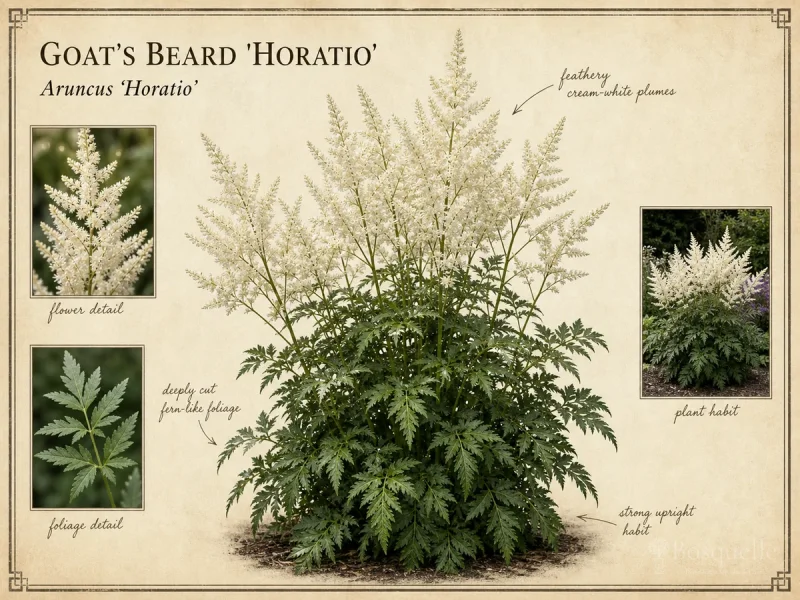
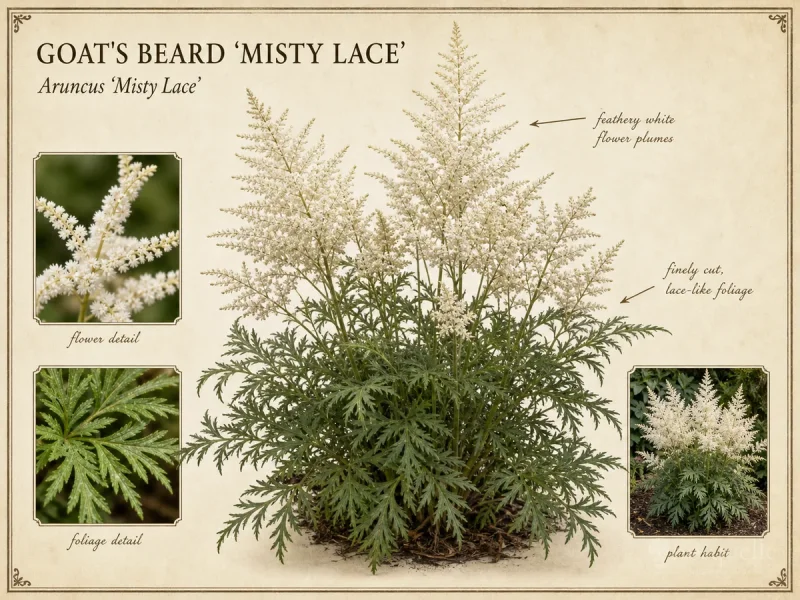
- Lace — ‘Chantilly Lace’, ‘Horatio’, and ‘Misty Lace’: named hybrids between the tall and dwarf types, usually 2–3 feet. Same moisture and light.
Is goat's beard the same as Astilbe?
No. Both can look feathery in shade, but Aruncus is in the rose family, with deeper roots and slower establishment. Check the Latin on the tag.
What is the difference between Aruncus dioicus and dwarf goatsbeard?
A. dioicus is the tall classic. A. aethusifolius stays much shorter for tighter beds. Match scale to the space before planting.
Pots
- Use a large pot with drainage holes and a mix that stays moist without sitting in a saucer of water.
- Dwarf and lace kinds fit a pot more easily than the tall wild type.
- Check moisture more often than in the ground. Open ground with cool mulched soil is easier to keep evenly moist.
Can I grow goat's beard in a container?
Yes, for dwarf or compact kinds in a large moisture-holding pot with drainage holes. Open ground is easier to keep evenly moist.
Partners
Pair with ferns, hostas, and other woodland perennials that already live in moist shade. Do not share a dry gravel strip with Mediterranean herbs.
Names
Bride's feathers and goatsbeard are the same plant. Aruncus is the Latin. Filipendula (meadowsweet) is a different rose-family plume.
Mulch the crown and water when the top inch dries in heat. Do not judge plume height until the second or third summer.
FAQ
Are goat's beard deer resistant?
Often less browsed than hostas, not guaranteed. Fence where deer pressure is high.
Should I fertilize goat's beard?
Compost at planting is enough. A light spring top-dress is optional. Avoid a high-nitrogen push that forces soft growth.
When do I cut goat's beard foliage back?
Cut the foliage to the ground in late fall or early spring before new shoots rise.
Can I grow goat's beard from seed?
Yes, with cold stratification and patience. A nursery plant is faster. Seed from a female plant will not come true to a named hybrid.
Recommended plants



More first-season notes by plant are gathered in How to Grow Guides.
Updated: Reviewed by Bosquelle Editors