
Grow globe thistle in full sun and lean, well-drained soil, and leave the taproot where you plant it. The tag may also say Echinops. Rich or winter-wet ground fails it faster than drought.

Give it full sun, lean soil, and drainage that stays dry in winter
| Factor | Recommended | Avoid |
|---|---|---|
| Light | Full sun for strong stems and dense globes | Shade that stretches stems and fades the blue |
| Soil | Average to lean, well-drained ground. Gravel or a raised bed helps in clay | Rich organic bowls and winter-wet pockets |
| Water | Water to establish, then ease off. Drought is normal once roots take | Keeping the crown wet all summer |
| Winter | Soil that drains so the crown does not sit in standing water | A low clay hole that drowns the plant by spring |
| Wildlife | Bees work the globes. Deer and rabbits often skip the spines | Expecting a pest-proof plant in a wet, shady bed |
Globe thistle wants sun and lean drain. Once it is set, missed summer water is less of a problem than a soggy winter crown. [1] It needs very well-drained soil to overwinter. Light afternoon shade can help foliage in heat, but the plant still wants sun. [2] New clumps often spend the first summer making leaves more than bloom. That is age, not a failed cultivar.
Is globe thistle hard to grow?
No, in full sun and lean drain. Rich wet clay and a move of a mature taproot fail it.
Does globe thistle come back every year?
Yes. It is a hardy perennial. Winter sog kills more clumps than summer drought.
Do globe thistles spread easily?
They can reseed. Deadhead before seed if seedlings get weedy. The clump itself stays put on a taproot.
Where is the best place to plant globe thistle?
Full sun and lean, well-drained ground — a dry border, not a bog or a rich mixed bed.
Does globe thistle like sun or shade?
Full sun. Shade stretches stems and softens the globes. A little afternoon shade in heat is optional.
Will globe thistle bloom the first year?
Often not. Many plantings make foliage the first summer and bloom the second.
Pair it with other dry-sun plants
Pair it with other lean-sun perennials that share drain — ornamental grasses, yarrow, lavender, Russian sage — not bog iris or thirsty annuals in one small pot.
Deadhead spent globes, then cut stems in late winter
| Factor | Recommended | Avoid |
|---|---|---|
| Spent globes | Cut them for a second flush, or before seed if seedlings get weedy | Letting every head seed in a tidy border |
| Winter stems | Cut in late winter or early spring when new shoots show | Shearing green stems in midsummer |
| Dried heads | Leave a few for winter structure and seed-eaters if you can spare seedlings | Treating every volunteer as a named cultivar |
Deadheading spent blooms encourages a second flush. Cut before seed if you do not want seedlings.
- Wear gloves. The globes and leaves are spiny.
- Cut spent heads for more bloom, or leave some dried heads if you want winter structure.
- If seedlings get weedy, deadhead before seed sets. Named kinds may not come true from seed.
- Cut the stems down in late winter or early spring when new growth starts. Do not shear in July.
Should you deadhead globe thistle?
Yes for a second flush and to limit seed. Leave a few dried heads if you want winter structure.
Should Echinops be cut back?
Cut spent globes in summer if you want more bloom. Cut the stems in late winter or early spring.
Do you cut back globe thistle in the fall?
You can leave stems through winter, then cut when new shoots show. Fall cut is optional, not required.
Leave the taproot put; divide only in spring if you must
The taproot wants a permanent seat. Division is difficult and slow to re-establish. If you must split a clump, do it carefully in spring and expect a slow restart. Most gardeners add a second plant instead of chopping a good clump. [3]
- Leave a healthy clump where it is.
- If you must divide, lift in spring, keep as much root as you can, and replant at once in drainable ground.
- Water the new piece through the first season. Do not expect a full show that summer.
Can I transplant globe thistle?
Usually no — the taproot resents a move. Site it permanently. If you must, lift carefully in spring.
Can you lift and divide Echinops?
It is hard and slow. Spring is the usual window. A new plant from a nursery is often easier.
Skip a patio pot except as a deep grit hold
Open lean ground wins. A pot is only a short hold: a deep container, a gritty mix, and no standing water in the saucer. Plant it out while it is still small. Do not keep a mature taproot in a bowl that stays wet.
Can globe thistle grow in pots?
A deep, sharply draining pot can hold a young plant. The lasting planting is in free-draining ground.
Not a cactus, sea holly, or a weed thistle
Echinops is globe thistle in the daisy family. Echinopsis is a cactus — a different genus and a different watering job. Sea holly is Eryngium: similar steel-blue look, still not this plant. A shop tag that says Eryngium on a Taplow Blue is a mislabel, not a second crop. Weed thistle and milk thistle are other plants. Confirm globe thistle / Echinops on the tag before you copy cactus or sea-holly care.
Is Echinops the same as Echinopsis cactus?
No. Echinops is globe thistle, a perennial with steel globes. Echinopsis is a cactus.
What is the difference between eryngium and Echinops?
Eryngium is sea holly. Echinops is globe thistle. Both like sun and drain; they are not the same plant.
How do I know what type of thistle I have?
Globe thistle has round steel heads on a clump, not a creeping weed thistle or a milk-thistle crop.
Taplow Blue, Veitch’s Blue, Arctic Glow, or a smaller ritro
Culture is the same lean sun, winter drain, and stay-put taproot. Height and flower color are the choice. Shop lists of Sea Stone and Platinum Blue are not extra plants we hold.
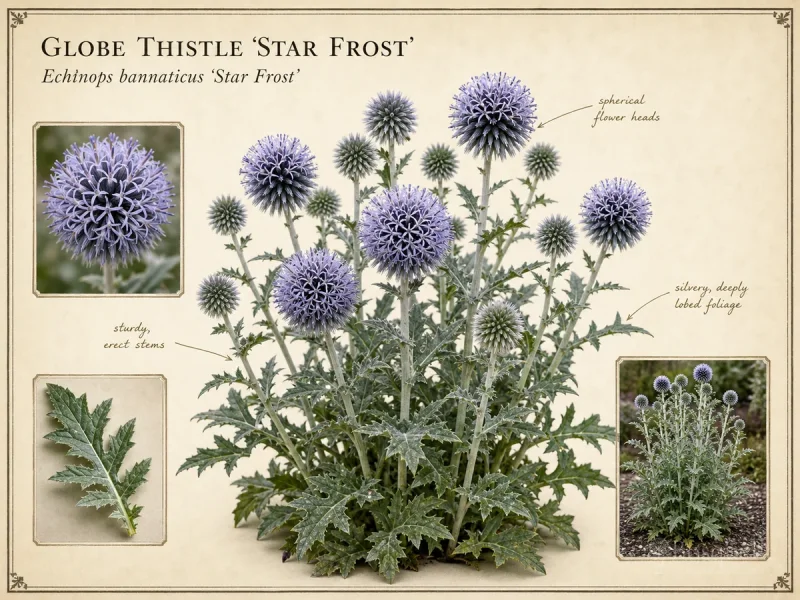
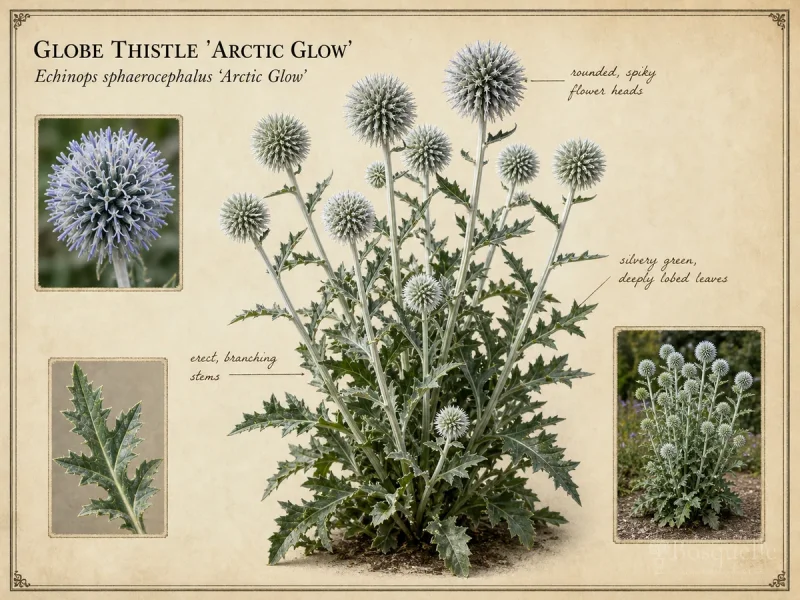
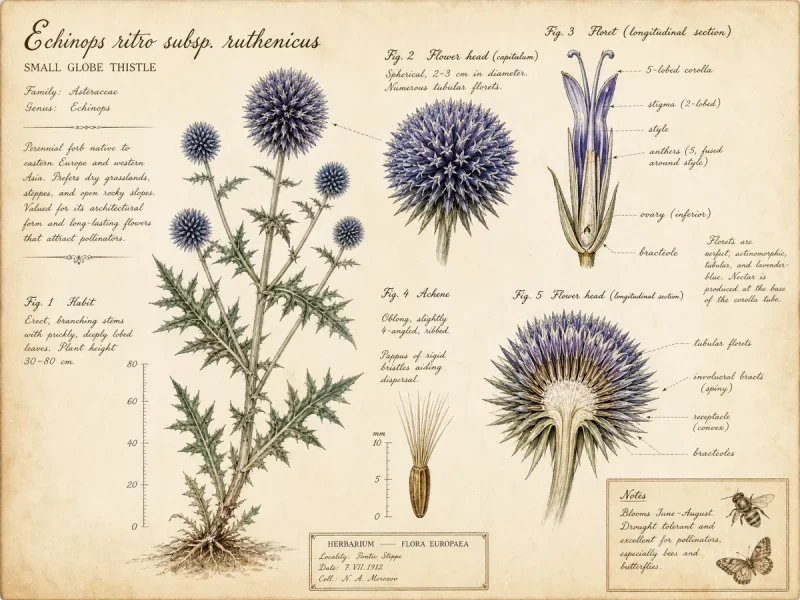
‘Blue Glow’, ‘Star Frost’, and ‘Taplow Blue’ are the usual bannaticus blues. ‘Veitch’s Blue’ is the darker ritro form. ‘Arctic Glow’ is the pale sphaerocephalus globe. E. ritro subsp. ruthenicus is the smaller scale on the same dry-sun contract. [4]
What are the different varieties of globe thistle?
We list Blue Glow, Star Frost, Taplow Blue, Veitch’s Blue, Arctic Glow, and a smaller ritro. Extra shop names are not extra kinds here.
What is the common name for Echinops?
Globe thistle. Some tags also say blue globe thistle.
Keep the bed lean and drained, leave the taproot put, deadhead if you want more bloom, and confirm the tag is not a cactus.
FAQ
What is Echinops?
The Latin genus for globe thistle. It is not Echinopsis cactus and not sea holly.
Is globe thistle invasive?
It can reseed. Northern gardens usually treat it as polite. Deadhead if seedlings get weedy.
Is Sea Stone a plant we hold?
No extra Sea Stone or Platinum Blue card. Culture is still the same lean-sun kinds on this page.
Related guides
Recommended plants



References
- [1] NC State Extension -
https://plants.ces.ncsu.edu/plants/echinops-ritro/ - [2] Illinois Extension -
https://extension.illinois.edu/flowers/globe-thistle - [3] Iowa State University Extension and Outreach -
https://yardandgarden.extension.iastate.edu/how-to/how-divide-and-transplant-perennials - [4] Northern Gardener -
https://northerngardener.org/plant-profile-globe-thistle/
This note is part of Echinops Guides.
More first-season notes by plant are gathered in How to Grow Guides.
Updated: Reviewed by Bosquelle Editors