
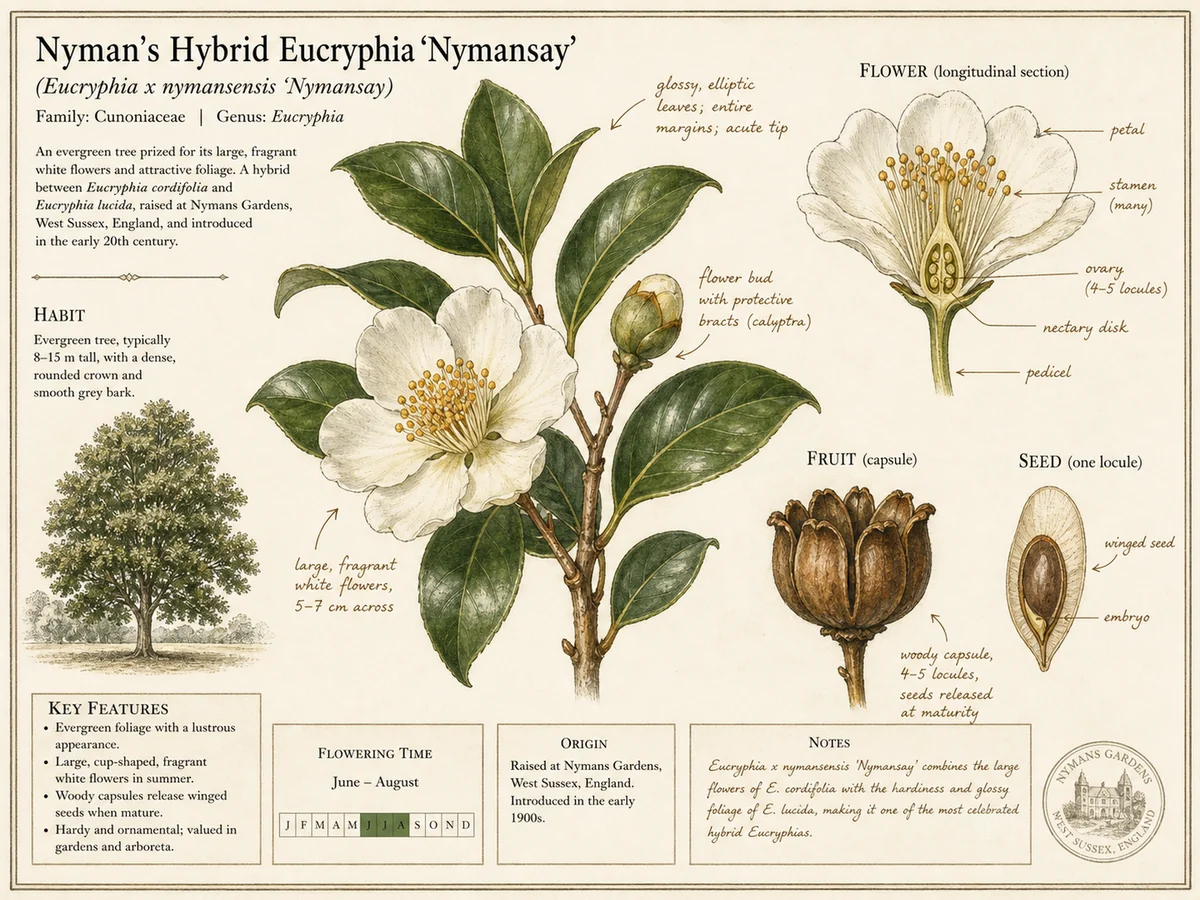
Grow eucryphia with cool, moist soil around the roots and the head in the sun, and shelter it from a drying wind. This tree is Eucryphia × nymansensis ‘Nymansay’, also sold as Nyman's Hybrid Eucryphia.
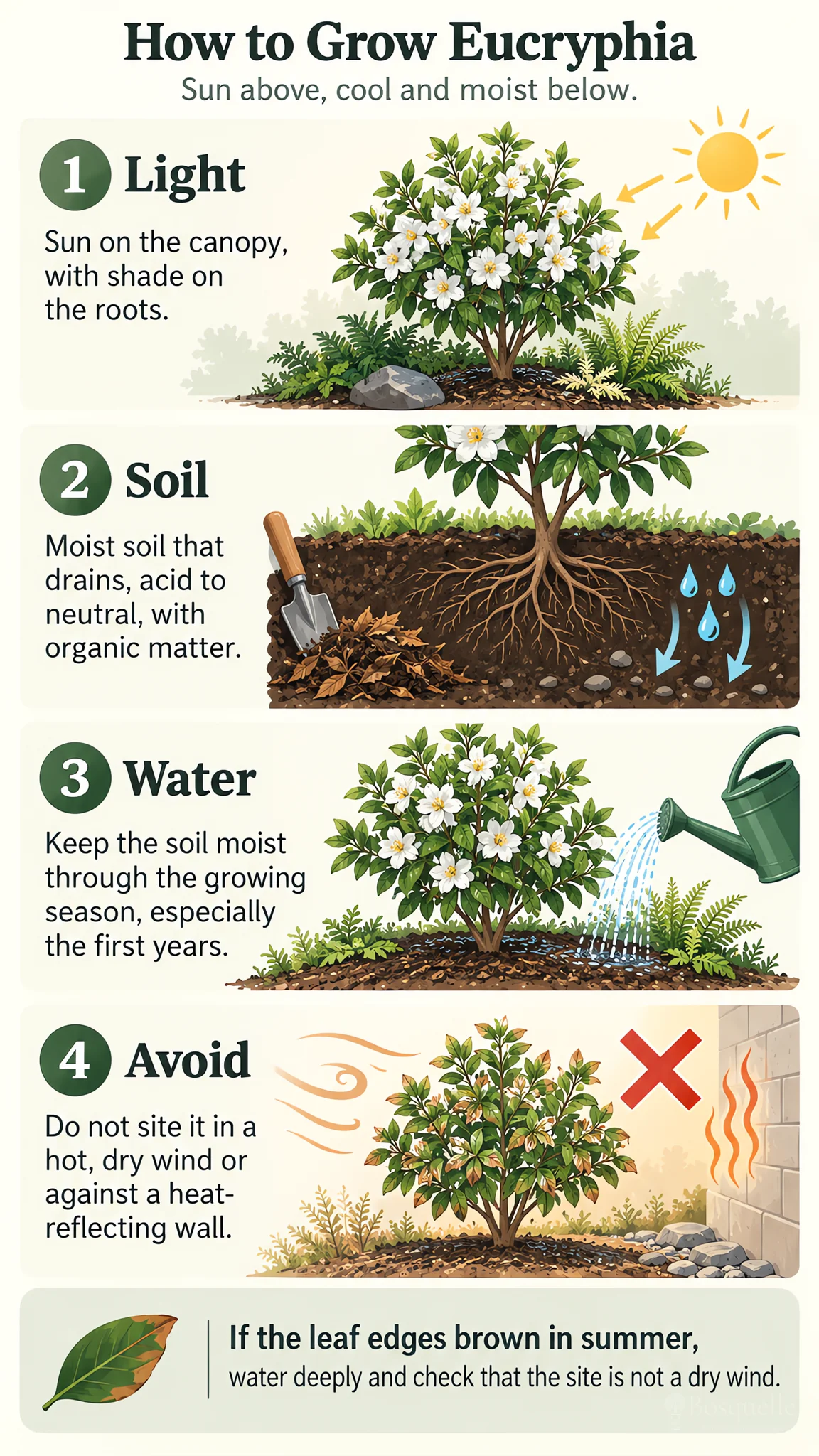
Keep the roots cool and moist, and the head in the sun
| Factor | Recommended | Avoid |
|---|---|---|
| Light | Sun on the canopy, with shade on the roots | Do not site it in a hot, dry wind or against a heat-reflecting wall |
| Water | Keep the soil moist through the growing season, especially the first years | Do not let the soil dry around the roots |
| Soil | Moist soil that drains, acid to neutral, with organic matter | Do not plant it where water stands around the roots |
| Size | About 20 to 50 feet tall and 6 to 12 feet wide | Do not crowd it against a walk; it stays narrow, but it still needs that height |
Nyman's Hybrid Eucryphia is an evergreen columnar tree about 20 to 50 feet tall and 6 to 12 feet wide. Keep the soil moist and cool around the roots, and let the canopy stand in sun, because that is how the tree sets its late-summer flowers. [1] Water through a dry spell, especially the first summers. A drying wind browns the leaves and can strip flower buds, so site it where other plants or a building break the wind. [2] Mulch over the roots to keep them cool, and keep the mulch off the trunk. Skip extra fertilizer the first year.
How do you grow eucryphia?
Give it cool, moist soil around the roots, sun on the canopy, room to reach about 20 to 50 feet, and shelter from a drying wind.
How do you care for eucryphia?
Keep the soil evenly moist, water deeply when a dry spell hits, and keep it out of a hot, dry wind. Brown leaf edges in summer usually mean the roots dried out.
How big does eucryphia get?
A mature tree is about 20 to 50 feet tall and about 6 to 12 feet wide. Leave that height so the canopy can fill in.
Plant it in spring, in a sheltered spot
Plant a young nursery tree in spring so the roots can grow while the soil is warming. Set the flare where the trunk widens at soil level, not buried in a deep hole, and pick a spot that is out of a drying wind.
- Plant in spring, while the soil is warming and the tree can still put on roots before the heat of summer.
- Dig a hole as deep as the root ball and about twice as wide. Do not bury the flare.
- Set the top of the root ball level with the soil, firm it, and water it in.
- Spread about 2 inches of mulch over the roots to keep them cool, and keep the mulch off the trunk. Water through the first summers if rain is short.
When should I plant eucryphia?
Plant it in spring, when the soil is warming. A young tree settles better then than a large tree moved in midsummer.
Prune little — cut dead or crossing wood
Eucryphia needs little pruning once it is in the ground. Cut dead, damaged, or crossing wood, and leave the natural columnar shape.
- Wait until after the late-summer flowers fade, or until late winter while the tree is still quiet.
- Cut dead, damaged, or crossing branches back to a side branch or a collar.
- Do not hard-cut a mature crown into a hedge. The flowers sit on the current wood, so a heavy cut removes the next show.
Do I need to prune eucryphia every year?
No. Cut dead or crossing wood and leave the natural shape. A yearly hard cut will cost you flowers.
It flowers in late summer
The show is a cover of white, fragrant flowers with a boss of yellow stamens, usually in late summer when few other trees are in bloom. [3] A young nursery tree can flower earlier than a seedling. Extra fertilizer will not rush that calendar. Keep the roots moist through summer so the buds do not drop.
When does eucryphia flower?
It usually flowers in late summer, with the show running into early fall. A young nursery tree can bloom sooner than a seedling.
Seed will not come true to Nymansay
You can sow seed, but a hybrid will not come true, so the seedling is not the named tree you bought. [4] Buy a nursery tree if you want that late-summer show on a known plant.
- If you still want to try seed, sow it in late winter in a mix that drains, and keep the mix from drying out.
- Grow the seedling under cover for at least the first winter.
- Plant it out in spring after frost, and keep watering it the first summers in the ground.
Start a plant from a semi-hardwood cutting
A semi-hardwood cutting is the usual way to keep the named tree. A nursery plant is still the easier start if you want flowers sooner.
- Take a short piece of firm summer wood, about 3 inches long, with a small heel of older wood if you can.
- Stick it in a mix that drains.
- Keep the mix barely moist until roots hold, in bright shade rather than hot sun.
Not eucalyptus — and not swamp titi
Eucalyptus is a different genus. The names look alike on a search page, and videos for eucryphia often mix in eucalyptus seed trays. If the tag says eucalyptus or gum tree, read How to Grow Eucalyptus.
Leatherwood is a name people use for more than one plant. Swamp titi is Cyrilla, also sold as leatherwood in the American South. If the tag says titi or swamp cyrilla, read How to Grow Titi. Leatherleaf is Chamaedaphne; that keep-alive is How to Grow Leatherleaf.
Tasmanian leatherwood honey comes from a different eucryphia that this shop does not hold. Nymansay, Mount Usher, and Rostrevor on a tag are still this genus. They want the same cool, moist soil and shelter. They are not a second species in this shop.
Is eucryphia a eucalyptus?
No. Eucalyptus is a different genus. Eucryphia is the late-summer evergreen with cool, moist roots and the head in the sun.
Is eucryphia the same as leatherwood?
Not in this shop. Swamp titi is also sold as leatherwood in the American South. Tasmanian leatherwood honey comes from a different eucryphia.
If the leaf edges brown in summer, water deeply and check that the site is not a dry wind.
FAQ
Can I grow eucryphia in a pot?
A nursery pot is how a young tree is sold, not a houseplant. Plant it in the ground. A 20-foot specimen will not stay in a patio pot, and a hot terrace dries the roots.
Does eucryphia need winter protection?
An established tree stays in the ground. Shelter it from a drying winter wind so the evergreen leaves do not brown. Do not lift it like a tender pot plant. Cold damage on the foliage often grows out in spring.
Is this the tree that makes leatherwood honey?
No. That honey comes from Tasmanian leatherwood, a different eucryphia. This tree is a garden show, not a kitchen crop.
Are eucryphia poisonous to dogs?
This tree did not show up on the pet-plant lists we opened. Keep pets from chewing landscape plants as a habit.
Is Nymansay a different species?
No. Nymansay is still Eucryphia × nymansensis. It wants the same cool, moist soil and shelter. It is the usual named tree in this shop.
Recommended plants
References
- [1] Royal Horticultural Society -
https://www.rhs.org.uk/plants/91467/eucryphia-x-nymansensis-nymansay/details - [2] Portland Monthly -
https://www.pdxmonthly.com/home-and-real-estate/2010/09/september-10-eucryphia - [3] Trees and Shrubs Online -
https://www.treesandshrubsonline.org/articles/eucryphia/eucryphia-x-nymansensis/ - [4] Plants For A Future -
https://pfaf.org/user/Plant.aspx?LatinName=Eucryphia+x+nymansensis
More first-season notes by plant are gathered in How to Grow Guides.
Updated: Reviewed by Bosquelle Editors