
Grow diphylleia in moist shade. Diphylleia is one species, Diphylleia cymosa, also sold as American umbrellaleaf. It is not the skeleton flower.

Keep it in moist shade
| Factor | Recommended | Avoid |
|---|---|---|
| Light | Part shade to full shade | Do not put it in hot afternoon sun |
| Soil | Moist, humus-rich woodland soil | Do not let the soil dry in summer |
| Water | Keep the soil moist all season | Do not let it dry, and do not sink the crown in deep water |
| Site | A seep, stream edge, or woodland bed, out of strong wind | Do not plant it in a dry, windy border |
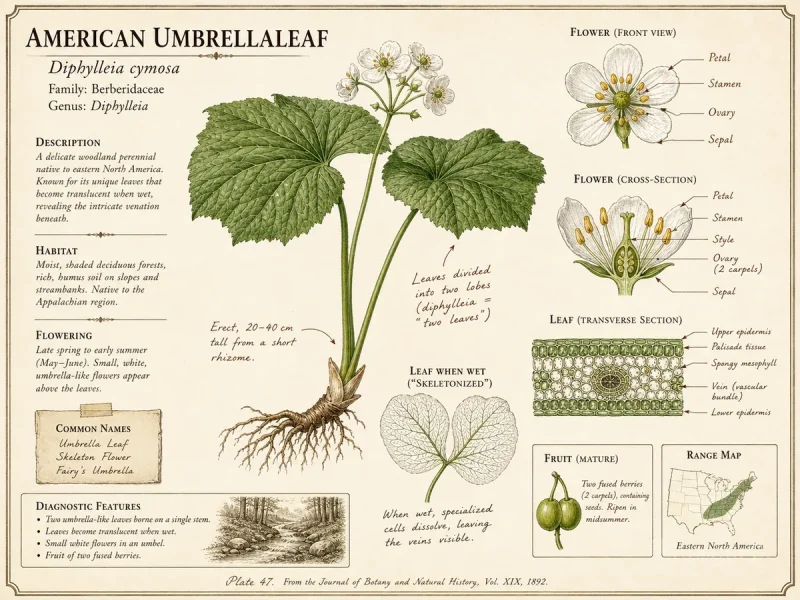
diphylleia is a clump of large umbrella leaves. A flowering stem usually carries two peltate leaves — the stalk joins under the middle of the blade — and each blade can reach a foot across or more. White flowers open in a cluster above those leaves in late spring, then blue berries sit on red stalks. Keep the soil moist and cool so the leaves stay green. Dry soil browns the edges. [1] [2]
How much sun does diphylleia need?
Part shade to full shade is the usual home. Hot afternoon sun browns the leaves unless you can keep the soil moist.
How wet should the soil stay?
Keep it moist all season. Do not let it dry in summer, and do not sink the crown in deep water.
Plant in spring, with the rhizome just below the soil
Plant a container plant in spring, when the soil is workable. Set the rhizome at the old soil line so the buds are not buried, and leave room for the leaves to open.
- Plant in spring, when the soil is workable.
- Dig a hole as deep as the pot and a little wider.
- Set the rhizome at the old soil line. Do not bury the buds.
- Leave about one to three feet between plants, so the leaves can open.
- Water well, then keep the soil moist.
- Choose a seep, stream edge, or woodland bed, not a dry border.
When do I plant diphylleia?
Plant in spring, with the rhizome at the old soil line.
Split a crowded clump in spring
When the clump is crowded, lift it in spring as the new shoots emerge. Split the rhizome so each piece has buds and roots, then replant at the same depth.
- In spring, as new shoots emerge, lift the clump.
- Split the rhizome so each piece has buds and roots.
- Replant at the same depth, and water so the soil stays moist.
When do I divide it?
In spring, as the new shoots emerge. Replant at once at the same depth.
Let the leaves die down in fall
The large leaves feed the rhizome for next spring. Leave them in place until they yellow and die down in fall. Do not cut green foliage. This is a hardy garden perennial. Do not lift the rhizomes and store them dry.
- Leave the leaves until they yellow and die down in fall. [3]
- Cut dead stems to the ground in late fall or in early spring, if you want a tidy bed.
- Spread a thin layer of leaf mold so the soil stays moist. Do not bury the crown under a heavy bark mulch.
Do I cut the leaves in summer?
No. Leave the leaves until they die down. Cut only dead stems later, if you want a tidy bed.
Not the skeleton flower — and not mayapple or indoor umbrella plant
Skeleton flower is Diphylleia grayi, a Japanese cousin. Its white petals turn clear when they stay wet. The plant we list is American umbrellaleaf. It wants the same moist shade, but the petals do not put on that show, and we do not list the Japanese plant as a second card.
What happens to a skeleton flower when it rains?
The Japanese skeleton flower turns clear after a long wet spell. American umbrellaleaf does not do that trick. If you bought this plant for glass petals, you have the wrong species.
How hard is it to grow skeleton flowers?
That question is about the Japanese plant. Grow this one in moist shade, and do not treat a shop packet of skeleton-flower seed as this clump.
Indoor umbrella plant is usually Schefflera, a woody houseplant that dries between waterings. This plant is a woodland perennial with two large leaves per flowering stem.
Mayapple is Podophyllum peltatum. Its flower hangs under the leaves, and the colony often dies back by midsummer. This plant holds larger leaves, and the white cluster stands above them. Some lists now file American umbrellaleaf as Podophyllum cymosum. That is the same plant, not mayapple.
If the tag says umbrella plant and the leaves are round and the flowers open on naked stems before the foliage, that is darmera. See How to Grow Darmera. If you bought the usual big shade leaves for a border, see How to Grow Hostas.
In the wild it forms colonies on moist Blue Ridge slopes, in seeps, and along streams, then it is grown as an ornamental in the same kind of ground. [4]
Is this the indoor umbrella plant?
No. Indoor umbrella plant is usually Schefflera. This plant wants moist garden soil and flowers above the leaves.
Is this the same as mayapple?
No. Mayapple hides its flower under the leaves. This plant holds the white cluster above two larger umbrella leaves.
Set it in moist shade, with the rhizome at the old soil line. Keep the soil from drying, and do not buy a skeleton flower, an indoor umbrella plant, or mayapple as this plant.
FAQ
Can I grow it from seed?
You can sow fresh seed in a cold frame, but the plants are slow. Division in spring is the usual way to make more clumps.
Can I grow it in a pot?
A large pot that stays moist, in shade, can hold a young plant. It is not a houseplant. A windowsill pot of ordinary mix will dry out.
Is skeleton flower a second kind we sell?
No. Skeleton flower is a Japanese cousin we do not list. The plant here is American umbrellaleaf. It wants the same moist shade.
Can I eat the berries?
Grow this plant for the leaves and the blue fruit on red stalks, not as a crop. Do not take the roots as medicine.
Recommended plants
References
- [1] Fine Gardening -
https://www.finegardening.com/plant/umbrella-leaf-diphylleia-cymosa - [2] NC State Extension -
https://plants.ces.ncsu.edu/plants/podophyllum-cymosum/ - [3] Royal Horticultural Society -
https://www.rhs.org.uk/plants/5929/diphylleia-cymosa/details - [4] Lady Bird Johnson Wildflower Center -
https://www.wildflower.org/plants/result.php?id_plant=DICY2
More first-season notes by plant are gathered in How to Grow Guides.
Updated: Reviewed by Bosquelle Editors