
Grow cholla in full sun with soil that drains fast. The tag may also say jumping cholla. Joints cling when you brush them; they do not leap.
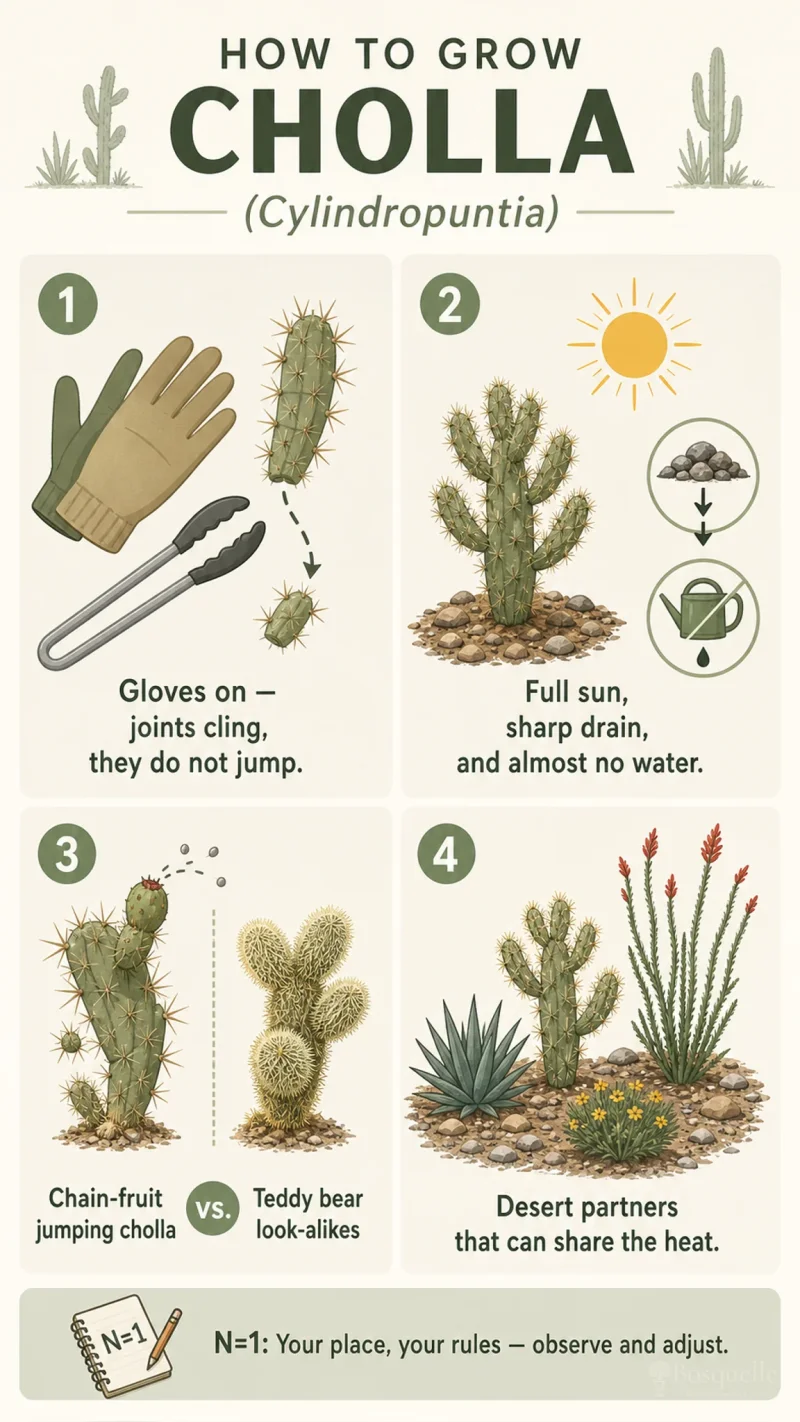
Give it full sun, sharp drainage, and water only when the soil is dry
| Factor | Recommended | Avoid |
|---|---|---|
| Light | Full sun for the whole day; desert heat is normal | Shade that keeps stems soft and slow to dry |
| Soil | Sandy, rocky, or a cactus mix that drains in minutes | Compost-rich beds, clay bowls, or any spot where water stands |
| Water | A deep soak only after the root zone is dry several inches down; rain often covers established plants in an arid garden | Watering on a calendar into wet soil |
| Handling | Metal tongs or a hose fragment to lift joints; eye protection when you prune | Bare hands, or grabbing a clinging joint with leather gloves |
| Winter | Leave established plants dry through cool weather | Wet soil while the plant is not in active growth |
Cholla takes the same full sun it gets in open desert. Give it a half day of direct light at a minimum; more is better. Soil must drain in minutes — sand, gravel, or a commercial cactus mix — because wet roots rot first. [1] Move every loose joint with metal tongs, not your hands. Barbed spines go through ordinary gloves once a segment clings, so tongs or a piece of hose are the working tool. [2] Water only when the soil is dry several inches down. In warm growth that may mean a deep soak every few weeks if rain stays away; in cool weather, skip extra water on plants that are already in the ground.
- Choose a full-sun strip with room to walk around the mature plant. Keep it off narrow paths.
- Use sandy or rocky ground, or a cactus mix. Raise a clay spot into a low mound so water cannot sit at the stem.
- Water deeply only after the root zone dries. Empty any saucer. Do not keep the soil damp.
How often should I water cholla?
Only when the soil is dry several inches down. In warm growth that may be every few weeks if rain stays away. Wet soil causes rot.
How do you remove cholla spines?
Lift the joint off skin or clothing with tongs or a comb. Then use tweezers or tape for remaining spines and glochids. Do not grab the joint with your fingers.
Pair it with other desert plants, and leave a walking gap
Site cholla with plants that want the same dry, blazing strip — agave, yucca, ocotillo, and other well-spaced cacti — and leave a clear walking gap so joints do not catch on neighbors you handle often.
Plant into dry soil, and root a callused joint
Plant a nursery plant into dry ground, at the same depth it grew in the pot, on a slight mound if the site is heavy. Do not water the day you plant. Wait about a week so any bruised roots can dry, then water once and let the soil dry again. Buy nursery stock. Wild chain-fruit cholla is salvage-restricted in Arizona; do not dig desert plants.
- Wear eye protection. Lift the plant or joint with metal tongs, not your hands.
- Slide a nursery plant from its pot. Knock off a peat-heavy mix if the garden soil is mineral and sandy.
- Dig a hole no deeper than the root ball. Set the stem at the old soil line, on a slight mound if drainage is slow.
- Backfill with the site soil. Do not add compost.
- Wait about a week, then water once. After that, water only when the soil is dry.
- To start a new plant, lift a healthy joint with tongs, let the cut dry in shade until it calluses, then stand it on dry cactus mix in bright light and withhold water until roots hold.
How do you propagate cholla?
Take a joint with tongs, let the cut callus in dry shade, then set it on dry cactus mix in bright light. Water only after roots hold.
Is it legal to dig cholla in Arizona?
Wild chain-fruit cholla is often salvage-restricted. Buy a nursery plant and keep the tag if your state asks. Do not dig desert specimens.
Use a pot that drains if you need a movable plant
Open ground is the default. A wide, heavy pot with a drainage hole and cactus mix works if you need to move the plant. Never leave it sitting in a saucer of water, and keep it off walkways.
Can I grow cholla in a pot?
Yes, in a wide pot that drains, with cactus mix, in full sun. Empty the saucer. Keep it away from paths.
Not a prickly pear, and it does not leap
Cholla is Cylindropuntia: cylindrical joints with papery sheaths on the spines. Prickly pear is Opuntia, with flat pads. Do not copy pad-cactus watering onto these stems. [3] The name jumping cholla describes how easily a joint detaches and clings when you brush it — not a spring-loaded throw. Teddy bear cholla is also sold as jumping cholla; both drop clingy joints. That nickname does not make them the same plant, and neither species leaps through the air. Eve's Needle and some cane-cholla tags are Austrocylindropuntia or another species, not these plants.
Why is it called jumping cholla?
Stem segments detach and cling so easily that it feels as if they jumped. You still have to brush the plant. They do not leap on their own.
Is cholla the same as prickly pear?
No. Cholla has round joints. Prickly pear has flat pads. Grow them as different plants.
Chain-fruit jumping cholla, teddy bear, golden, or tree cholla
Sun, drainage, tongs, and dry soil are shared. Outline and fruit are the choice. Do not treat extra shop names as a different plant.
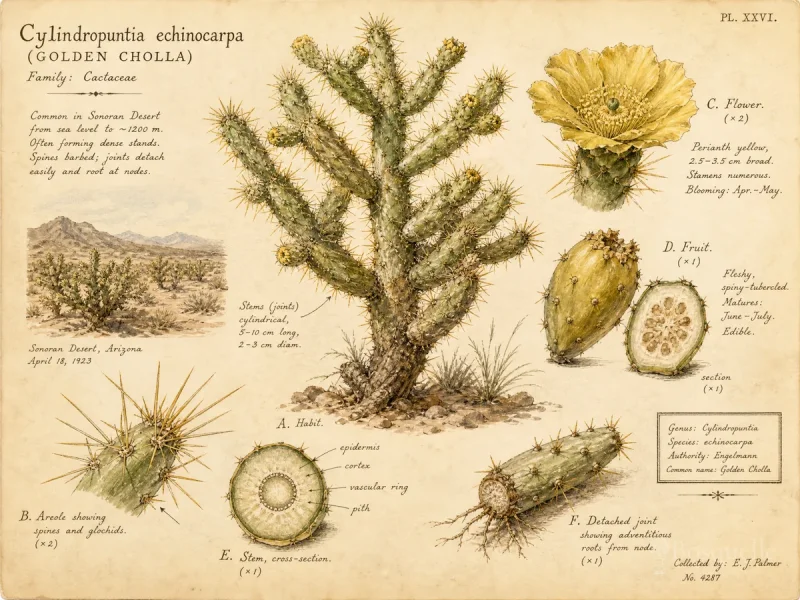
C. fulgida is chain-fruit / hanging-chain cholla — a taller, branching plant, often about six to ten feet, with pink to magenta flowers and spineless fruit that hangs in long chains for years. C. bigelovii is teddy bear cholla: denser golden spines on a usually shorter shrub; shops also say jumping cholla, but it does not make the hanging fruit chains. C. echinocarpa is golden or silver cholla, a bushy plant with pale sheaths. C. imbricata is tree or walking-stick cholla, with a stout trunk and pink to purple flowers. [4] Choose chain-fruit when you want the hanging fruit; choose teddy bear for the dense golden outline; choose tree cholla for a taller cane form.
Jumping cholla vs teddy bear cholla — what’s the difference?
Chain-fruit jumping cholla (C. fulgida) makes hanging fruit chains and a taller frame. Teddy bear cholla (C. bigelovii) is usually shorter with denser golden spines. Both drop clingy joints.
How big does jumping cholla get?
Chain-fruit plants often reach six to about ten feet. Tree cholla can run taller. Plan path setbacks before you plant.
Site it in full sun, move joints with tongs, plant into dry soil, and start new plants from a callused joint.
FAQ
Are extra shop names extra plants?
No. Buckhorn, pencil, Christmas cholla, and similar tags are other species or shop names. This page covers the four catalog plants.
Is cane cholla Eve's Needle?
Some cane-cholla tags are Eve's Needle (Austrocylindropuntia), a different plant. Walking-stick / tree cholla in this catalog is Cylindropuntia imbricata. Read the Latin on the tag.
Can I eat cholla?
Garden culture is the job here, not a food essay. Do not treat the joints as a crop.
What about cholla wood?
The dry skeleton is a craft material, not a grow step. Site a living plant in sun with drainage instead.
Recommended plants



References
- [1] University of Arizona Campus Arboretum -
https://arboretum.arizona.edu/snyder-preserve-cylindropuntia-fulgida - [2] University of Arizona Cooperative Extension -
https://www.extension.arizona.edu/publication/how-transplant-cactus - [3] Southwest Desert Flora -
https://www.southwestdesertflora.com/WebsiteFolders/All_Species/Cactaceae/Cylindropuntia%20fulgida,%20Jumping%20Cholla.html - [4] Texas A&M AgriLife Extension -
https://rangeplants.tamu.edu/plant/cholla/
More first-season notes by plant are gathered in How to Grow Guides.
Updated: Reviewed by Bosquelle Editors