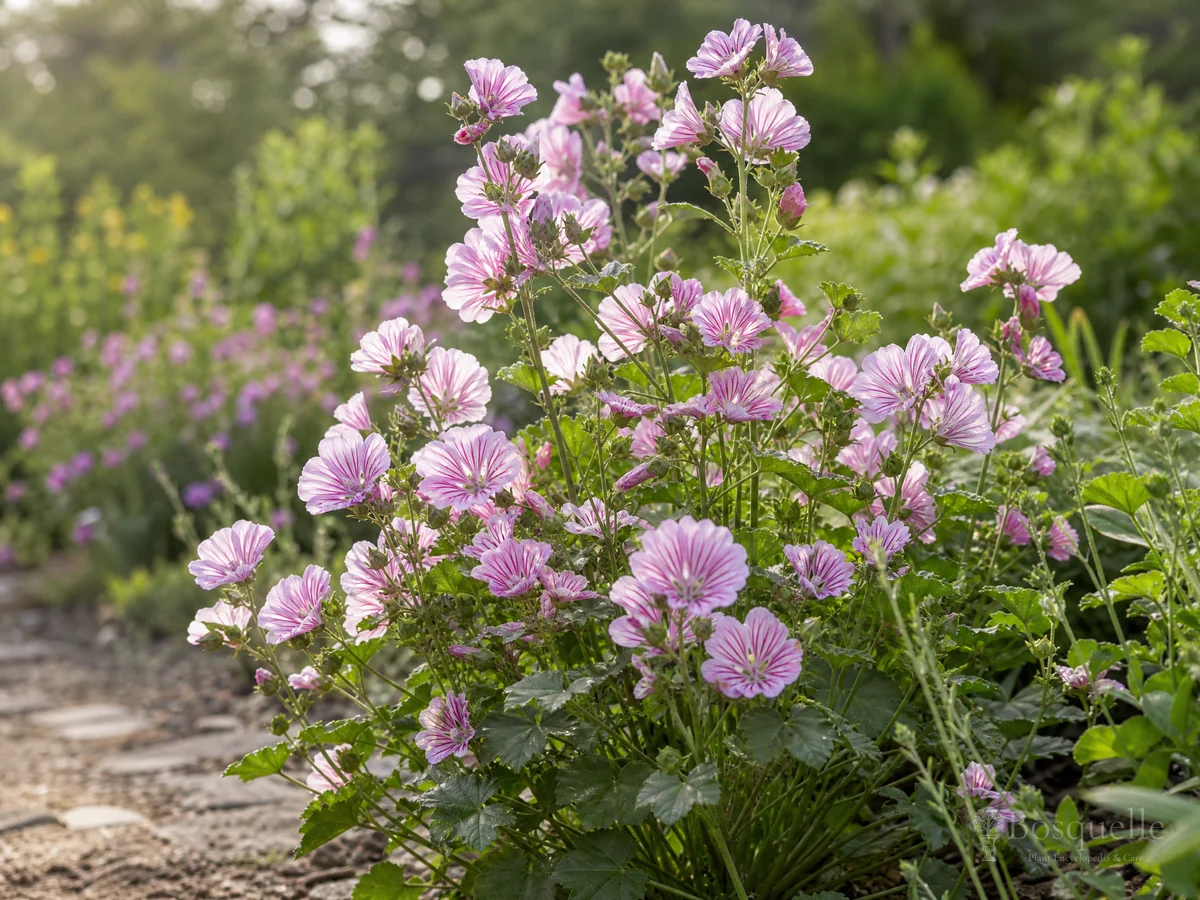
Grow checkerbloom as a slim spike of silky, five-petaled flowers that look like a miniature hollyhock. Checkerbloom is Sidalcea, also called prairie mallow or checker mallow — not a garden hollyhock and not globemallow.

Give it full sun, soil that drains, and even moisture in summer
| Factor | Recommended | Avoid |
|---|---|---|
| Light | Full sun; light afternoon shade in a hot summer | Do not plant it in deep shade, where the spikes thin |
| Water | Even moisture in summer for garden hybrids | Do not leave the crown in a wet winter pocket |
| Soil | Soil that drains, with compost worked in at planting | Do not plant into soggy clay that stays wet all winter |
| Site | A border with moving air, out of a hard wind | Do not plant it in hot, humid still air with no shade at noon |
| Feed | A light compost mulch in spring | Do not dump nitrogen every week |
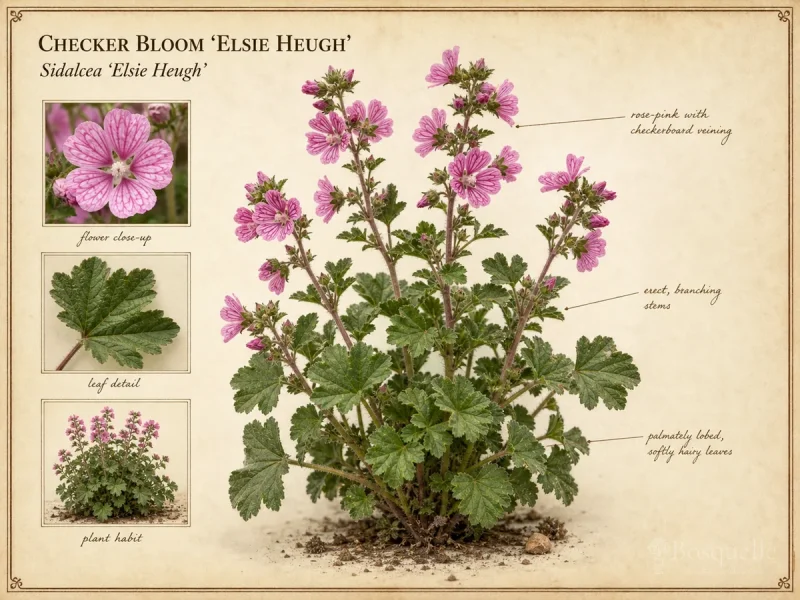
Checkerbloom wants full sun and soil that drains. Garden hybrids want even moisture through summer, because dry soil in the heat stops the next buds. [1] A hot, humid summer with no afternoon shade is a poor fit, so give it moving air and a little shade at noon in the South. [2] Elsie Heugh uses that moist, draining bed as a two- to three-foot hybrid with fringed pale-pink petals. checkerbloom is Sidalcea malviflora, the California native. After the rains stop, let that plant rest dry instead of watering it like a border hybrid; the top can die back in late summer and return when the rains start again. [3] Water a new plant through the first summer. A native stand can rest later; a new crown still needs that first soak.
How much sun does checkerbloom need?
Give it full sun. Light afternoon shade helps in a hot summer. Deep shade thins the spikes.
How often do I water it in summer?
Keep garden hybrids evenly moist in summer. A California native can rest once the dry season starts. Winter wet around the crown is what rots it.
Plant in spring, with the crown at soil level
Plant a young plant in spring after the soil has warmed, or in early fall on ground that drains. Set the crown at the same depth it grew in the pot. Leave about two to three feet so air can move around the stems.
- Plant in spring after frost, or in early fall on soil that drains.
- Dig a hole as deep as the pot and a little wider.
- Set the crown at soil level. Do not bury the stems.
- Water through the first summer so the roots can take. Do not leave the crown in a winter puddle.
Split a crowded clump in spring
If the clump dies out in the center, lift it in spring and split it into pieces that each have roots and shoots. Reset each piece at the same depth, about eight to twelve inches apart on a native clump. Named kinds stay true this way, because they do not come true from seed.
When do I plant it?
Plant in spring after frost, with the crown at soil level. Early fall is fine on ground that drains.
Sow species seed in fall
Species checkerbloom starts well from seed sown in late fall, because winter cold helps it germinate. Soak the seed in hot water overnight before you sow, then cover it about an eighth of an inch. [4] Named hybrids such as Elsie Heugh do not come true from seed, so divide those instead of sowing them.
- Sow species seed in late fall on bare soil that drains.
- Soak the seed in hot water overnight, then cover it about an eighth of an inch.
- Keep the seedbed from drying until seedlings take. Leave them in place.
- Do not sow a named hybrid if you want the same flower. Split that clump in spring instead.
When do I sow checkerbloom seed?
Sow species seed in late fall, after a hot-water soak, and cover it about an eighth of an inch. Named hybrids do not come true from seed.
Cut the spikes back after they fade
Spikes open from early summer into late summer if the soil stays moist. Cut each spent spike back as the top flowers fade, so side shoots can open a second flush. When flowering is finished, cut the stems down to the basal leaves. Pull any rust-spotted leaves and throw them away, rather than leaving them on the crown.
- Cut spent spikes back as the top flowers fade, down to a leafy joint.
- When the flush is done, cut the stems down to the basal leaves.
- Pull rust-spotted leaves and throw them away. Do not compost them on the bed.
- Stake only if a hard wind knocks a tall stem. Most clumps stand without canes.
Do I cut the spikes after they bloom?
Yes. Cut spent spikes so a second flush can open, then cut the stems to the basal leaves in fall.
Not a hollyhock — and not globemallow
Hollyhock is Alcea, a taller stalk that often rusts hard in humid air — see How to Grow Hollyhocks. Checkerbloom is Sidalcea, a slimmer spike with rounded basal leaves and more deeply lobed stem leaves. Globemallow is Sphaeralcea, a dry-garden plant that wants almost no extra water — see How to Grow Globemallow. A shop tag that says prairie mallow can mean this plant or scarlet globemallow; read the Latin. Garden mallow is Malva — see How to Grow Mallow. Winecup is Callirhoe — see How to Grow Winecup. Tree mallow is Lavatera — see How to Grow Tree Mallow.
Is this the same as a hollyhock?
No. Hollyhock is Alcea. Checkerbloom is Sidalcea, a slimmer spike. Globemallow is Sphaeralcea, a dry-garden plant.
Set checkerbloom in full sun on soil that drains, keep garden hybrids moist in summer, and cut the spikes after they fade.
FAQ
Is Elsie Heugh a different species?
Elsie Heugh is a named garden hybrid of checkerbloom, not a second genus. Give it the same full sun and draining soil, and keep it evenly moist in summer.
Do you list Oregon checkermallow?
Oregon checkermallow is another Sidalcea, from moist meadows, and it is not on this list. Use the same sun and draining soil if you already own one.
Can I grow checkerbloom in a pot?
It is a border plant, not a houseplant. A deep outdoor pot can hold a young plant if the mix drains, but you will water more often than in the ground.
Does checkerbloom come back every year?
Yes. It dies to a basal rosette in winter and grows again in spring. A California native can rest in late summer and return with the rains. Winter wet around the crown is what stops it.
Can I eat it?
Do not eat this plant. It is a garden flower, not a kitchen crop.
Recommended plants

References
- [1] Missouri Botanical Garden -
https://www.missouribotanicalgarden.org/PlantFinder/PlantFinderDetails.aspx?kempercode=m350 - [2] Harvest to Table -
https://harvesttotable.com/how-to-grow-sidalcea-false-mallow/ - [3] Theodore Payne Foundation -
https://www.theodorepayne.org/nativeplantdatabase/index.php?title=Sidalcea_malviflora - [4] Lady Bird Johnson Wildflower Center -
https://www.wildflower.org/plants/result.php?id_plant=SIMA2
More first-season notes by plant are gathered in How to Grow Guides.
Updated: Reviewed by Bosquelle Editors