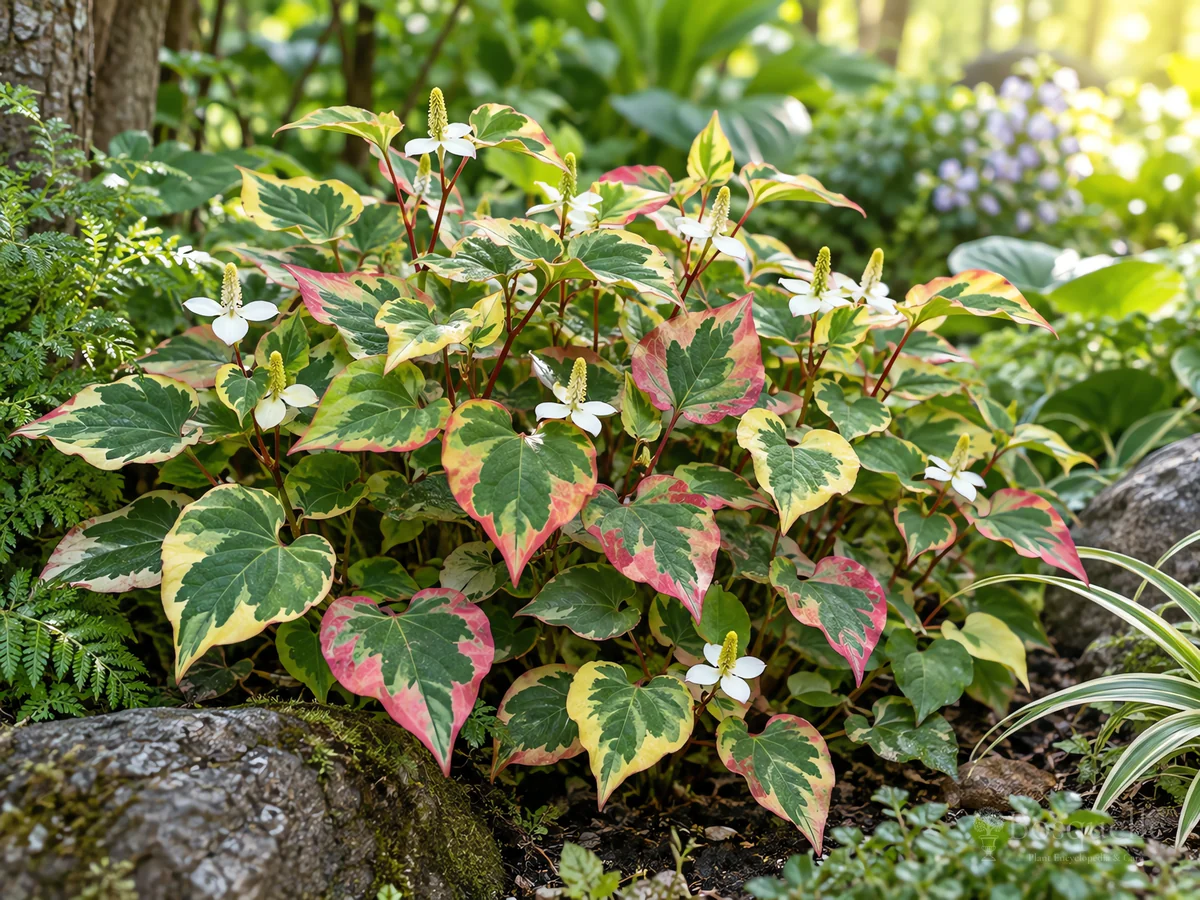
Grow chameleon plant in consistently moist to wet soil, and give the cream-and-red leaves sun. Chameleon plant is Houttuynia cordata ‘Chameleon’, also called fish mint — a wet-running groundcover, not lizard's tail.
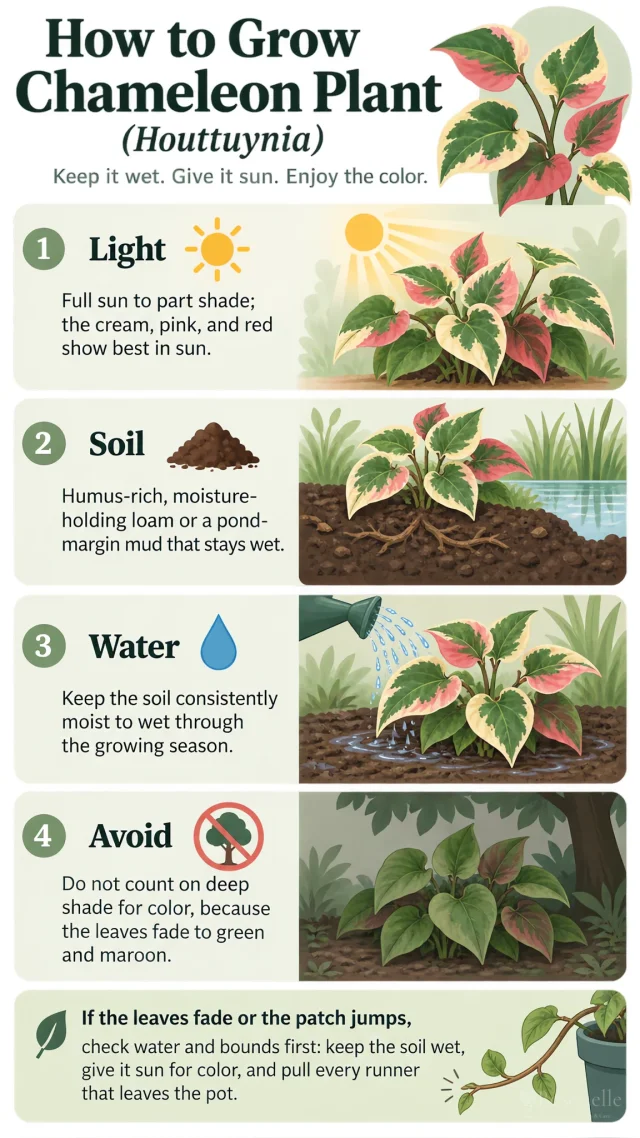
Keep the soil wet, and give the variegated leaves sun
| Factor | Recommended | Avoid |
|---|---|---|
| Light | Full sun to part shade; the cream, pink, and red show best in sun | Do not count on deep shade for color, because the leaves fade to green and maroon |
| Water | Keep the soil consistently moist to wet through the growing season | Do not let the bed dry out, because dry ground scorches the leaves |
| Soil | Humus-rich, moisture-holding loam or a pond-margin mud that stays wet | Do not plant it in a dry, sandy bed and expect it to stay compact and colorful |
| Feed | Little or none — average garden soil is enough | Do not feed it heavily, because extra fertilizer only pushes more runners |
Chameleon plant is a heart-leaved runner from wet ground in Southeast Asia. Keep the soil wet and give it sun if you want the cream, pink, and red to hold, because shade grows a greener, more vigorous mat. [1] It will take part shade, and even heavy shade, but the variegation dulls there. Full sun to part sun is the usual garden spot, as long as the ground does not dry. [2] Do not mix it into a mixed wet border, because the rhizomes run through neighbors. Contain the clump in a pot — that plant-out is on Planting Chameleon Plant. Once it is in, water whenever the soil starts to dry at the surface, and expect little or no fertilizer.
How much sun does chameleon plant need?
Full sun to part shade. The cream and red show best in sun. Deep shade keeps it alive but fades the leaves toward green.
Cut dead stems in spring, and pull every runner that jumps
The tops die after a hard freeze, and new shoots are slow to show in spring. When you see the first red stems, cut last year's dead stems to the ground so the new flush is easy to watch.
Through the season, pull or snip any runner that has jumped the pot or the barrier, because a piece left in the soil will start a new patch. If a stem has lost the cream and red and gone all green, dig that stem and its crown out, because the green form is stronger and will take over. [3] In a hot, dry spell the leaves may scorch; cut the ruined foliage off and water the crowns, and a fresh flush follows.
- In late winter or early spring, cut dead stems to the ground before the new shoots elongate.
- Pull or snip every runner that has jumped the pot as soon as you see it, and bag the pieces.
- Dig out any all-green shoot and its crown, so the variegated plant is not crowded out.
When does chameleon plant bloom?
In mid to late spring. Tiny greenish-white flowers sit on a short spike with four white bracts, and they are easy to miss among the leaves.
If it has already run, dig it out and bag every piece
Once chameleon plant is in open ground, it is hard to finish. The rhizomes snap, and any scrap left behind sprouts again, so one casual fork-over makes more plants, not fewer. [4] Work from outside the patch inward, and keep at it for more than one season.
- Start about 2 feet outside the visible foliage, so you catch rhizomes that have already run ahead of the leaves.
- Dig at least 12 inches deep and dump each shovelful onto a tarp. Sift out every rhizome, stem, and leaf fragment.
- Bag those pieces for the trash. Do not compost them, and do not dump them in a waterway.
- Watch the spot through the next one or two seasons and pull any sprout as soon as it shows.
Can I just mow it or cover it?
Mowing the tops does not kill the rhizomes. A tarp can miss runners that creep out from the edge, so digging and bagging is the reliable home method.
Not lizard's tail — and not yerba mansa or Vietnamese coriander
Lizard's tail is Saururus, a native wetland plant with a nodding white spike and no cream-and-red leaves. If that is the tag, read How to Grow Lizard's Tail instead.
Yerba mansa is Anemopsis, a western marsh plant once listed as Houttuynia californica. That is a different genus. Read How to Grow Yerba Mansa if that is the shop name. Fish mint on an herb tag is often this same Houttuynia; Vietnamese coriander is Persicaria odorata, a different kitchen herb — see How to Grow Vietnamese Coriander if that is the plant in the pot. Bruised chameleon plant leaves smell fishy or citrus; that scent, the heart-shaped leaf, and the four white bracts are the usual check.
Is chameleon plant the same as lizard's tail?
No. Lizard's tail is Saururus, with a nodding white spike. Chameleon plant is Houttuynia, the cream-and-red wet runner.
If the leaves fade or the patch jumps, check water and bounds first: keep the soil wet, give it sun for color, and pull every runner that leaves the pot.
FAQ
Is there more than one kind of chameleon plant?
Houttuynia cordata ‘Chameleon’ is the plant here, also sold as ‘Variegata’ and ‘Tricolor’ — the same cultivar under extra names. A green species and a double-bract form exist in trade but are not in this catalog.
Will it come back after winter?
Yes. The tops die after a hard freeze, and the rhizomes send up new shoots in spring. They are often slow to show, so wait before you assume the pot is empty.
Can I grow it as a houseplant?
It is a garden plant for wet ground or a pond pot. You can keep a pot on a wet patio; a dry indoor windowsill is not the right home.
Is the leaf edible?
People eat the green species in parts of Asia. Do not treat the garden plant as a recipe or a medicine.
Related guides
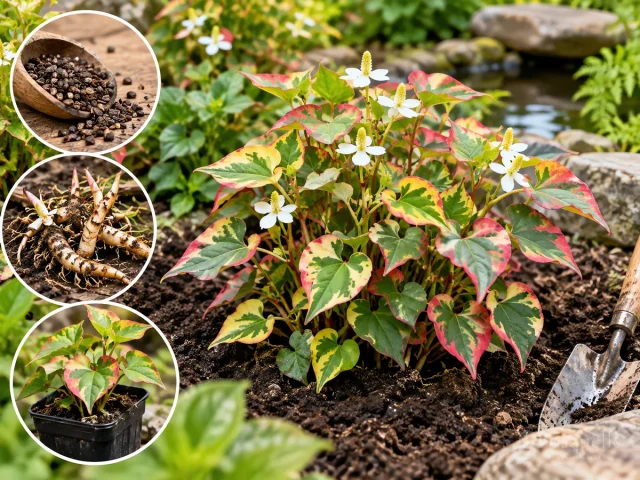
Recommended plants
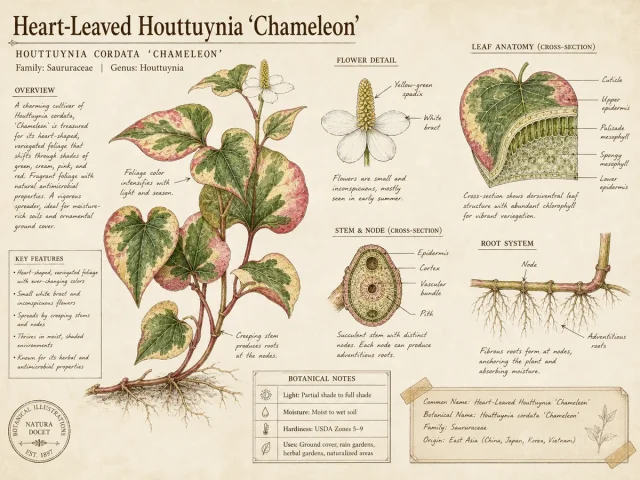
References
- [1] NC State Extension Gardener -
https://plants.ces.ncsu.edu/plants/houttuynia-cordata/ - [2] Missouri Botanical Garden -
https://www.missouribotanicalgarden.org/PlantFinder/PlantFinderDetails.aspx?taxonid=248966 - [3] Ohio State University -
https://hvp.osu.edu/pocketgardener/source/description/ho_rdata.html - [4] Gardening Know How -
https://www.gardeningknowhow.com/ornamental/groundcover/chameleon-plant/get-rid-of-chameleon-plants.htm
This note is part of Houttuynia Guides.
More first-season notes by plant are gathered in How to Grow Guides.
Updated: Reviewed by Bosquelle Editors