
Grow catalpa in full sun, with room for a coarse shade tree that drops long pods. Cigar tree is the name most gardeners type for those pods.
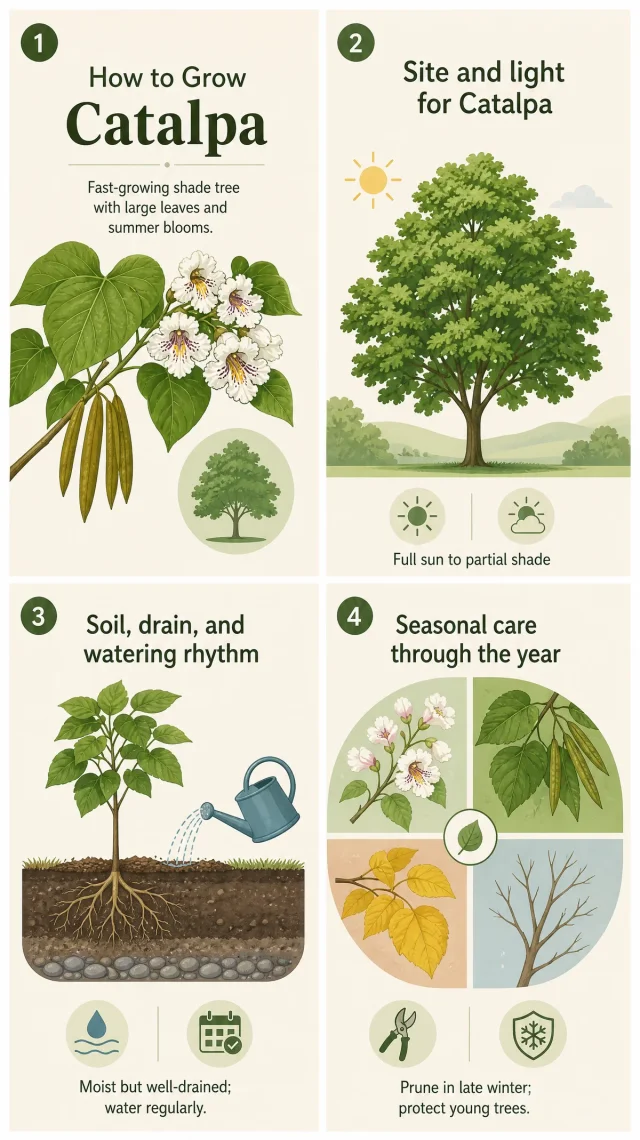
Full sun, room to mature, and soil that drains after rain
| Factor | Recommended | Avoid |
|---|---|---|
| Light | Full sun; light part shade is tolerable | Deep shade with weak bloom |
| Soil | Moist loam preferred; wet, dry, or alkaline sites are acceptable | A puddle that never drains, or a tiny courtyard |
| Size | Plan 40 to 60 feet tall and 20 to 40 feet wide for northern catalpa | Wires, walks, and a parking pad under the canopy |
| Water | Settle a new tree, then extra water only in long drought | Daily irrigation on an established tree |
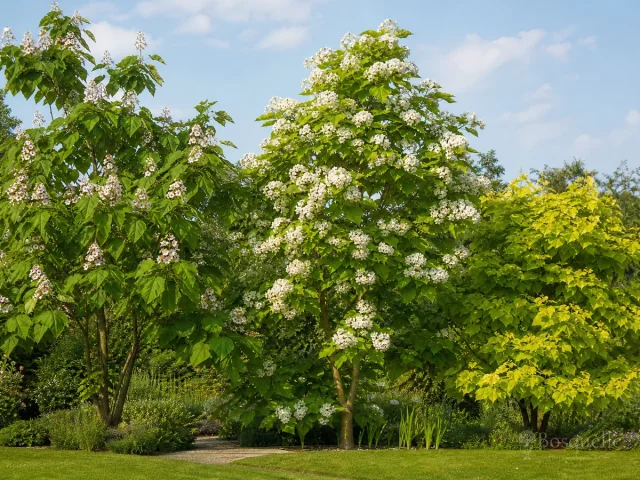
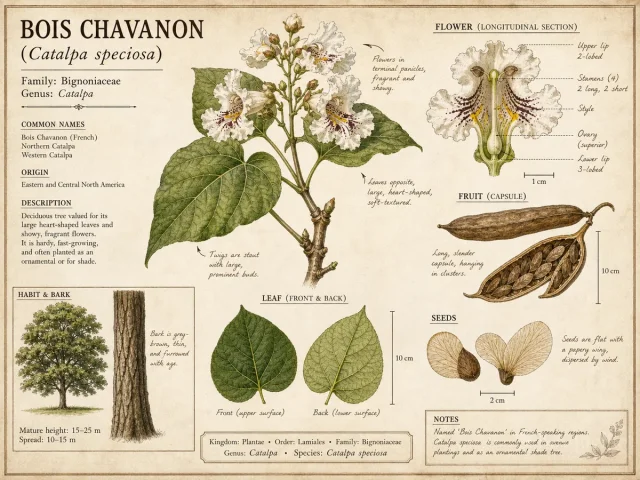
Site for sun and space first. Northern catalpa (C. speciosa) takes full sun or part shade and prefers moist loam, but it still grows on awkward wet or dry ground. [1] Give it the width of a real shade tree — about 40 to 60 feet tall and 20 to 40 feet wide at Morton's brief — and keep the crown off power lines. [2]
How big does catalpa get?
Northern catalpa is commonly 40 to 60 feet tall and 20 to 40 feet wide. Southern catalpa is often a little shorter. Do not site it under wires.
Pods, brittle wood, and catalpa worms
After the white panicles fade, long bean-like pods hang, then drop. Leaves are large and coarse. Illinois flags the fruit as messy and the tree as too coarse for a small, tidy yard. [3] Wood is brittle, so storms shed limbs — prune for a strong framework on Pruning Catalpa.
Catalpa sphinx caterpillars — catalpa worms — can strip leaves in outbreak years. Florida notes the tree is regularly defoliated and still lives. [4] Do not spray by default. A healthy tree pushes a second flush if the chew happens early.
How messy is catalpa?
Pods, large leaves, and spent flowers drop. Site it over lawn or a bed you can rake, not over a walk or parked cars.
Do catalpa worms hurt the tree?
Usually no. Outbreaks look bad, then the tree leafs out again. Skip a calendar spray. Repeated defoliation on an already sick tree is a different problem.
Northern, southern, or golden catalpa
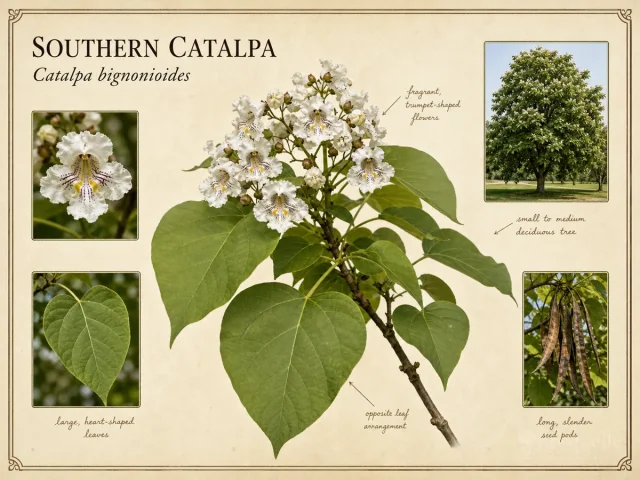
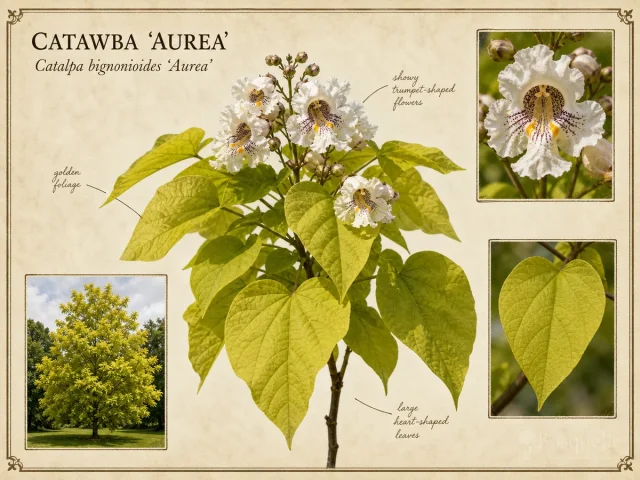
Northern catalpa (C. speciosa) is the colder-hardy, earlier bloom. Southern catalpa (C. bignonioides) is shorter and flowers later. Golden (‘Aurea’) is the yellow-leaf southern selection. Shop classes and the princess-tree lookalike are on Types of Catalpa.
Plant, prune, or grow from seed
- Set a tree in spring or fall, flare at grade — Planting Catalpa.
- Prune while dormant for a strong leader — Pruning Catalpa.
- Sow dry pods without pretreatment — Growing Catalpa from Seed.
If the yard cannot take pods and storm wood, pick a different shade tree — do not site catalpa under wires.
FAQ
How fast does catalpa grow?
Fast when young, often a couple of feet a year, then it slows as the crown rounds out.
How long does a catalpa live?
Often around 60 years in a landscape. Large old trunks can hold rot — that is age, not a missed watering.
What else can I plant under catalpa?
Tough shade that can take summer drought at the roots — not a thirsty hosta bed on the same faucet. Leave the flare clear of mulch volcanoes.
Is it a good tree in Colorado or a small yard?
It takes heat, drought, and alkaline soil once established, but it is still a large, pod-dropping tree. A small tidy courtyard is the wrong site.
What pests hit catalpa?
Catalpa worms are the famous one and usually not fatal. Leaf spots and mildew are cosmetic. Verticillium wilt can kill — that is a disease, not a worm year.
Related guides


Recommended plants
References
- [1] NC State Extension -
https://plants.ces.ncsu.edu/plants/catalpa-speciosa/ - [2] The Morton Arboretum -
https://mortonarb.org/plant-and-protect/trees-and-plants/northern-catalpa/ - [3] University of Illinois Extension -
https://web.extension.illinois.edu/hortanswers/plantdetail.cfm?PlantID=192&PlantTypeID=7 - [4] University of Florida IFAS -
https://ask.ifas.ufl.edu/publication/ST130
This note is part of Catalpa Guides.
More first-season notes by plant are gathered in How to Grow Guides.
Updated: Reviewed by Bosquelle Editors