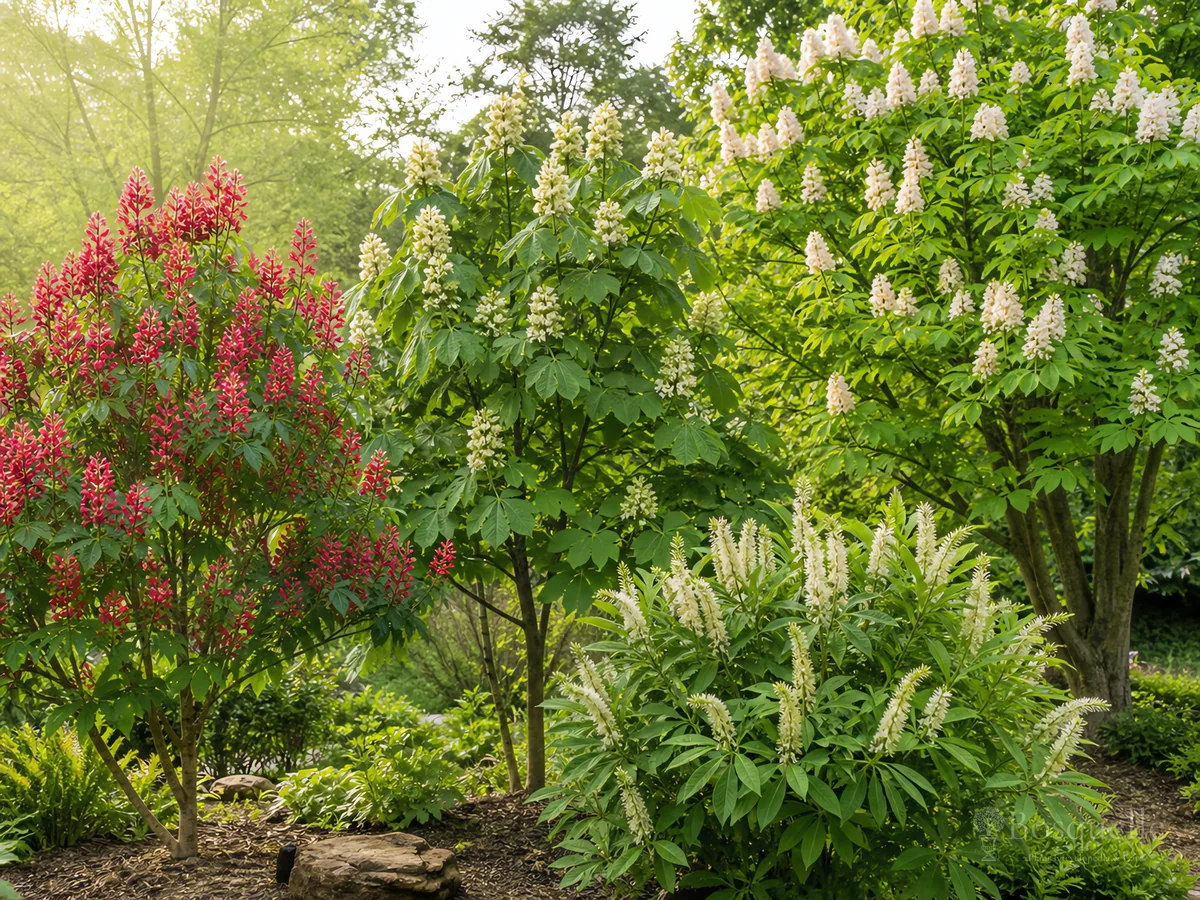
Grow buckeye and horse chestnut in sun to part shade with moist, fertile soil that drains. Buckeye is Aesculus — a deciduous tree or large shrub with palmate leaves and spring flower panicles, not an edible chestnut.

Give it sun to part shade and moist soil that drains
| Factor | Recommended | Avoid |
|---|---|---|
| Sun | Full sun to part shade; afternoon shade helps in hot summers | Do not site it in deep shade that thins the crown and cuts bloom |
| Soil | Moist, fertile, slightly acidic loam, the kind along a stream terrace | Do not plant in compacted clay, dry sandy subsoil, or a low wet pocket |
| Site | A woodland edge, a north or east lawn, or a yard with room for the mature crown | Do not use a street strip, a reflected-heat wall, or a salted curb |
| Kind | bottlebrush buckeye and red buckeye take more shade than the large trees | Do not squeeze horse chestnut or Ohio buckeye into a bed that cannot hold a 40 ft crown |
Buckeye is an understory tree in rich woods, so the root zone wants moisture it can drain. Compacted new-construction soil and a dry summer lawn are the main reasons leaves scorch and drop early. [1] [2] yellow buckeye still wants that moist drain, even though blotch bothers it less. Match size and light on Types of Buckeye.
How much sun does buckeye need?
Sun to part shade. Most kinds flower more with a few hours of direct sun. Horse chestnut and Ohio buckeye take part shade. Red buckeye and bottlebrush buckeye grow well in woodland shade.
Water a new tree through the first season
A new buckeye needs water so roots move out of the nursery ball. An established tree handles short dry spells better, but a long hot stretch still scorches the outer leaves.
- Soak the root zone after you plant. Check a few inches down and water again when that soil starts to dry, not on a fixed calendar.
- Keep the root zone moist — not soggy — through the first full growing season. A slow soak is more useful than a brief splash every day.
- Once the tree is established, water during extended dry periods. Stop if soil below the surface is still wet.
- Mulch about two inches over the root zone to hold moisture. Keep the mulch a few inches off the trunk so the bark stays dry.
How often should I water a new buckeye?
Water when the soil a few inches down starts to dry, through the first growing season. Do not keep the hole soggy, and do not let a new tree bake through a dry week.
Prune little, in late winter, and leave the lower limbs
Buckeye and horse chestnut need little pruning once the form is set. Late winter, before the buds open, is the usual window.
- Wait until late winter. You can see the branch structure, and the tree is still dormant.
- Cut out dead, damaged, or crossing wood. On a young tree, keep one main leader if the top has split into two.
- Leave the lower limbs on Ohio buckeye unless they are dead or in the way of a walk. Those limbs are part of the natural rounded crown.
- Do not top a mature horse chestnut, and do not cut large live limbs you can leave. Big wounds on this genus close slowly and invite decay.
Bottlebrush buckeye is a shrub. If the colony has run past the bed, cut unwanted suckers at the ground in late winter and stay on this light prune — do not shear it like a hedge.
When should I prune buckeye?
Late winter, before buds open. Remove dead, damaged, or crossing wood. Keep cuts light on a mature tree.
Leaves turn brown in midsummer — drought scorch or leaf blotch
Two different problems brown buckeye and horse chestnut in midsummer. Both look alarming on an established tree, and neither is usually fatal.
Drought scorch starts at leaf margins and tips on the sunny or windward side of the canopy. Leaves inside the crown stay greener longer. The root zone ran dry in heat. Water deeply and keep the mulch in place; the tree leafs out normally the next spring.
Guignardia leaf blotch shows as reddish-brown patches with a bright yellow margin, scattered through the whole canopy, not only the sunny side. The spots show on both faces of the leaflet. [3] Infected leaves may drop by late summer, but the buds stay alive. Rake and bag fallen leaves in autumn so spores do not splash onto new growth. Do not reach for a spray on a large landscape tree — the disease is cosmetic.
If the tag is California buckeye, bare branches in July can be summer rest, not scorch. Pick that kind on Types of Buckeye.
Why are my buckeye leaves turning brown?
Scorch browns the edges on the sunny side after a dry spell. Leaf blotch makes scattered reddish patches with yellow margins. Water scorch. Rake blotch leaves in fall.
Not an edible chestnut — buckeye and horse chestnut are Aesculus
Buckeye and horse chestnut belong to Aesculus. Edible chestnut belongs to Castanea. They are in different families, and the nuts are not interchangeable.
- Aesculus (buckeye and horse chestnut) — palmate compound leaves with 5–7 leaflets from one stalk; a round nut in a fleshy, sparsely spined husk; all parts toxic, including the nut.
- Castanea (sweet chestnut) — simple toothed leaves; an edible nut inside a densely spiny bur with a small point or tassel at the tip.
Do not eat buckeye nuts or horse chestnuts. Aesculin and saponins cause stomach upset and, in larger amounts, weakness. Squirrels cache the nuts; people, dogs, cats, and horses should not. [4] Rake fallen nuts where pets play.
Are buckeyes safe to eat?
No. Seeds, leaves, bark, and flowers contain aesculin and saponins. Only true chestnut (Castanea) has an edible nut.
If the outer leaves brown in July, soak the root zone once, then wait — a new tree almost always traces that scorch to a dry week.
FAQ
Can I grow buckeye in a container?
Only as a short nursery start. Buckeye and horse chestnut make large root systems and do not stay healthy long-term in a pot. Bottlebrush buckeye is the better candidate for a large tub, and even that does best in the ground.
What about spraying leaf blotch?
Skip the spray on a landscape tree. Rake and bag fallen leaves in fall. The blotch is ugly in a wet summer and is not a killing disease on an established plant.
Related guides
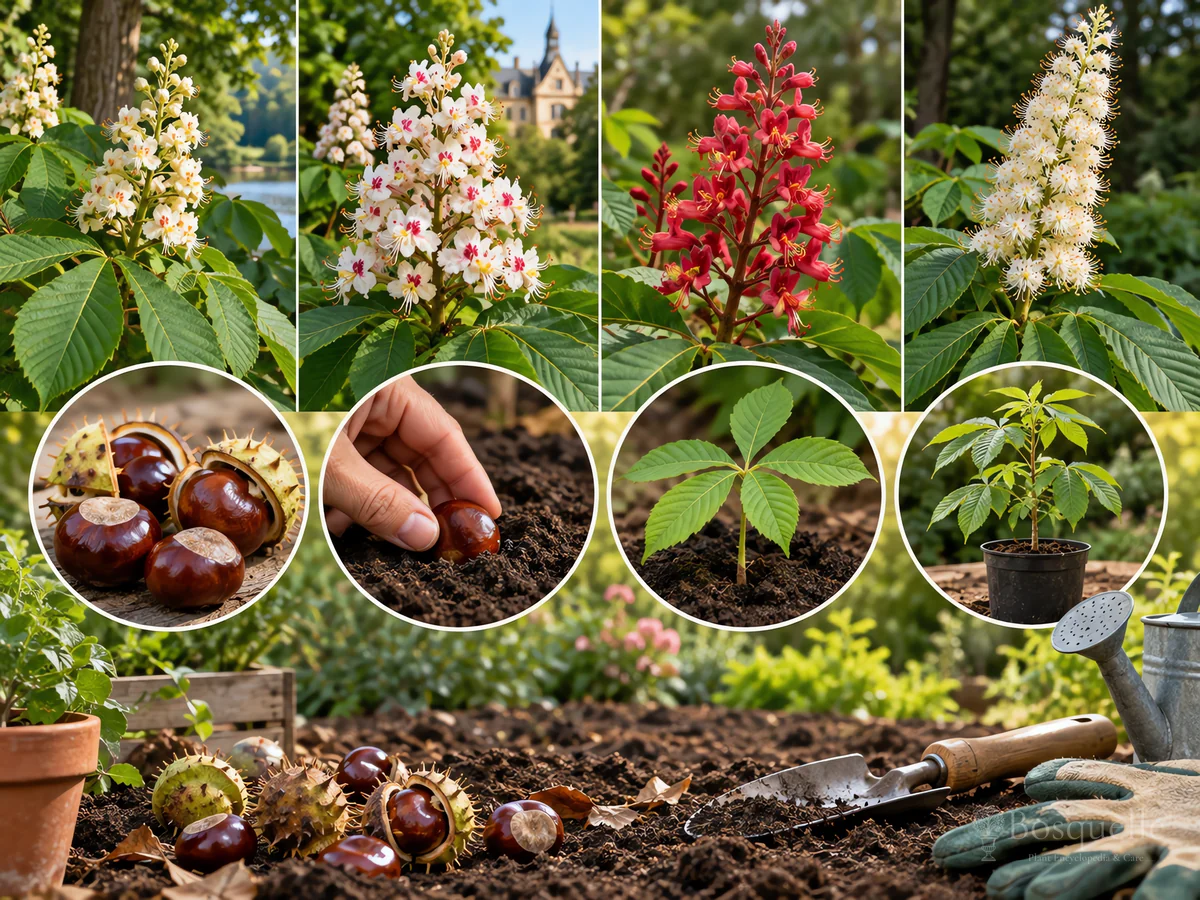

Recommended plants


References
- [1] The Ohio State University -
https://www.osu.edu/impact/life-at-ohio-state/growing-buckeye-trees - [2] North Carolina Extension Gardener Plant Toolbox -
https://plants.ces.ncsu.edu/plants/aesculus-glabra/ - [3] University of Minnesota Extension -
https://apps.extension.umn.edu/garden/diagnose/plant/deciduous/buckeye/leavesspots.html - [4] ASPCA Animal Poison Control -
https://www.aspca.org/pet-care/aspca-poison-control/toxic-and-non-toxic-plants/buckeye
This note is part of Aesculus Guides.
More first-season notes by plant are gathered in How to Grow Guides.
Updated: Reviewed by Bosquelle Editors