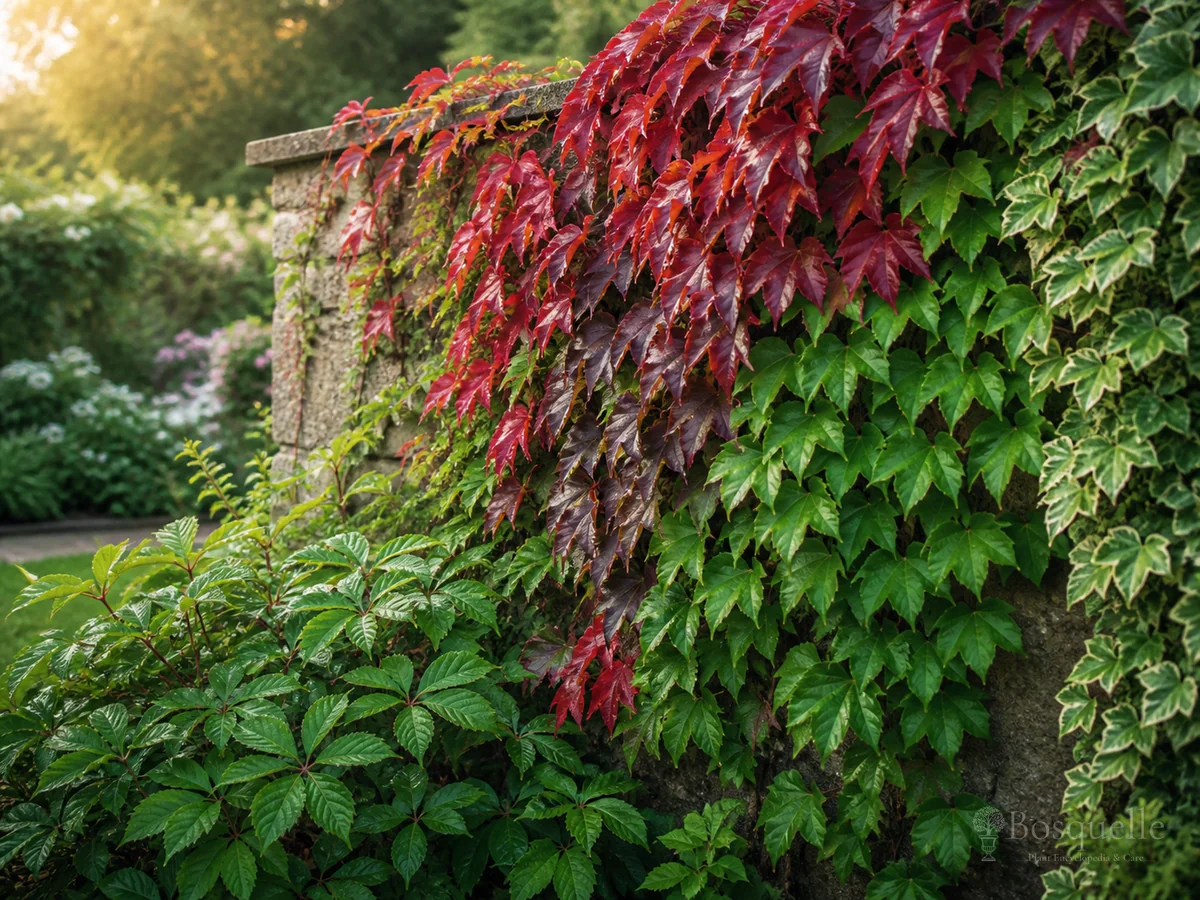
Grow Boston ivy on sturdy masonry you accept marking, not on wood siding or shingles. Tags may also say Japanese creeper. If the tag says English ivy, that is a different genus.
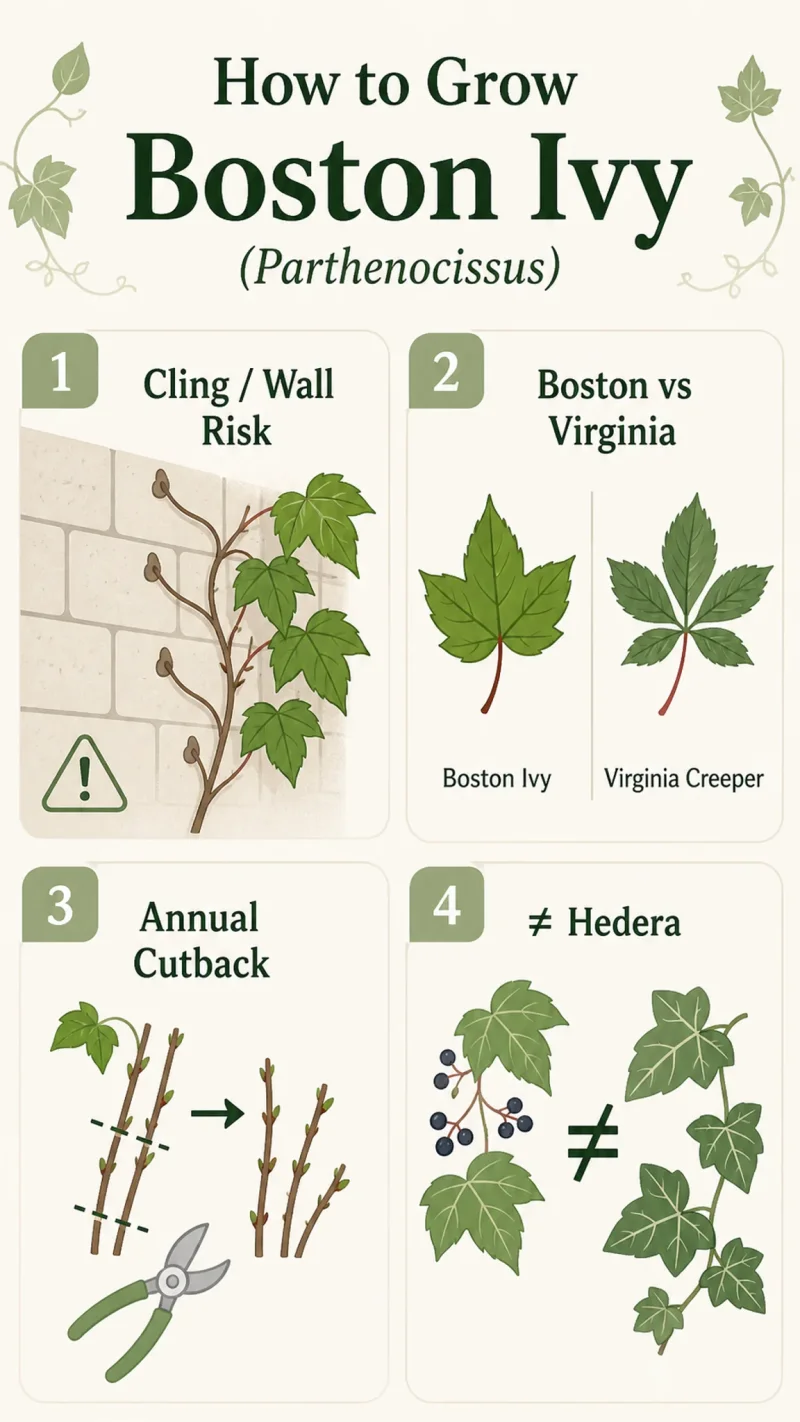
Put it on sturdy masonry, not wood or shingles
| Factor | Recommended | Avoid |
|---|---|---|
| Wall | Brick, stone, or concrete you accept marking, or a trellis set a few inches off wood | Wood siding, shingles, soft mortar, gutters, shutters, or wiring as the climb path |
| Light | Full sun to shade. Strongest fall color in sun. In hot summers, an east or north wall is easier | Expecting red fall color on a deep-shade wall |
| Soil | Average dry to medium ground that drains after rain | A permanently soggy crown |
| Water | Water the first season, then ordinary moisture. Established vines tolerate short dry spells | Planting on a hot south wall and skipping water the first summer |
| Winter | Bare deciduous stems. Plan the off-season look on the wall | Treating it as evergreen English ivy |
Boston ivy climbs with adhesive discs on short tendrils. Those discs mark masonry and ruin paint on wood. Site the vine on a wall you can live with, keep it off trees, and leave a clear strip at the base so you can see runners. [1] [2]
Does Boston ivy come back every year?
Yes. It is a hardy deciduous vine. Leaves drop in fall; bare stems are normal, not dead.
Will Boston ivy damage my brick wall?
It can. Discs mark mortar and are hard to pull off live. Use sturdy masonry you accept marking, or grow on a trellis set off the wall.
What are the pros and cons of planting Boston ivy?
Fast summer cover and strong fall color on a wall you accept marking. The cost is annual cutback, marks on mortar, and damage if you let it into gutters or under shingles.
Grow it in a pot against a wall
A large pot with drainage holes can hold a vine on a patio trellis if you water it through heat. Open ground against masonry is easier long-term. Empty the saucer after rain.
Will Boston ivy grow in pots?
Yes, in a large pot with a trellis you can water. A small decorative bowl dries too fast for a wall vine.
Plant at pot depth and train stems to the wall
Plant a nursery vine in spring, or in early fall if roots still have weeks to take. Set the crown at the same depth it grew in the pot. One plant covers a large wall, so do not crowd three vines onto a short garage.
- Choose masonry, concrete, or a freestanding trellis set off wood siding. Keep gutters, vents, and roof edges out of the climb path.
- Dig a hole as deep as the pot and a little wider. Do not bury the crown in a compost collar.
- Set the plant at pot depth, backfill with the soil you dug, and water to settle.
- Guide young stems toward the wall. Temporary ties help until the discs grip. Do not tuck stems under shingles.
- Mulch the root zone and keep a clear strip so runners are easy to cut. Keep vines off living tree crowns.
- Water through the first season, especially on a hot south or west wall.
When should I plant Boston ivy?
Spring, or early fall while the soil is still warm enough for roots. Midsummer on a hot wall is a poor window unless you can water.
How long does it take to grow Boston ivy?
A nursery vine can cover a lot of wall in a few seasons. Growth is fast once discs take. Plan the cutback from year one.
Where is the best place to plant Boston ivy?
A sturdy masonry wall or a trellis set off wood. Full sun gives the strongest fall color. Keep it off gutters and trees.
Start a cutting if you want another vine
Stem cuttings root in moist mix. Take a piece with at least one node, keep the mix barely moist, and pot it on once roots hold. Named kinds stay true from cuttings.
- Cut a healthy stem with a node in late spring or early summer.
- Strip the lower leaves. Stick the node into moist mix that drains.
- Keep it out of hot midday sun until new growth shows, then plant it as you would a nursery vine.
Cut it off windows and gutters every year
Plan a yearly cut. Late winter or early spring, while the stems are bare, is the easy window. Cut stems off windows, doors, gutters, shutters, and wiring before summer growth fills them. [3]
- In late winter or early spring, walk the wall and cut stems off architectural features.
- Thin congested mats so air can move through the foliage.
- If the wall is already full, pinch or cut tips in summer to hold height. Do not wait until gutters fill.
- On Virginia creeper, also pull runners at the bed edge before they root into the lawn or a neighbor's fence.
How to cut back Boston ivy?
Once a year, in late winter or early spring, cut it off windows, gutters, and wiring. Tip in summer only to hold height.
When should I prune Boston ivy?
Late winter or early spring, while stems are bare. That is the same calendar as keeping it off the house, not a separate job.
Kill the vine first, then brush off the pads
If you need the vine off the wall, cut it at the base and wait. Live pulls tear paint and mortar. Dead pads loosen, then you can brush them off. A residue can remain.
- Cut the vine at the soil line so the top is severed from the roots.
- Leave the dead stems on the wall until the discs dry and loosen.
- Brush or pick the pads off. Do not scrape live tissue off historic mortar.
- Dig remaining Virginia creeper runners at the bed edge so they do not resprout into the same wall.
How do you remove Boston ivy from a wall?
Cut it at the base and let the top die, then brush off the pads. Pulling live stems scars the wall.
Is Boston ivy hard to get rid of?
It is if you pull it live. Killing the vine first makes a cleaner peel. Watch for resprouts at the root.
Not English ivy or poison ivy — those are other plants
English ivy is Hedera. It is often evergreen and it is a different genus, with its own indoor and outdoor habits. Boston ivy is deciduous Parthenocissus.
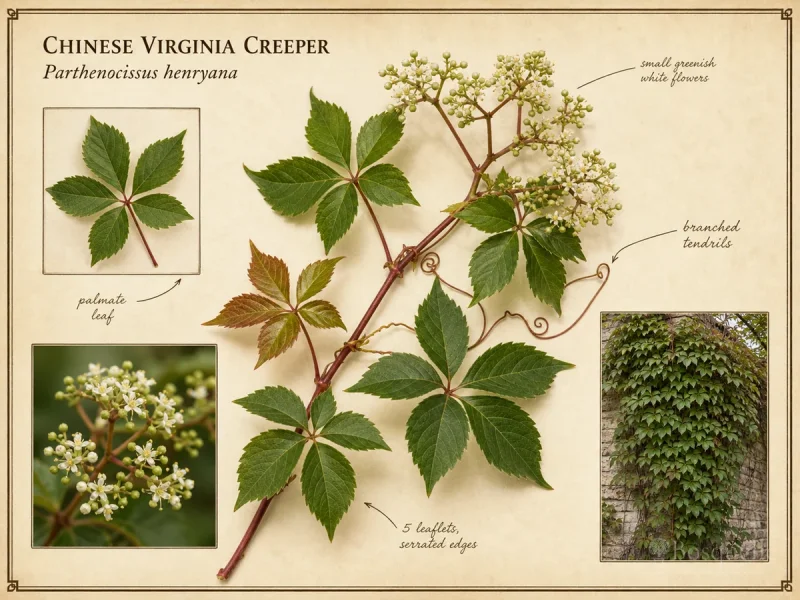
Poison ivy is Toxicodendron. It has three leaflets. Virginia creeper usually has five. The rhyme “leaflets five, let it thrive” is the field check — still do not eat the berries. [4]
Is English ivy the same plant?
No. English ivy is Hedera, often evergreen. Boston ivy is deciduous Parthenocissus with adhesive discs.
How can I tell if this is poison ivy or Boston ivy?
Poison ivy has three leaflets. Boston ivy leaves are usually three-lobed on one blade. Virginia creeper usually has five leaflets.
Boston ivy, Veitchii, Virginia creeper, and silver-vein creeper
Culture is the same for the four kinds we hold: masonry you accept marking, water the first season, one yearly cut off the house. Leaf shape and roam are the choice. Do not treat a shop list of twenty names as a different plant.
P. tricuspidata is classic Boston ivy — often three-lobed leaves and tight wall cling. ‘Veitchii’ is a named Boston ivy with the same discs and cut calendar. P. quinquefolia is Virginia creeper — usually five leaflets, native across much of eastern North America, and freer to roam as groundcover and into trees. Keep a dry winter mat of it off siding. P. henryana is silver-vein creeper, finer foliage with marked veins, still a clinging Parthenocissus.
Is Boston ivy the same as Virginia creeper?
No. Both are Parthenocissus. Boston ivy is usually three-lobed. Virginia creeper usually has five leaflets and roams more.
Which is better, Boston ivy or Virginia creeper?
Boston ivy for a tight masonry wall. Virginia creeper if you want five-leaflet native cover and will cut runners. Neither belongs on wood siding.
Put it on masonry, plant once at pot depth, cut it off the house each year, and read the tag so you did not buy English ivy.
FAQ
Are Boston ivy or Virginia creeper berries safe to eat?
No. Birds take them. People should not. Virginia creeper fruit can make you very sick if eaten.
Does Virginia creeper spread aggressively?
Yes. It creeps on the ground and climbs. Edge the bed and keep the yearly cut. It is a native vine, not a polite patio plant.
Will Japanese beetles eat Boston ivy?
They can skeletonize leaves in some regions. Air through the mat helps. Do not build a spray calendar from that one pest.
Is this the ivy on college walls?
Boston ivy is the vine people mean by ivy-league walls. That nickname is not a second plant.
Recommended plants


References
- [1] NC State Extension Gardener -
https://plants.ces.ncsu.edu/plants/parthenocissus-tricuspidata/ - [2] University of Minnesota -
https://trees.umn.edu/boston-ivy-parthenocissus-tricuspidata - [3] Illinois Extension -
https://extension.illinois.edu/flowers/boston-ivy - [4] NC State Extension Gardener -
https://plants.ces.ncsu.edu/plants/parthenocissus-quinquefolia/
More first-season notes by plant are gathered in How to Grow Guides.
Updated: Reviewed by Bosquelle Editors