
Grow alligator flag in standing water and full sun. Thalia is also sold as water canna. It is not a canna lily.
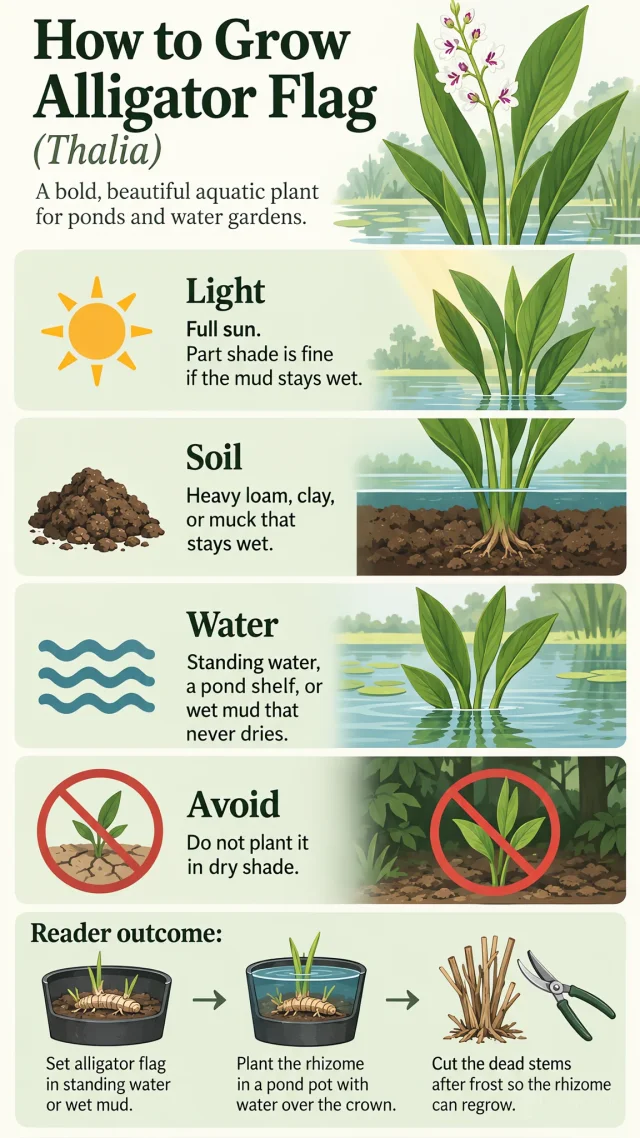
Keep it in standing water and full sun
| Factor | Recommended | Avoid |
|---|---|---|
| Light | Full sun. Part shade is fine if the mud stays wet | Do not plant it in dry shade |
| Water | Standing water, a pond shelf, or wet mud that never dries | Do not let the crown dry out |
| Soil | Heavy loam, clay, or muck that stays wet | Do not plant it in a mix that drains in a day |
| Pot | A five- to twenty-gallon pond pot if you need a contained clump | Do not toss extras into a lake, ditch, or storm drain |
| Winter | Keep the rhizome under water, or move the pot to a frost-free room and keep the soil wet | Do not leave a red-stemmed plant on a shallow shelf through a hard freeze |
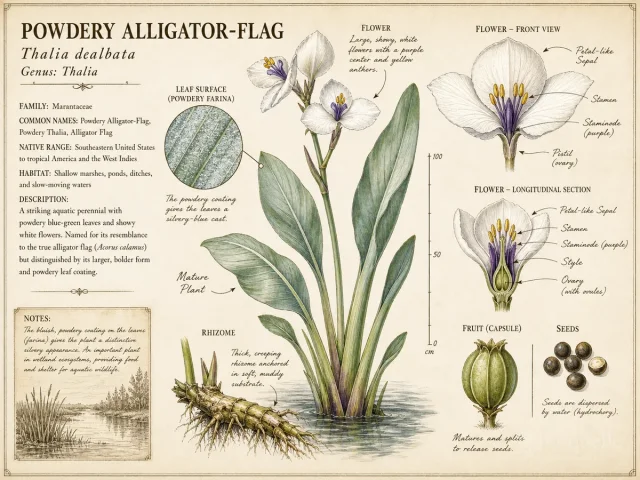
Alligator flag wants wet mud or shallow water. Full sun is the usual pond-edge home, and part shade still works when the mud never dries. [1] powdery alligator-flag uses that wet as powdery blue-green leaves and a violet panicle. red-stemmed alligator-flag uses the same wet, with red stalks and no powdery coat. Both plants share the same need for water. Neither one is a dry-bed canna or a windowsill houseplant.
How much sun does alligator flag need?
Give it full sun. Part shade is fine when the mud stays wet. Dry shade stalls the leaves and the flowers.
How wet does it need to stay?
Keep the crown wet. Standing water, a pond shelf, or wet mud is the home. A dry week crisps the leaves.
Plant the rhizome in a pond pot, with water over the crown
Plant in spring from a potted plant or a rooted division. Set the rhizome in heavy loam in a five- to twenty-gallon pond pot, with the buds facing up. Set that pot so water covers the crown, usually several inches to about 18 inches in the growing season. [2] Leaves should stand above the surface.
- Plant in spring, once the water will stay up and new shoots are starting.
- Set the rhizome in heavy loam in a five- to twenty-gallon pond pot, with the buds facing up, not buried in a deep hole.
- Set that pot so water covers the crown. Several inches to about 18 inches is enough in the growing season; do not drop it off a deep shelf where the leaves stay underwater.
- Add a few rocks in the pot so wind does not tip a tall clump.
- Bag extras. Do not toss them into a lake, ditch, or storm drain.
How do I plant alligator flag?
Set the rhizome in a five- to twenty-gallon pond pot of heavy loam in spring, buds up. Set the pot so water covers the crown, usually several inches to about 18 inches.
Split a crowded clump in spring
Most gardeners start a new patch from a rooted piece, not from seed. Lift a crowded clump in spring while the mud is wet, keep a bud and some roots on each piece, and replant at once in wet mud or a fresh pot.
- Lift a crowded clump in spring while the mud is wet and workable.
- Pull or cut a piece that has roots and at least one bud.
- Replant at once in wet mud or a fresh pot, and keep it wet while it takes.
After frost, cut it back and keep the rhizome from freezing
The tops brown after frost, and new leaves come from the rhizomes in spring if the crown stayed wet and did not freeze. Cut the dead stems after frost, then sink the pot so about 18 to 24 inches of water covers the crown, or move it to a bright, frost-free room and keep the soil wet. [3] Red-stemmed alligator flag is less hardy than powdery alligator-flag, so bring that pot inside before a hard freeze.
- Cut the dead stems after frost browns the leaves.
- Sink the pot so about 18 to 24 inches of water covers the crown, or move it to a bright, frost-free room and keep the soil wet.
- If it is growing in wet ground, cut the tops and mulch heavily so the rhizome does not freeze.
- Bring a red-stemmed plant indoors before a hard freeze, and keep the soil wet.
Do I cut it back in winter?
Yes. Cut the dead stems after frost. Then sink the pot so about 18 to 24 inches of water covers the crown, or keep it wet in a frost-free room. Bring a red-stemmed plant indoors before a hard freeze.
Not a canna lily — and not a prayer plant or a daffodil named Thalia
A tag that says water canna or hardy canna is often alligator flag, not a canna lily. Canna has large red, orange, or yellow flowers, and the rhizomes rot in standing water. Alligator flag has small violet flowers and wants wet mud. See How to Grow Canna Lilies.
Prayer plant is Maranta, a houseplant in the same family that wants a damp indoor mix, not a pond — see How to Grow Prayer Plant. A spring-bulb tag that says Thalia is Narcissus, a daffodil — see How to Grow Daffodils. Pickerelweed is shorter, with heart-shaped leaves and a denser flower spike. Powdery alligator-flag has a white coat on the leaves. Red-stemmed alligator flag does not. [4]
Is this a canna lily?
No. Canna lily has large warm-colored flowers and rots in standing water. Alligator flag has small violet flowers and wants wet mud or a pond pot.
Is Thalia a daffodil?
Not this plant. A daffodil named Thalia is Narcissus, a spring bulb for soil that drains. Alligator flag is Thalia, a pond plant with paddle leaves.
Set alligator flag in standing water or wet mud, plant the rhizome in a pond pot with water over the crown, and cut the dead stems after frost so the rhizome does not freeze.
FAQ
Is red-stemmed alligator flag a different plant?
Red-stemmed alligator flag is Thalia geniculata. Powdery alligator-flag is Thalia dealbata. Both want standing water or wet mud. The red-stemmed kind has red stalks and no powdery coat, and it needs a frost-free winter.
Can I grow alligator flag in a dry pot?
No. A mix that dries in a day crisps the leaves. A pond pot works when the soil stays wet or sits under several inches of water. It is not a dry patio plant.
Can I grow it from seed?
You can, but most gardeners split a rooted piece in spring. Seed is slower, and the pots still have to stay wet.
Should I dig it from a wild swamp?
No. Buy a nursery plant. Powdery alligator-flag is scarce in parts of its range, and digging a wild clump hurts the stand.
Recommended plants

References
- [1] NC State Extension Gardener -
https://plants.ces.ncsu.edu/plants/thalia-dealbata/ - [2] Missouri Botanical Garden -
https://www.missouribotanicalgarden.org/PlantFinder/PlantFinderDetails.aspx?taxonid=282651 - [3] Missouri Department of Conservation -
https://mdc.mo.gov/discover-nature/field-guide/powdery-thalia-water-canna - [4] Illinois Wildflowers -
https://illinoiswildflowers.info/wetland/plants/powder_thalia.html
More first-season notes by plant are gathered in How to Grow Guides.
Updated: Reviewed by Bosquelle Editors