
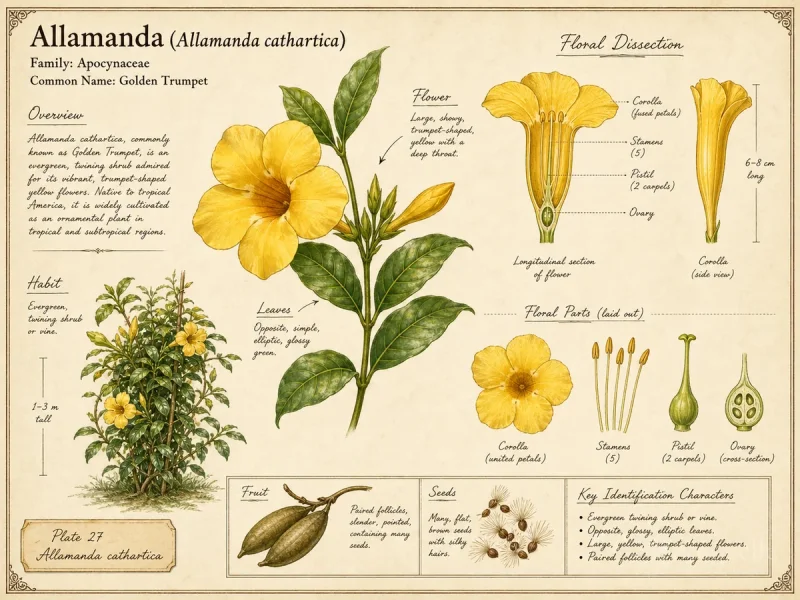
Grow allamanda in full sun and heat, in soil that drains. Allamanda is a tropical evergreen in the dogbane family — golden trumpet is the yellow climber most tags mean. Frost kills it, so most of the country grows it as a summer plant or a pot you bring inside.
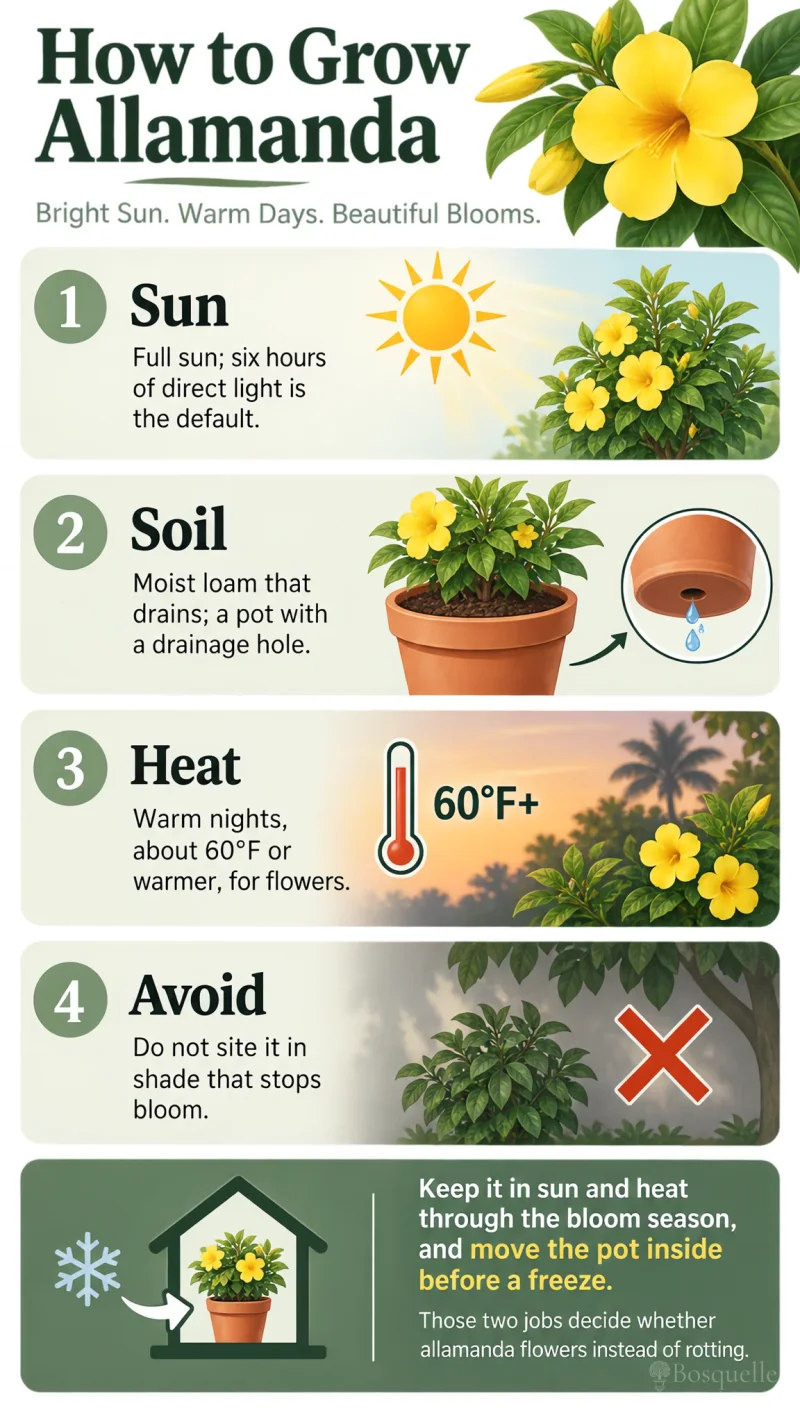
Give it full sun, warm nights, and soil that drains
| Factor | Recommended | Avoid |
|---|---|---|
| Sun | Full sun; six hours of direct light is the default | Do not site it in shade that stops bloom |
| Heat | Warm nights, about 60°F or warmer, for flowers | Do not expect a full show in a cool, short summer |
| Soil | Moist loam that drains; a pot with a drainage hole | Do not leave the roots in standing water — they rot |
| Support | Tie a climber to a trellis or fence the day you plant | Do not wait for it to twine — it has no tendrils |
| Sap | Wear gloves when you prune; keep sap off skin and out of eyes | Do not let children or pets chew stems or flowers |
Allamanda wants full sun and heat. It takes plenty of water during the growing season, but the soil has to drain. [1] Tie a climber from day one. golden trumpet does not twine and does not make tendrils, so a floppy vine is a training miss, not a different plant. Match vine or bush on Types of Allamanda.
How much sun does allamanda need?
Full sun. Six hours of direct light is the default. It will live in lighter shade, but flowering drops off fast.
Does allamanda need a trellis?
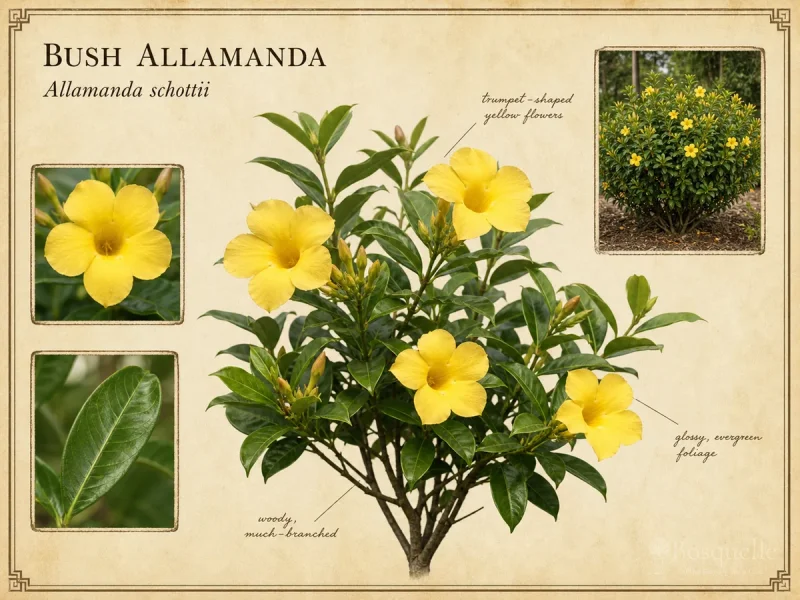
A climbing allamanda does. Tie the stems; they will not wrap the post on their own. A bush allamanda stands without a trellis.
Water when the top dries, and feed while it blooms
Allamanda blooms on new shoots in summer and fall if the root zone stays moist — not soggy — and you feed while it is growing. Let the surface dry slightly between waterings so the mix can take air. [2]
- Water deeply until excess runs out of a pot, or until the root zone of a bed is wet several inches down.
- Wait until the top of the mix feels dry, then water again. Do not keep the mix wet all week.
- Feed every two to three weeks from spring through bloom with a fertilizer labeled for flowering plants.
- Stop feeding in late summer as nights cool, so the plant can rest instead of pushing soft growth into frost.
A long dry spell drops flower buds. A wet pot in cool weather rots the roots. Water to the weather, not to a fixed calendar.
How to plant allamanda
- Wait until nights stay reliably warm — about 60°F or higher — before you plant out or move a pot outside.
- Dig a hole as deep as the root ball and two to three times as wide. Set the plant at the same depth it grew in the pot.
- Backfill with the original soil mixed with a little compost. Water to settle. Do not bury the stem. Space a shrub about three to five feet from its neighbor. [3]
- Tie a climber to a trellis or fence the same day. A bush allamanda can skip the tie if you are keeping it as a shrub.
How often do I water allamanda?
Water when the top of the mix dries. In heat that may be often; in a cool week, wait. Do not leave a saucer of standing water under the pot.
When should I plant allamanda?
After the last frost, when nights stay warm. In a frost-free yard you can plant in any warm month. A pot can wait indoors until then.
Bring it in before frost, then cut it back in spring
Allamanda is frost-tender. A light freeze strips the leaves; a hard freeze kills the plant. In a frost-free yard it can stay in the ground. Everywhere else, treat a pot as a plant you move. Flowers form on the new shoots that follow a spring cut, so do not strip that wood in late summer if you still want bloom.
- Move a container inside when nights drop toward 40°F. Do not wait for the first freeze on the forecast.
- Give it the brightest window you have. Cut watering back and stop fertilizer so the plant can rest.
- In spring, just before new growth starts, cut stems back to one or two nodes. Flowers form on the new shoots that follow.
- Move the pot back outside only after nights stay warm, and harden it off in increasing sun for a week so leaves do not scorch.
You can also grow it as a summer annual and replace it the next year. That is simpler than forcing a dim indoor winter.
When should I bring allamanda inside?
When nights drop toward 40°F. A sunny room is better than a dark garage if you want leaves to hold. Keep the mix on the dry side until spring.
Not a mandevilla — and not a hardy trumpet vine
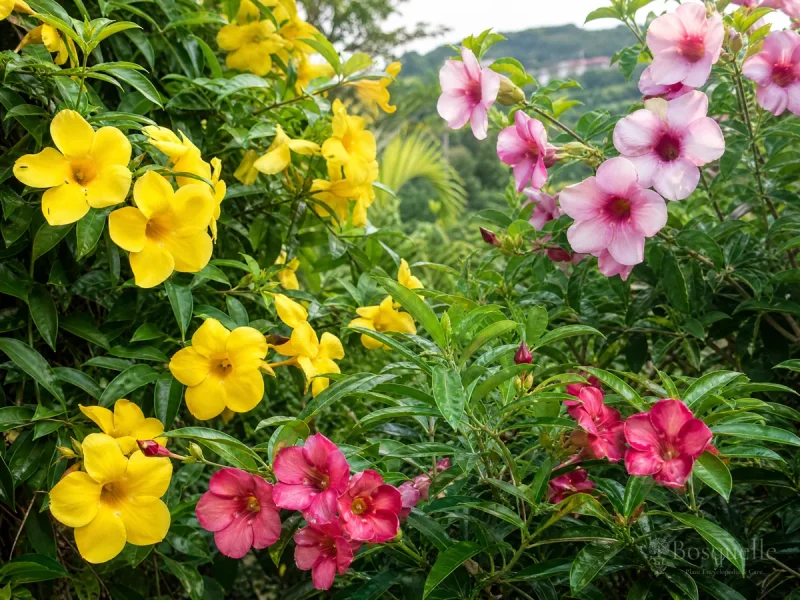
Allamanda is not mandevilla. Shops sometimes label a pink mandevilla as pink allamanda; that plant is a different genus, and its care lives on How to Grow Mandevilla. Allamanda is also not hardy trumpet vine. The orange climber that survives a cold winter is Campsis, covered on How to Grow Trumpet Vine. Golden trumpet is the yellow Allamanda in this cluster.
Is allamanda a mandevilla?
No. Allamanda is a different tropical plant. Pink allamanda on a nursery tag is usually mandevilla. Yellow golden trumpet is Allamanda.
How to start allamanda from a cutting
Take a cutting in late spring if you want another plant. Half-hardened stems — stems that have started to firm — root more reliably than soft new tips or old woody canes.
- In late spring, cut a half-hardened stem and strip the lower leaves. Wear gloves; the milky sap irritates skin.
- Stick the cutting in a mix that drains. Bottom heat helps roots form.
- Cover the pot so the air stays humid until the stem resists a gentle tug. Then grow it on in full sun and heat like the parent plant.
Can I start allamanda from a cutting?
Yes. Take a half-hardened stem in late spring, stick it in a mix that drains, and keep it warm and humid until roots form. Wear gloves; the sap irritates skin.
Keep it in sun and heat through the bloom season, and move the pot inside before a freeze — those two jobs decide whether allamanda flowers instead of rotting or frosting out.
FAQ
Can I grow allamanda as a houseplant all year?
It is possible in a very bright, warm room, but it is a large plant that wants more light and humidity than most houses give. Most gardeners summer it outside and bring the pot in for a rest, or grow it as an annual.
Is allamanda invasive in Florida?
UF/IFAS rates yellow allamanda (Allamanda cathartica) a high invasion risk and does not recommend it for Florida landscapes. [4]Bush allamanda sits on the same conservative list. Check local guidance before you plant either in the ground there.
What pests hit allamanda?
Mealybugs, whiteflies, scale, and spider mites show up, especially on a plant you bring indoors. Wipe them off and keep the mix from staying wet. Do not spray as a default.
Is wild allamanda the same plant?
No. Wild allamanda is Pentalinon luteum, a Florida native with yellow trumpets. It is not Allamanda, and it is not this cluster.
Is the sap poisonous?
Yes. All parts are mildly toxic if eaten, and the milky sap can irritate skin and eyes. Wear gloves when you prune, and keep pets from chewing stems.
Related guides
Recommended plants

References
- [1] North Carolina Extension Gardener Plant Toolbox -
https://plants.ces.ncsu.edu/plants/allamanda-cathartica/ - [2] Wisconsin Horticulture -
https://hort.extension.wisc.edu/articles/golden-trumpet-allamanda-cathartica-golden-trumpet/ - [3] University of Florida IFAS Extension -
https://ask.ifas.ufl.edu/publication/FP032 - [4] UF/IFAS Assessment of Nonnative Plants -
https://assessment.ifas.ufl.edu/assessments/allamanda-cathartica/
This note is part of Allamanda Guides.
More first-season notes by plant are gathered in How to Grow Guides.
Updated: Reviewed by Bosquelle Editors