
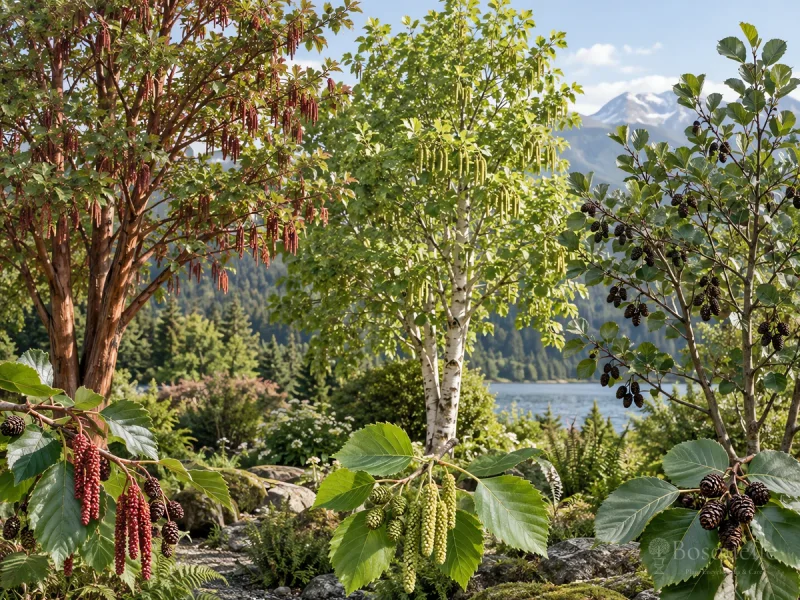
Grow alder in sun on soil that stays moist to wet. Alder is Alnus, a birch-family tree sold as an alder tree, with small woody cones that hang on through winter. A paper-bark birch is a different plant.

Give it sun and soil that stays moist to wet
| Factor | Recommended | Avoid |
|---|---|---|
| Sun | Full sun to part shade; six hours of light is the default | Do not site it in deep shade that thins the crown |
| Soil | Moist to wet ground — a stream bank, rain garden, swamp edge, or wet meadow | Do not plant it in a lawn that dries out in summer |
| Poor soil | Poor or flood-prone soil is usable because the roots fix nitrogen | Do not treat that as a reason to skip water on a new tree |
| Space | A wet opening with room for the kind you bought | Do not squeeze a western tree into a small dry courtyard |
Alder wants sun and ground that stays moist. Seasonal flooding is fine, and poor soil works because the roots form nodules with nitrogen-fixing bacteria, so a wet bank is a better home than a dry bed. [1] smooth alder is an eastern thicket about 10 to 15 feet tall on that same wet ground. [2] white alder takes heat and wind if the soil stays wet. red alder is the large western tree. [3] Match the kind to the site on Types of Alder.
How much sun does alder need?
Full sun to part shade. Six hours of direct light is the default. Deep shade thins the crown.
How wet should the soil stay?
Moist to wet through the year. A stream bank, rain garden, or swamp edge is the right kind of site. A lawn that dries in summer is the usual reason a new tree stalls.
Plant on a wet bank, with the flare at the soil
Plant alder where the soil already stays wet, not in a spot you hope to keep watering forever. Set the root flare — where the trunk widens at the base — at the soil surface. A western tree needs a wide opening; an eastern thicket needs less room, but still a wet bank.
- Pick a stream bank, rain garden, pond edge, or wet meadow that does not dry out in summer.
- Dig a hole as deep as the root ball and two to three times as wide. Tease circling roots.
- Set the flare at the surrounding soil grade. Do not bury the flare under extra backfill.
- Backfill with the original soil, water to settle, and mulch the root zone. Keep the mulch a few inches off the trunk.
- Leave about 24 to 60 feet for a western tree, or about 12 to 24 feet for an eastern thicket.
When should I plant alder?
Fall or early spring, while the plant is dormant. Fall planting lets roots move into cool wet soil. Spring planting works if you can water through the first summer.
How far apart do I plant alder?
Give a western tree about 24 to 60 feet of open ground. Give an eastern thicket about 12 to 24 feet. Do not treat a red alder like a 15-foot shrub.
Water a young tree until the roots find moisture
A new alder still needs water until the roots leave the nursery ball and reach the wet soil you chose. An established tree on a stream bank takes a short dry spell better than a tree on a made bed.
- Soak the root zone after planting. Check a few inches down and water again when that soil starts to dry.
- Keep the root zone moist through the first two growing seasons. Do not let a new tree dry out between soaks.
- Once the tree is established on a wet site, water only in a long dry spell. Stop if soil below the surface is still wet.
- Mulch about two inches over the root zone. Keep bark clear so the trunk stays dry.
How often do I water a new alder?
Water when the top few inches start to dry, through the first two seasons. A slow soak is more useful than a brief splash every day. After that, a tree on a wet bank needs water only in a long dry spell.
Prune in late winter for a leader, or keep a thicket
Prune while the plant is still dormant, in late winter or very early spring, before new growth starts. A western tree wants a strong central leader when it is young. An eastern alder suckers; leave the suckers if you want a bank thicket, and cut extras if you want a few main stems.
- Wait until late winter or early spring, before buds break.
- On a young western tree, keep one central leader and space the main side branches. Cut competing upright stems with tight crotches.
- On an eastern thicket, cut extra suckers if you want a few trunks, or leave them if you are holding a stream bank.
- Cut dead or broken wood back to live wood. Do not top a mature tree to hold height — the regrowth is weak.
- On an old eastern thicket, you can cut the stems to about six inches above the ground in late winter to restart a dense bank planting.
- If you want another thicket plant, dig a rooted sucker in early spring and set it on wet ground the same day.
When should I prune alder?
Late winter or early spring, before new growth. Keep a leader on a young western tree. On an eastern thicket, cut extra suckers only if you do not want a colony.
Not a birch — and not witch alder
Alder is Alnus. Birch is Betula. Witch alder is Fothergilla. They are not the same plant and they do not take the same care.
- Alder (Alnus) — moist to wet ground, and small woody cones that hang on through winter after the seeds drop. Those cones are the usual winter ID.
- Birch (Betula) — papery bark that peels on many kinds, and female catkins that break apart instead of turning woody. Care lives on How to Grow Birch.
- Witch alder (Fothergilla) — a witch-hazel relative grown for bottlebrush bloom and fall color, not a true alder. See How to Grow Fothergilla.
Hazel alder on an eastern tag is still smooth alder, not a hazelnut. If the tag says Corylus, see How to Grow Hazelnut. Confirm the Latin on the tag.
Is alder a birch?
No. Alder is Alnus. Birch is Betula. Both are in the birch family, but alder keeps woody cones in winter, and birch catkins fall apart. A paper-bark tag is birch, not alder.
How to grow alder from seed
Fresh seed often sprouts without a long chill. Dried seed needs a cool, moist rest first. A nursery plant is still the usual start for a landscape tree. [4]
- Collect the woody cones in fall when they begin to open, and shake out the seed.
- Sow fresh seed on moist mix and barely cover it. Keep the mix moist until seedlings show true leaves.
- If the seed has dried in storage, mix it with damp sand or peat and refrigerate it at about 41°F for about six months, then sow the same way.
- Grow the seedlings in pots you can water, then plant them to a wet site once they are sturdy enough to handle.
Can I grow alder from seed?
Yes. Sow fresh seed on moist mix, barely covered. Dried seed needs a cool, moist rest of about six months first. A nursery plant is faster for a landscape tree.
If the leaves flag in a dry week, soak the root zone once, then check a few inches down before you water again.
FAQ
Can I grow alder in a pot?
Only as a short nursery start. Landscape alder wants wet ground and a spreading root system, and it does not stay healthy long-term in a container.
Can I start alder from a stem cutting?
Stem cuttings are unreliable on these species. On an eastern thicket, dig a rooted sucker in early spring instead. For seed, use the steps above.
What pests hit alder?
Canker can be severe on eastern thickets. Tent caterpillars chew western trees in some years. Hose or pick pests when you see them. Do not spray as a default.
Related guides
Recommended plants


References
- [1] NC State Extension Gardener -
https://plants.ces.ncsu.edu/plants/alnus-rubra/ - [2] NC State Extension Gardener -
https://plants.ces.ncsu.edu/plants/alnus-serrulata/ - [3] Oregon State University Landscape Plants -
https://landscapeplants.oregonstate.edu/plants/alnus-rhombifolia - [4] Lady Bird Johnson Wildflower Center -
https://www.wildflower.org/plants/result.php?id_plant=ALSE2
This note is part of Alnus Guides.
More first-season notes by plant are gathered in How to Grow Guides.
Updated: Reviewed by Bosquelle Editors