
Harvest patchouli by cutting leafy shoots in the morning once the plant is well grown. Shade-dry the leaves until they are crisp and earthy.
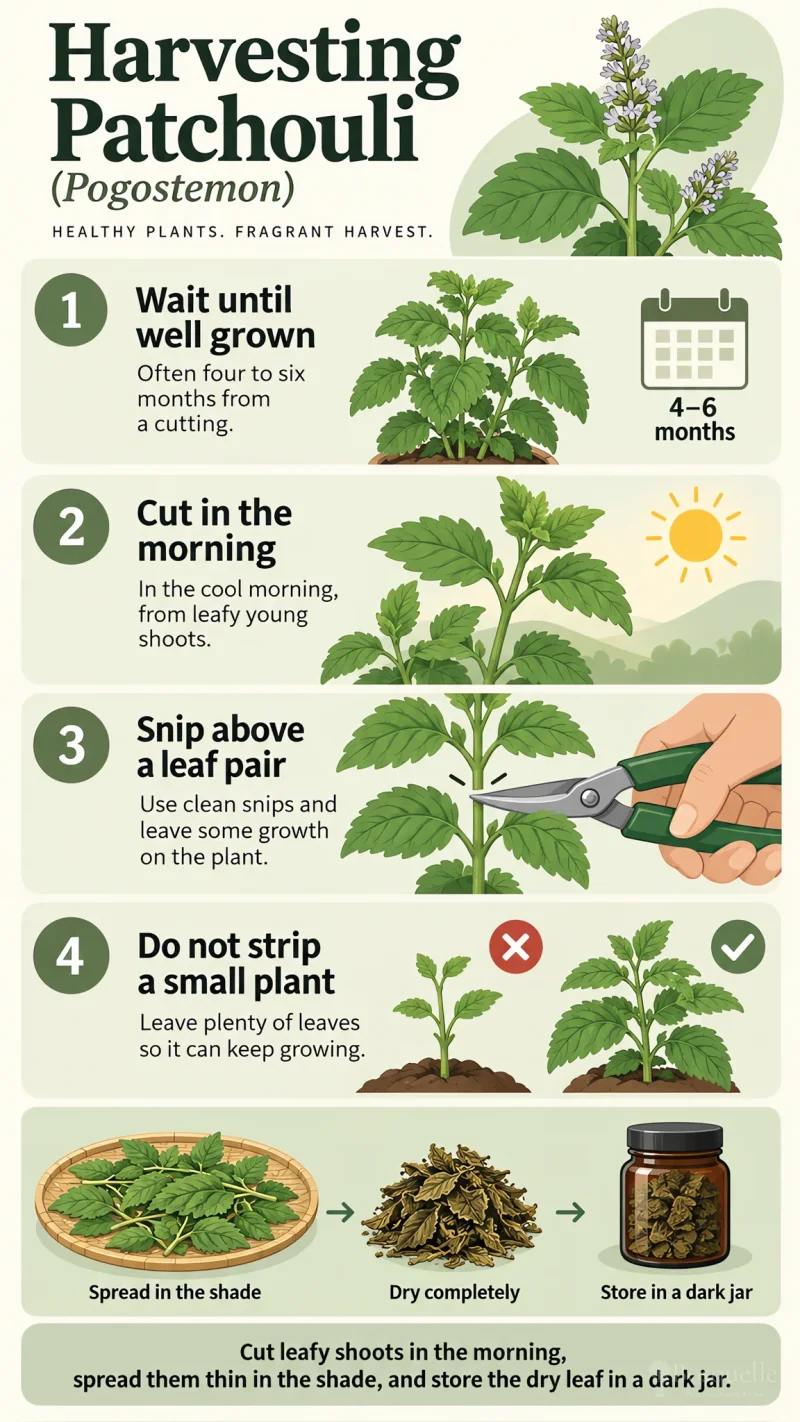
Cut leafy shoots in the morning when the plant is well grown
| Factor | Recommended | Avoid |
|---|---|---|
| Cue | Wait until the plant is well grown, often four to six months from a cutting | Do not strip a small new plant of every leaf |
| When | Cut in the cool morning, from leafy young shoots | Do not wait until leaves yellow or brown |
| How | Snip shoots above a leaf pair; leave some growth on the plant | Do not rip thick woody stalks for scent |
| How much | Take a third or so of the leafy growth, then let it refill | Do not cut it to the soil line |
The scent of patchouli is in the leaves, not the flowers. Wait until the plant is well grown — often four to six months after you set a rooted cutting — then cut leafy young shoots in the morning. [1] Top leaves hold more scent than thick old stalks. Leave some growth so the plant can push again. [2] A well-grown plant can be cut more than once a season. Farm fields take later cuts every few months; a house pot needs a rest between cuts. [3]
- Wait until the plant is bushy and the leaves are full, not a thin new cutting.
- In the morning, snip leafy shoots above a leaf pair. Take young growth about a hand's length, with at least a few mature leaf pairs.
- Strip off thick woody stalks. They add bulk and little scent.
- Leave enough leaves on the plant so it can grow back. Do not scalp it.
When do I pick the leaves?
When the plant is well grown and the leaves are full, in the cool morning. Do not wait until they yellow.
What do I do with fresh patchouli leaves?
Spread them in a thin layer in the shade until they are dry and earthy, then store them dark and dry.
Shade-dry the leaves on a screen, out of the sun
Fresh leaves smell green. The familiar earthy scent develops as they dry in the shade. Spread them in a thin layer on a screen or a clean tray, out of sun and rain, and turn them so they dry evenly. They are ready when they feel crisp and smell like the dried herb, often three to six days in a shed, or one to two weeks in a still room. [4] Do not heap wet leaves or try to ferment them. A wet heap molds, and a ferment step makes an unpleasant smell, not a better one.
- Spread leaves and tender tips in a single layer on a screen. Keep them in moving air, out of direct sun.
- Turn the layer once a day so the underside dries.
- When the leaves are crisp, pull out any remaining thick stalks. Store the dry leaf in a jar out of the light.
- Dried leaf keeps its scent for months. Use it in a sachet or potpourri. Distilling oil is a factory job, not a kitchen step.
Warmth and watering stay on How to Grow Patchouli.
How do I dry the leaves?
Spread them thin in the shade, turn them, and wait until they are crisp. Do not dry them in hot sun, and do not ferment a wet heap.
Cut leafy shoots in the morning, spread them thin in the shade, and store the dry leaf in a dark jar.
FAQ
How do I extract oil from patchouli leaves?
You do not, at home. Steam distillation is a factory process. Shade-dry the leaves for scent instead.
How long until a young plant is ready to cut?
Plan on four to six months from a rooted cutting, and only if the plant stayed warm and leafy. A small indoor pot may give only a pinch of leaf.
Related guides
Recommended plants
References
- [1] National Horticulture Board (India) -
https://nhb.gov.in/Horticulture%20Crops/Patchouli/Patchouli1.htm - [2] American College of Healthcare Sciences -
http://files.achs.edu/mediabank/files/achs_patchouli_monograph.pdf - [3] Tamil Nadu Agricultural University -
https://agritech.tnau.ac.in/horticulture/horti_aromatic%20crops_patchouli.html - [4] Bren Haas -
https://brenhaas.com/patchouli-growing/
This note is part of Pogostemon Guides.
More harvest timing notes by plant live in Harvesting Guides.
Updated: Reviewed by Bosquelle Editors