
Leave a craft bottle gourd on the vine until the rind is hard and the stem is drying. Then cut it and dry it until the seeds rattle.
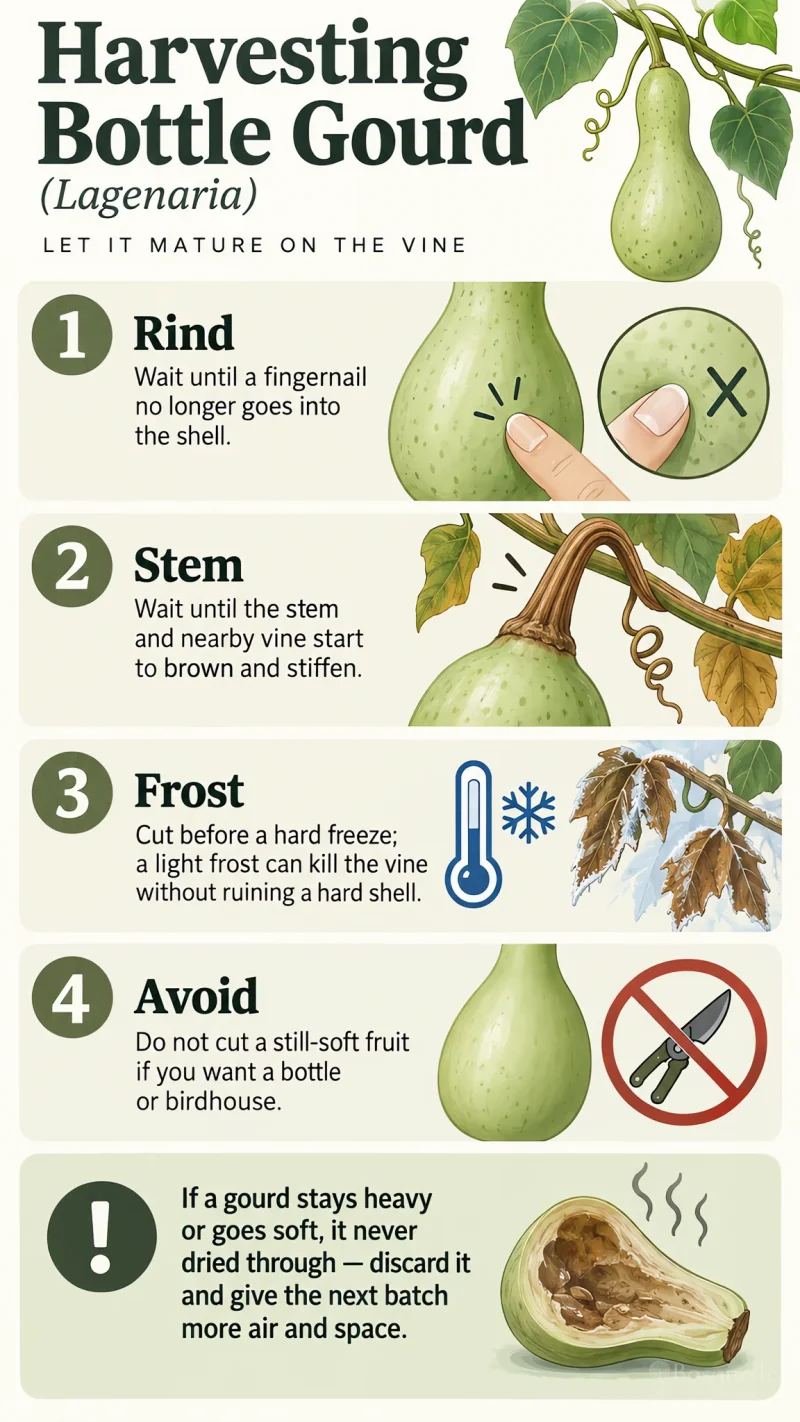
Cut when the rind is hard and the stem is drying
| Factor | Recommended | Avoid |
|---|---|---|
| Rind | Wait until a fingernail no longer goes into the shell | Do not cut a still-soft fruit if you want a bottle or birdhouse |
| Stem | Wait until the stem and nearby vine start to brown and stiffen | Do not yank or twist the fruit off the vine |
| Frost | Cut before a hard freeze; a light frost can kill the vine without ruining a hard shell | Do not leave immature fruit out for a hard freeze |
| Cut | Cut with pruners and leave an inch or more of stem on the gourd | Do not harvest by pulling, which tears the vine and the fruit |
bottle gourd for a bottle or birdhouse stays on the vine until the shell is hard. Ease off watering as fall comes and the vines start to wither. A light frost may kill the leaves; a hard freeze can still ruin a fruit that has not hardened. [1] [2] Young kitchen fruit — while the skin still gives — is picked on How to Grow Bottle Gourd, not here.
- Press a fingernail into the rind. If it no longer goes in, the gourd is ready to cut.
- Cut the stem with pruners. Leave an inch or more of stem attached so you can hang the gourd while it dries. [3]
- Handle the fruit by the stem. Do not stack fresh gourds in a wet pile.
When is a bottle gourd ready to cut for crafts?
When a fingernail no longer goes into the rind and the stem is drying. Cut before a hard freeze.
How to cure and dry the gourd
Wash off soil. A quick dip in one part household bleach to nine or ten parts water helps clean the skin. Dry the gourd, then set it where air moves, warm and out of the rain, with gourds not touching.
- Wash the gourd. Dip it briefly in a weak bleach solution if you want, then dry the surface.
- Hang it by the stem, or stand it on a rack, in a shed or garage with moving air. [4]
- Turn it now and then so one side does not stay wet. Surface mold is common while the inside dries; wipe it if you like, and discard any gourd that goes soft or sunken.
- Wait until the shell is tan, the gourd feels light, and the seeds rattle when you shake it. That can take weeks for a small fruit and several months for a large one.
How long does a bottle gourd take to dry?
Often one to six months, longer for a large fruit. It is dry when it feels light and the seeds rattle.
What fails while the gourd dries
A wet pile is the usual reason a promising shell rots. Soft spots, a sour smell, or a gourd that stays heavy after months means the inside never dried — throw that one out. Do not eat a hard-shell fruit; the kitchen crop was the young picking. Once the seeds rattle, the gourd is dry enough to craft. Do not store it in a plastic bag.
If a gourd stays heavy or goes soft, it never dried through — discard it and give the next batch more air and space.
FAQ
Can I eat a hard-shell bottle gourd?
No. A hardened fruit is for drying, not the kitchen. Pick eating fruit while the skin still gives.
Can I dry bottle gourds in the freezer?
No. Freeze damage ruins the shell. Dry them in moving air, warm and out of the rain.
Related guides


Recommended plants

References
- [1] LSU AgCenter -
https://www.lsuagcenter.com/topics/lawn_garden/home_gardening/vegetables/home_garden_crops/harvesting-and-curing-hardshell-gourds - [2] UF/IFAS Gardening Solutions -
https://gardeningsolutions.ifas.ufl.edu/plants/ornamentals/bottle-gourds/ - [3] University of Arkansas Extension -
https://www.uaex.uada.edu/counties/white/news/horticulture/ornamental-gourds.aspx - [4] University of California ANR -
https://ucanr.edu/node/109505
This note is part of Lagenaria Guides.
More harvest timing notes by plant live in Harvesting Guides.
Updated: Reviewed by Bosquelle Editors