
Grow fernleaf biscuitroot from seed by sowing it in late fall, barely covered, so winter can chill it. The seed will not come up well if you sow it dry in a warm room in spring.
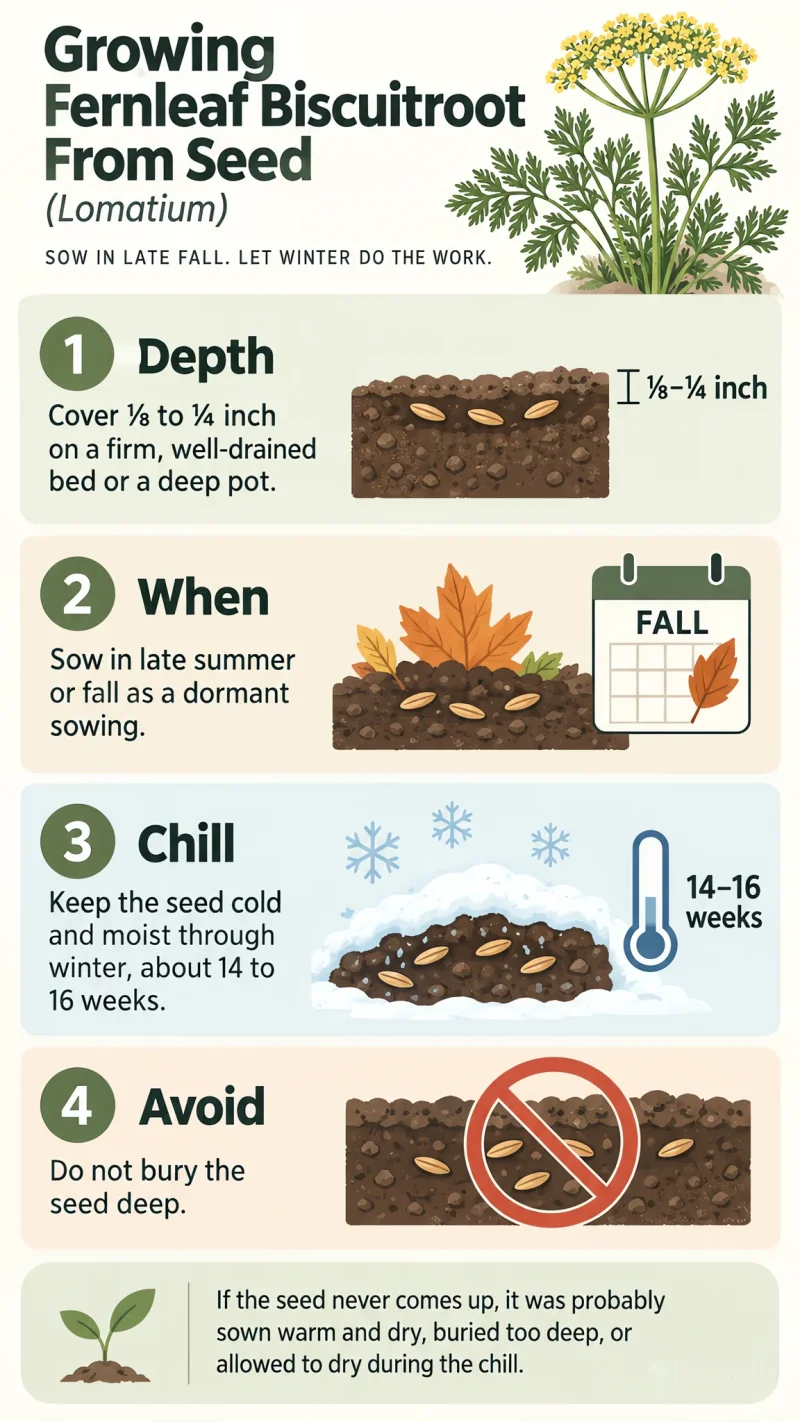
Sow it in late fall, barely covered, so winter can chill the seed
| Factor | Recommended | Avoid |
|---|---|---|
| When | Sow in late summer or fall as a dormant sowing | Do not sow dry seed in a warm room in spring and expect a quick crop |
| Depth | Cover ⅛ to ¼ inch on a firm, well-drained bed or a deep pot | Do not bury the seed deep |
| Chill | Keep the seed cold and moist through winter, about fourteen to sixteen weeks | Do not let the seed dry out once the chill has started |
| Bed | A weed-free, well-drained bed or deep pot in sun | Do not sow into soggy clay |
Fernleaf biscuitroot grows from seed, and that seed is dormant when it drops. The embryo is still small, so it needs a long stretch of cold, moist weather before it can sprout. [1] Sow it outdoors in late summer or fall, cover it about an eighth to a quarter of an inch, and let winter do the work. [2] Once the chill has started, keep the seed moist. If it dries out partway through, many seeds die or go dormant again and wait another year. [3] See How to Grow Fernleaf Biscuitroot for the grown plant.
- Firm a weed-free, well-drained seedbed in full sun, or fill a deep pot with gritty mix.
- Sow in late summer or fall. Cover the seed about ⅛ to ¼ inch.
- Keep that surface just moist through winter until seedlings appear in spring.
- Leave the seedlings in place. They put most of their first year into the taproot.
How deep do I sow fernleaf biscuitroot seed?
About ⅛ to ¼ inch. Press it into firm, well-drained soil. Do not bury it deep.
Keep the seed moist in the cold, or start it in a fridge for about sixteen weeks
The simplest route is a dormant fall sowing outdoors. If you start it under cover, mix the seed with damp sand or a damp paper towel, keep it in the refrigerator about fourteen to sixteen weeks, and never let that mix dry. Then sow it about ⅛ to ¼ inch deep in a deep pot and grow it on in bright light. Some lots need a longer chill, and some seedlings wait until the second spring. [4]
The first year you may see only a few leaves. Those tops will yellow in midsummer. That is normal. Leave the pot or bed dry through that rest, then grow the plant on another year before you expect flowers.
- For a direct sowing, wait until late summer or fall, then sow ⅛ to ¼ inch deep on a firm, sunny, well-drained bed.
- Keep that bed just moist through winter until seedlings show in spring.
- To start indoors, keep seed moist and cold about fourteen to sixteen weeks, then sow it shallow in a deep pot and do not let the mix dry during the chill.
- When first-year leaves yellow, stop watering and wait for the next spring flush.
Do I have to chill the seed in a fridge?
Not if you sow outdoors in late fall. Winter supplies the cold, moist stretch. A fridge is only for seed you start under cover.
If the seed never comes up, it was probably sown warm and dry, buried too deep, or allowed to dry during the chill. Next time sow it in fall, barely covered, and keep that surface moist until spring.
FAQ
Can I collect my own seed?
Yes. Wait until the umbels are dry and the brown fruits come off easily, usually five to eight weeks after bloom. Shake the heads over a bag, dry them, and store the clean seed cool and dry until you sow it in fall.
Can I grow it from a cutting or a division?
Not as a home method. Fernleaf biscuitroot grows from a taproot and does not divide or root from cuttings well. Raise it from seed.
Will it self-sow in the garden?
Sometimes, on rocky, well-drained ground, if you leave some ripe heads standing. A fall sowing is still the reliable way to start a patch.
Related guides

Recommended plants
References
- [1] University of Washington ESRM 412 -
https://courses.washington.edu/esrm412/protocols/2012/LODI.pdf - [2] Western Forbs -
https://westernforbs.org/species/fernleaf-biscuitroot-lomatium-dissectum/ - [3] Annals of Botany (PMC) -
https://pmc.ncbi.nlm.nih.gov/articles/PMC2707919/ - [4] Native Plant Network -
https://rngr.net/renderNPNProtocolDetails?selectedProtocolIds=apiaceae-lomatium-3905
This note is part of Lomatium Guides.
More notes on making another plant live in Propagating Guides.
Updated: Reviewed by Bosquelle Editors