
Grow California bay from seed by collecting purple fruit in fall, keeping the seed cool and moist, cracking the shell, and sowing it about an inch deep.
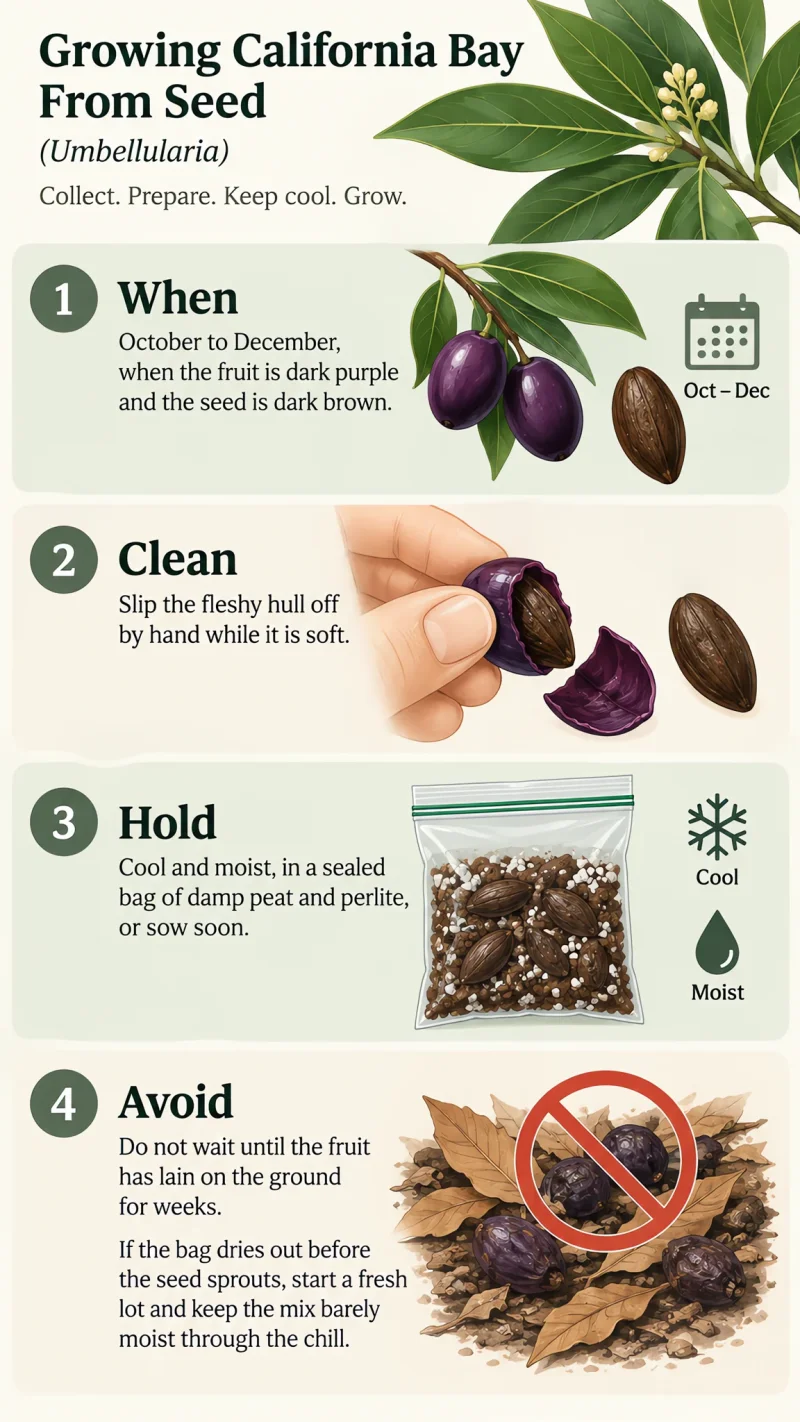
Collect purple fruit in fall, then keep the seed cool and moist
| Factor | Recommended | Avoid |
|---|---|---|
| When | October to December, when the fruit is dark purple and the seed is dark brown | Do not wait until the fruit has lain on the ground for weeks |
| Clean | Slip the fleshy hull off by hand while it is soft | Do not store the cleaned seed dry in a paper envelope |
| Hold | Cool and moist, in a sealed bag of damp peat and perlite, or sow soon | Do not let the seed dry on a sunny tray |
California bay drops olive-like fruit in autumn. Pick it when the skin is dark purple and the seed inside is dark brown, from October into December. [1] Gather fallen fruit the same week if squirrels have not already taken it, and slip the hull off while it is still soft. [2] Fresh seed held dry loses its sprout. Keep it cool and moist, or move it into the chill bag the same day. [3] A nursery tree is still the faster landscape route if you need a plant this year; that job is on Planting California Bay.
- Collect fruit in October, November, or December when it is dark purple.
- Slip the hull off. Do not smash the seed.
- Sow soon, or mix the seed with damp peat and perlite in a sealed bag in the refrigerator.
- Check the bag now and then. If a root tip shows, pot that seed at once.
When do I collect California bay seed?
October to December, when the fruit is dark purple and the seed is dark brown.
Crack the shell, chill it, and sow it about an inch deep
A light crack in the hard shell speeds sprouting. Do not crush the kernel. Mix the cracked seed with three parts loose soil, or with equal parts peat and perlite, moisten the mix, and hold the sealed bag at about 30 to 42 degrees Fahrenheit for 90 to 120 days. When the first root shows, or when the chill is done, press the seed about an inch deep, root down, in a deep pot — a 4-by-4-by-14-inch tree band works — filled with a mix that drains. Keep the mix moist, not wet. Covered seed sprouts more evenly than seed left on the surface. Sprouting may take two or three months even after the chill. Stem cuttings can root, but the method is unreliable at home, so seed is the route that works. [4] The grown-plant plan stays on How to Grow California Bay.
- Crack the shell lightly with a nutcracker or the side of a hammer. Stop before you smash the kernel.
- Bag the seed in damp peat and perlite, and chill it 90 to 120 days at about 30 to 42 degrees Fahrenheit.
- Sow about an inch deep, root down, in a deep pot that drains. Keep the mix moist.
- Grow it in the pot through the first year. Do not treat a leafy twig in a jar as the home method.
Do I need to chill California bay seed?
Yes. A 90- to 120-day stretch in the refrigerator, in damp mix, raises the sprout rate. A light crack in the shell helps too.
Can I grow California bay from a cutting?
Seed is the reliable home method. A stem cutting is slow and often fails.
If the bag dries out before the seed sprouts, start a fresh lot and keep the mix barely moist through the chill.
FAQ
Can I collect my own seed?
Yes, from ripe purple fruit in fall. Clean the hull the same day, and do not let the seed dry out.
Can I divide California bay like a clump?
No. It is a tree, not a perennial clump. Sow seed, or buy a young container plant.
Related guides

Recommended plants
References
- [1] National Plant Data Center -
https://plants.sc.egov.usda.gov/DocumentLibrary/plantguide/pdf/cs_umca.pdf - [2] Forest Service Woody Plant Seed Manual -
https://www.fs.usda.gov/nsl/Wpsm/Umbellularia.pdf - [3] Forest Service Silvics of North America -
https://research.fs.usda.gov/silvics/california-laurel - [4] NC State Extension -
https://plants.ces.ncsu.edu/plants/umbellularia-californica/
This note is part of Umbellularia Guides.
More notes on making another plant live in Propagating Guides.
Updated: Reviewed by Bosquelle Editors